
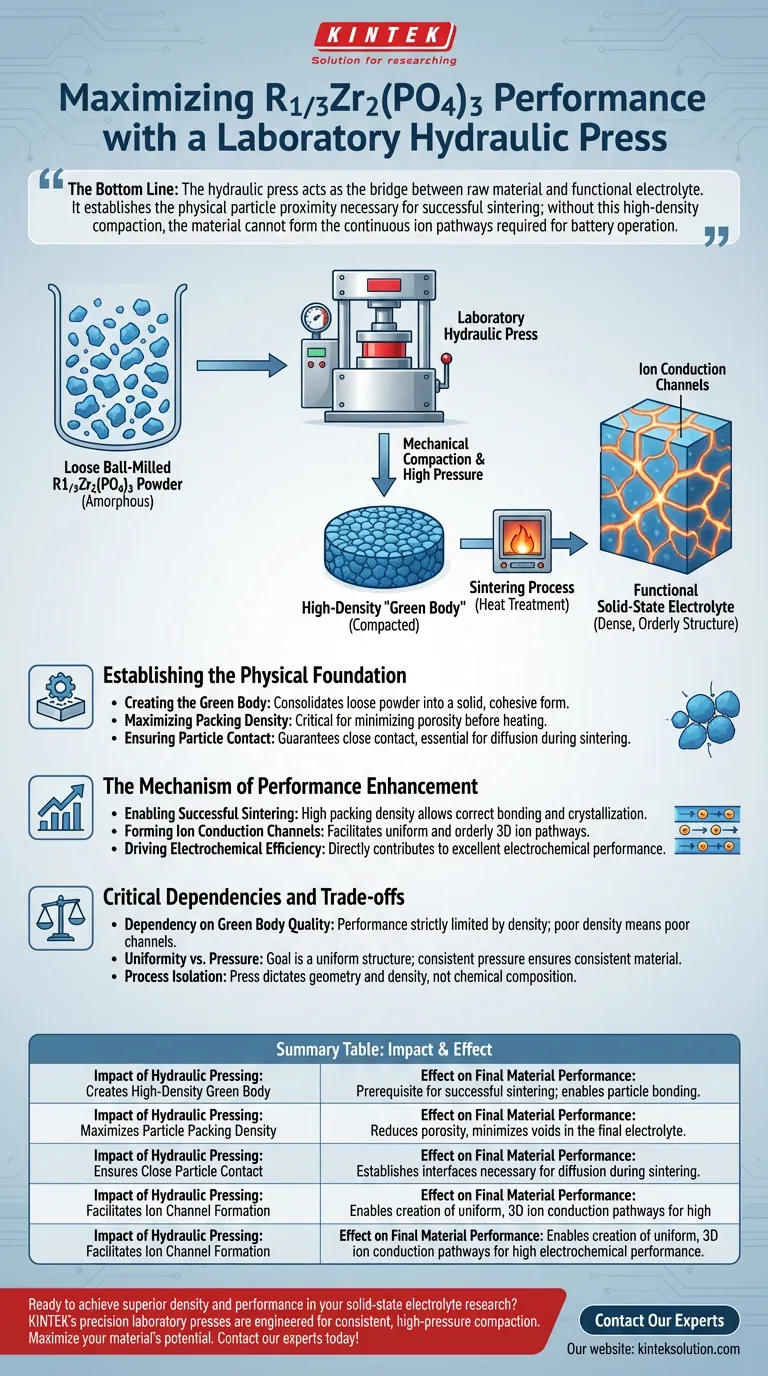
The primary impact of using a laboratory hydraulic press on ball-milled R1/3Zr2(PO4)3 powder is the creation of a high-density "green body" essential for high-performance sintering. By mechanically compacting the amorphous powder, the press forces particles into close physical contact, eliminating voids and increasing packing density. This mechanical step is the prerequisite for forming the dense, orderly three-dimensional ion conduction channels required for excellent electrochemical performance.
The Bottom Line: The hydraulic press acts as the bridge between raw material and functional electrolyte. It establishes the physical particle proximity necessary for successful sintering; without this high-density compaction, the material cannot form the continuous ion pathways required for battery operation.
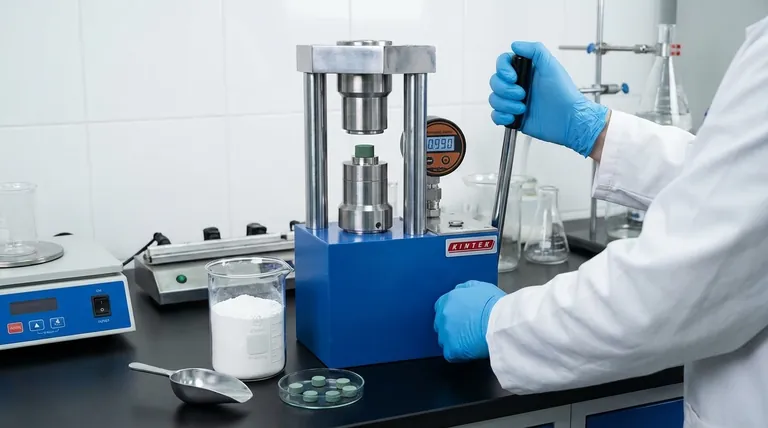
Establishing the Physical Foundation
The transition from a loose powder to a functional solid-state electrolyte begins with mechanical force. The hydraulic press serves a specific, structural role in this conversion.
Creating the Green Body
Ball-milling leaves R1/3Zr2(PO4)3 in an amorphous, powderized state. The hydraulic press consolidates this loose material into a solid, cohesive form known as a "green body."
Maximizing Packing Density
The press effectively increases the packing density of the material before any heat is applied. This reduction in volume is critical for minimizing porosity in the final product.
Ensuring Particle Contact
For sintering to be effective, particles must physically touch. The hydraulic press guarantees close contact between the amorphous particles, establishing the necessary interfaces for diffusion.
The Mechanism of Performance Enhancement
The mechanical action of the press directly influences the chemical and electrical properties of the final material. The press dictates the internal architecture of the electrolyte.
Enabling Successful Sintering
High packing density is a requirement for successful sintering. The press creates the dense structure that allows the material to bond and crystallize correctly when heated.
Forming Ion Conduction Channels
The ultimate goal of this material is to conduct ions. The initial compaction facilitates the formation of uniform and orderly three-dimensional ion conduction channels during the sintering process.
Driving Electrochemical Efficiency
The quality of these channels defines the material's performance. By ensuring a dense and orderly structure, the press directly contributes to achieving excellent electrochemical performance in the final solid-state electrolyte.
Critical Dependencies and Trade-offs
While the hydraulic press is a powerful tool, it is important to understand its role within the broader context of material preparation. It is a diagnostic and preparatory instrument that dictates downstream success.
The Dependency on Green Body Quality
The final performance is strictly limited by the quality of the green body. If the press fails to achieve sufficient density, the subsequent sintering process will not produce the required ion channels.
Uniformity vs. Pressure
The goal is a uniform structure, not just a compressed one. Similar to how presses are used to test blocking resistance in laminates or plastics, the consistency of the pressure applied determines the consistency of the final material.
Process Isolation
The press prepares the physical state, but it does not alter the chemical composition directly. It is a tool for geometric and density optimization, which then allows the chemistry to function as intended during sintering.
Making the Right Choice for Your Research
To maximize the potential of your R1/3Zr2(PO4)3 material, you must view the hydraulic press as a critical processing variable, not just a shaping tool.
- If your primary focus is Electrochemical Conductivity: prioritize maximizing the packing density of the green body to ensure continuous ion channels form during sintering.
- If your primary focus is Process Consistency: utilize the press to create uniform green bodies, eliminating density variations that could skew sintering results.
The hydraulic press transforms potential into performance by providing the structural density required for advanced ion conduction.
Summary Table:
| Impact of Hydraulic Pressing | Effect on Final Material Performance |
|---|---|
| Creates High-Density Green Body | Prerequisite for successful sintering; enables particle bonding. |
| Maximizes Particle Packing Density | Reduces porosity, minimizes voids in the final electrolyte. |
| Ensures Close Particle Contact | Establishes interfaces necessary for diffusion during sintering. |
| Facilitates Ion Channel Formation | Enables creation of uniform, 3D ion conduction pathways for high electrochemical performance. |
Ready to achieve superior density and performance in your solid-state electrolyte research?
KINTEK's precision laboratory presses, including automatic and heated models, are engineered to deliver the consistent, high-pressure compaction required to transform your ball-milled powders like R1/3Zr2(PO4)3 into optimal green bodies. Our machines help you eliminate density variations and create the foundational structure necessary for high-performance sintering.
Maximize your material's potential. Contact our experts today to find the perfect lab press for your specific application!
Visual Guide
Related Products
- Laboratory Hydraulic Press Lab Pellet Press Machine for Glove Box
- Laboratory Hydraulic Press 2T Lab Pellet Press for KBR FTIR
- 24T 30T 60T Heated Hydraulic Lab Press Machine with Hot Plates for Laboratory
- Laboratory Hydraulic Press Lab Pellet Press Button Battery Press
- Laboratory Hydraulic Pellet Press for XRF KBR FTIR Lab Press
People Also Ask
- How does a laboratory hydraulic press contribute to the preparation of Li3-3xScxSb samples? Optimize Ionic Conductivity
- What is the function of a laboratory hydraulic press in FT-IR of curcumin-coated MWCNTs? Achieve Optical Clarity.
- Why is a laboratory hydraulic press required for compression molding boron-siloxane? Solve High-Loading Density Challenges
- What role does a laboratory hydraulic press play in the preparation of piezoelectric ceramic discs for DC-PG? | KINTEK
- What role does a laboratory hydraulic press play in reaction pellets? Optimizing Lunar Soil and Metal Fuel Density



















