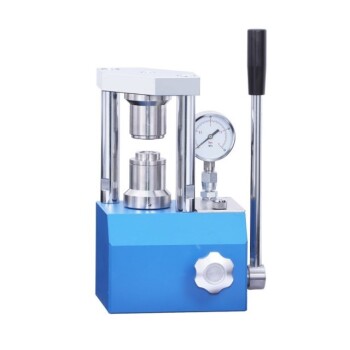
High-precision pressure control is the mechanical foundation of reproducible battery data. By applying consistent force during the sealing process, a laboratory hydraulic machine ensures that the internal components—cathode, anode, separator, and electrolyte—maintain uniform physical contact. This directly minimizes charge transfer resistance (Rct) while creating a hermetic seal that guards against electrolyte leakage and the infiltration of moisture or oxygen.
Core Takeaway: Precise pressure regulation eliminates mechanical variability from your experimental data. It ensures that the specific capacity and cycle stability you measure reflect the intrinsic electrochemical properties of your active materials, rather than inconsistencies in the assembly process.
Optimizing Electrochemical Performance
Minimizing Internal Resistance
The primary function of controlled pressure is to establish "tight contact" between the active materials, separators, and current collectors.
Without sufficient compression, gaps occur at these interfaces, leading to high ohmic internal resistance. High-precision pressure minimizes this resistance, ensuring that charge transfer occurs efficiently across the internal components.
Enhancing Interface Stability
For advanced chemistries, such as solid-state batteries or those using porous frameworks, the interface is critical.
Uniform pressure promotes the compaction of solid-state electrolytes and ensures liquid electrolytes sufficiently wet porous structures. This intimate contact is essential for optimizing electrochemical kinetics and evaluating the true energy density of materials under high-rate conditions.
Ensuring Structural and Environmental Integrity
Preventing Leakage and Contamination
A coin cell is only as good as its seal. Precise radial and axial pressure ensures the battery case and sealing ring deform correctly to create a robust mechanical lock.
This hermetic seal prevents the evaporation of volatile electrolytes (crucial in aqueous systems) and blocks external contaminants like oxygen and moisture. This isolation is vital for obtaining reliable data during long-term cycle life testing.
Maintaining Component Alignment
In complex setups, such as magnetic-field-assisted batteries, external forces can disrupt internal alignment.
A high-precision press applies force that counteracts these external interferences, such as magnetic attraction. This prevents structural displacement of the lithium foil or catalyst layers, ensuring the cell remains mechanically stable throughout the testing period.
The Risks of Inconsistent Pressure
While high precision is the goal, understanding the consequences of pressure variability is essential for troubleshooting.
Variable Data Reliability: If the sealing pressure fluctuates between samples, your data will reflect assembly errors rather than material performance. You may see artificial spikes in resistance or unexplained capacity fade that are purely mechanical in origin.
Compromised Sealing: Insufficient pressure fails to crimp the case effectively, leading to slow electrolyte leakage. This is particularly dangerous for long-term cycling, as the cell may dry out or react with air halfway through the experiment, invalidating weeks of testing time.
Making the Right Choice for Your Goal
To maximize the value of your sealing equipment, align your pressure strategy with your specific research objectives.
- If your primary focus is Materials Characterization: Prioritize pressure uniformity to minimize contact resistance, ensuring that capacity data reflects the active material's intrinsic limits.
- If your primary focus is Long-Term Cycle Life: Focus on the precision of the crimping force to guarantee a hermetic seal that prevents electrolyte evaporation or atmospheric contamination over time.
- If your primary focus is Solid-State Batteries: Ensure the machine can deliver high, uniform compression to establish the intimate solid-solid interfacial contact required for ion transport.
Ultimately, precise pressure control transforms battery assembly from a variable art into a reproducible science.
Summary Table:
| Feature | Impact on Coin Cell Assembly | Research Value |
|---|---|---|
| Uniform Compression | Minimizes Ohmic Resistance (Rct) | Ensures true material capacity data |
| Hermetic Sealing | Prevents electrolyte leakage/moisture | Crucial for long-term cycle stability |
| Component Alignment | Prevents structural displacement | Maintains stability in complex setups |
| Repeatable Force | Eliminates mechanical variability | Guarantees batch-to-batch reproducibility |
Elevate Your Battery Research with KINTEK Precision
Inconsistent assembly can compromise months of research. At KINTEK, we specialize in comprehensive laboratory pressing solutions designed to transform battery assembly from a variable art into a reproducible science.
Whether you are working on battery research, materials characterization, or advanced solid-state chemistries, our range of manual, automatic, heated, and glovebox-compatible models—including specialized cold and warm isostatic presses—delivers the precise pressure control required for superior interface stability and hermetic sealing.
Ready to eliminate mechanical variables from your data? Contact KINTEK today to find your ideal pressing solution.
References
- Seunghyeop Baek, Munseok S. Chae. Amorphous Lithium Borate Coating Enhances the Electrochemical Performance of Lithium Manganese Iron Phosphate Cathodes for Highly Stable Lithium‐Ion Batteries. DOI: 10.1002/batt.202500207
This article is also based on technical information from Kintek Solution Knowledge Base .
Related Products
- Laboratory Hydraulic Press Lab Pellet Press Machine for Glove Box
- Automatic Laboratory Hydraulic Press Lab Pellet Press Machine
- Button Battery Sealing Press Machine for Lab
- 24T 30T 60T Heated Hydraulic Lab Press Machine with Hot Plates for Laboratory
- Automatic High Temperature Heated Hydraulic Press Machine with Heated Plates for Lab
People Also Ask
- How does a laboratory hydraulic press contribute to the preparation of Li3-3xScxSb samples? Optimize Ionic Conductivity
- What is the function of a laboratory hydraulic press in FT-IR of curcumin-coated MWCNTs? Achieve Optical Clarity.
- Why is a laboratory hydraulic press required for compression molding boron-siloxane? Solve High-Loading Density Challenges
- What role does a laboratory hydraulic press play in reaction pellets? Optimizing Lunar Soil and Metal Fuel Density
- What role does a laboratory hydraulic press play in the preparation of piezoelectric ceramic discs for DC-PG? | KINTEK