
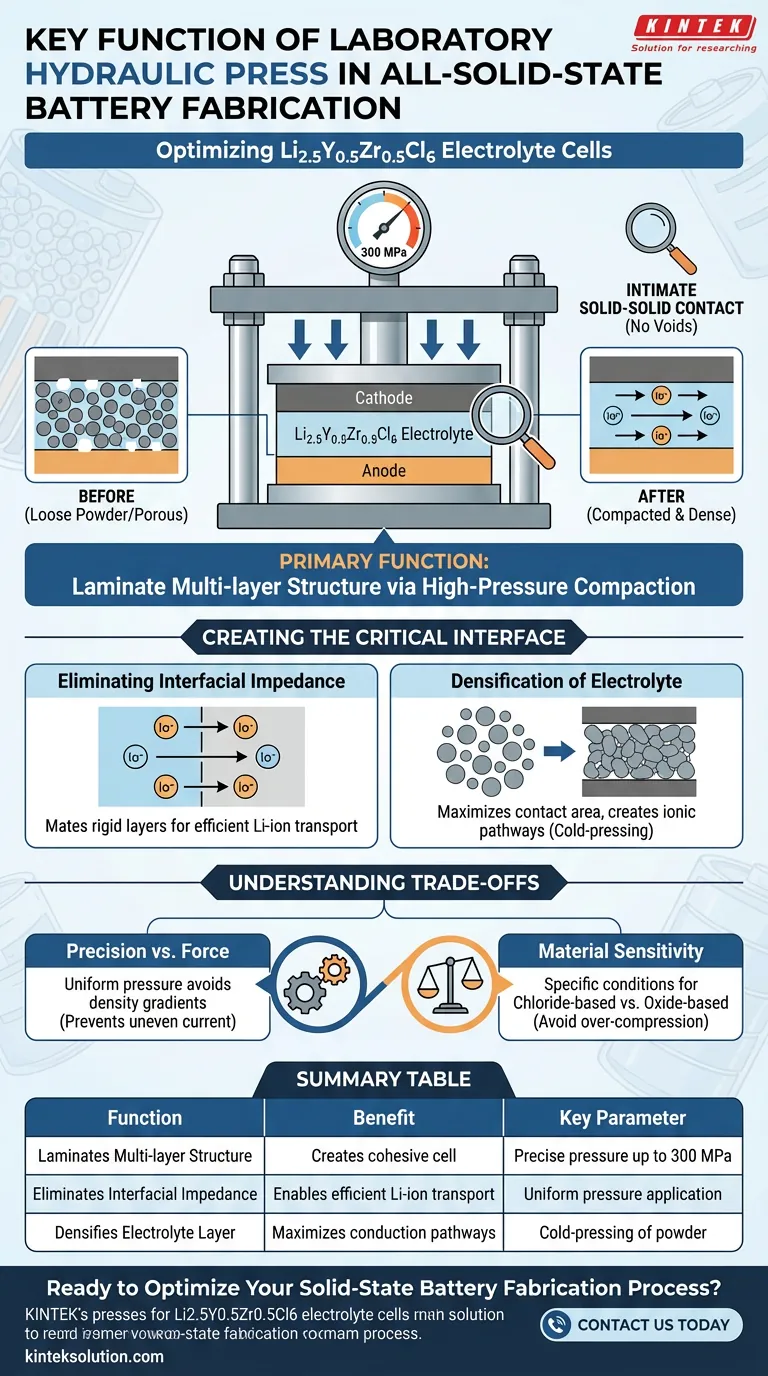
The primary function of a laboratory hydraulic press in the fabrication of all-solid-state batteries using a Li2.5Y0.5Zr0.5Cl6 electrolyte is to laminate the multi-layer cell structure through precise, high-pressure compaction.
Specifically, the press applies pressure (often up to 300 MPa) to compact the cathode, the solid electrolyte layer, and the anode together. This mechanical force is the catalyst for integrating these distinct layers into a single, cohesive unit capable of functioning as a battery.
The Core Engineering Goal: In solid-state batteries, the lack of liquid components means ions cannot flow across gaps. The hydraulic press solves this by forcing intimate solid-solid contact, effectively eliminating voids to minimize interfacial impedance and enable efficient lithium-ion transport.
Creating the Critical Interface
The success of a solid-state battery relies entirely on the quality of the contact between its layers. The hydraulic press facilitates two specific mechanisms that make this possible.
Eliminating Interfacial Impedance
The greatest barrier to performance in solid-state batteries is the resistance found at the boundaries between layers.
Unlike liquid electrolytes that naturally wet the electrode surfaces, solid electrolytes like Li2.5Y0.5Zr0.5Cl6 remain rigid.
The hydraulic press applies sufficient force to physically mate the electrolyte with the anode and cathode. This creates a seamless interface, ensuring that lithium ions can traverse the boundary without encountering high resistance.
Densification of the Electrolyte
Before lamination, the electrolyte often exists as a loose powder or a porous structure.
The press performs a "cold-pressing" function, compacting the material to increase its density significantly.
By minimizing internal porosity, the press maximizes the contact area between particles. This creates continuous, efficient pathways for ionic conduction throughout the electrolyte layer.
Understanding the Trade-offs
While high pressure is necessary, the application must be precise. Using a hydraulic press involves balancing mechanical integrity with material limitations.
Precision vs. Force
It is not enough to simply apply maximum force. The references highlight the need for precise and stable pressure.
Inconsistencies in pressure application can lead to density gradients within the pellet or laminate.
If the pressure is not uniform, the electrolyte layer may develop areas of high resistance, leading to uneven current distribution and potential cell failure.
The Role of Material Sensitivity
Different solid electrolytes require different processing conditions.
For Li2.5Y0.5Zr0.5Cl6, the process is typically a cold-press lamination around 300 MPa.
This contrasts with oxide-based electrolytes (like LAGP), which often use the press to form a "green pellet" that requires subsequent high-temperature sintering. Understanding the specific mechanical properties of the chloride-based electrolyte is vital to avoid over-compression or structural damage.
Making the Right Choice for Your Goal
When utilizing a hydraulic press for Li2.5Y0.5Zr0.5Cl6 based cells, your operational parameters should be dictated by your specific performance metrics.
- If your primary focus is reducing internal resistance: Prioritize the uniformity of pressure application to ensure maximum contact area at the cathode-electrolyte interface.
- If your primary focus is mechanical stability: Focus on achieving the optimal pressure threshold (near 300 MPa) to ensure the laminate remains robust without cracking the electrolyte layer.
Ultimately, the hydraulic press is not just a shaping tool; it is the instrument responsible for establishing the fundamental ionic connectivity of the solid-state cell.
Summary Table:
| Function | Benefit | Key Parameter |
|---|---|---|
| Laminates Multi-layer Structure | Creates a single, cohesive battery cell | Precise pressure up to 300 MPa |
| Eliminates Interfacial Impedance | Enables efficient lithium-ion transport | Uniform pressure application |
| Densifies Electrolyte Layer | Maximizes ionic conduction pathways | Cold-pressing of electrolyte powder |
Ready to Optimize Your Solid-State Battery Fabrication Process?
Building a high-performance all-solid-state battery requires precise control over layer lamination and electrolyte densification. KINTEK specializes in laboratory hydraulic presses (including automatic, isostatic, and heated models) designed to deliver the uniform, high-pressure compaction (up to 300 MPa) essential for creating flawless interfaces in cells using Li2.5Y0.5Zr0.5Cl6 and other solid electrolytes.
Our presses help you minimize interfacial resistance and achieve the mechanical stability needed for reliable battery performance. Contact our experts today to discuss how our lab press solutions can accelerate your R&D and ensure the success of your energy storage projects.
Contact Us Today to Get a Customized Solution for Your Lab!
Visual Guide
References
- Han Xu, Jianwen Liang. Mechanically robust halide electrolytes for high-performance all-solid-state batteries. DOI: 10.1038/s41467-025-64726-y
This article is also based on technical information from Kintek Solution Knowledge Base .
Related Products
- Laboratory Hydraulic Press Lab Pellet Press Machine for Glove Box
- Laboratory Hydraulic Press 2T Lab Pellet Press for KBR FTIR
- 24T 30T 60T Heated Hydraulic Lab Press Machine with Hot Plates for Laboratory
- Laboratory Hydraulic Press Lab Pellet Press Button Battery Press
- Laboratory Hydraulic Pellet Press for XRF KBR FTIR Lab Press
People Also Ask
- How does a laboratory hydraulic press contribute to the preparation of Li3-3xScxSb samples? Optimize Ionic Conductivity
- What is the function of a laboratory hydraulic press in FT-IR of curcumin-coated MWCNTs? Achieve Optical Clarity.
- Why is a laboratory hydraulic press required for compression molding boron-siloxane? Solve High-Loading Density Challenges
- What role does a laboratory hydraulic press play in reaction pellets? Optimizing Lunar Soil and Metal Fuel Density
- What role does a laboratory hydraulic press play in the preparation of piezoelectric ceramic discs for DC-PG? | KINTEK



















