
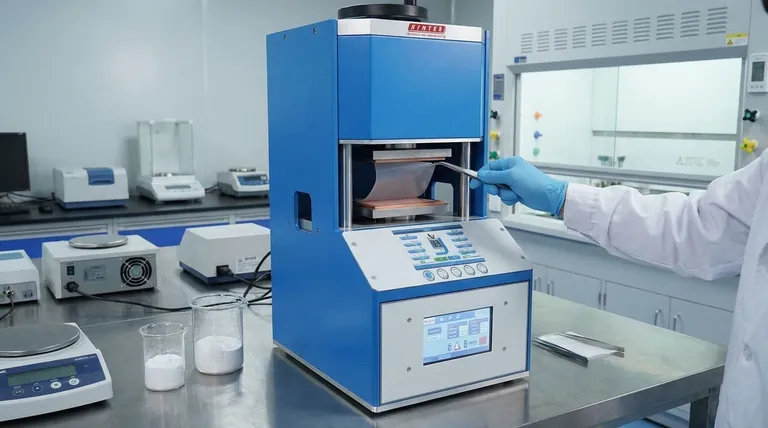
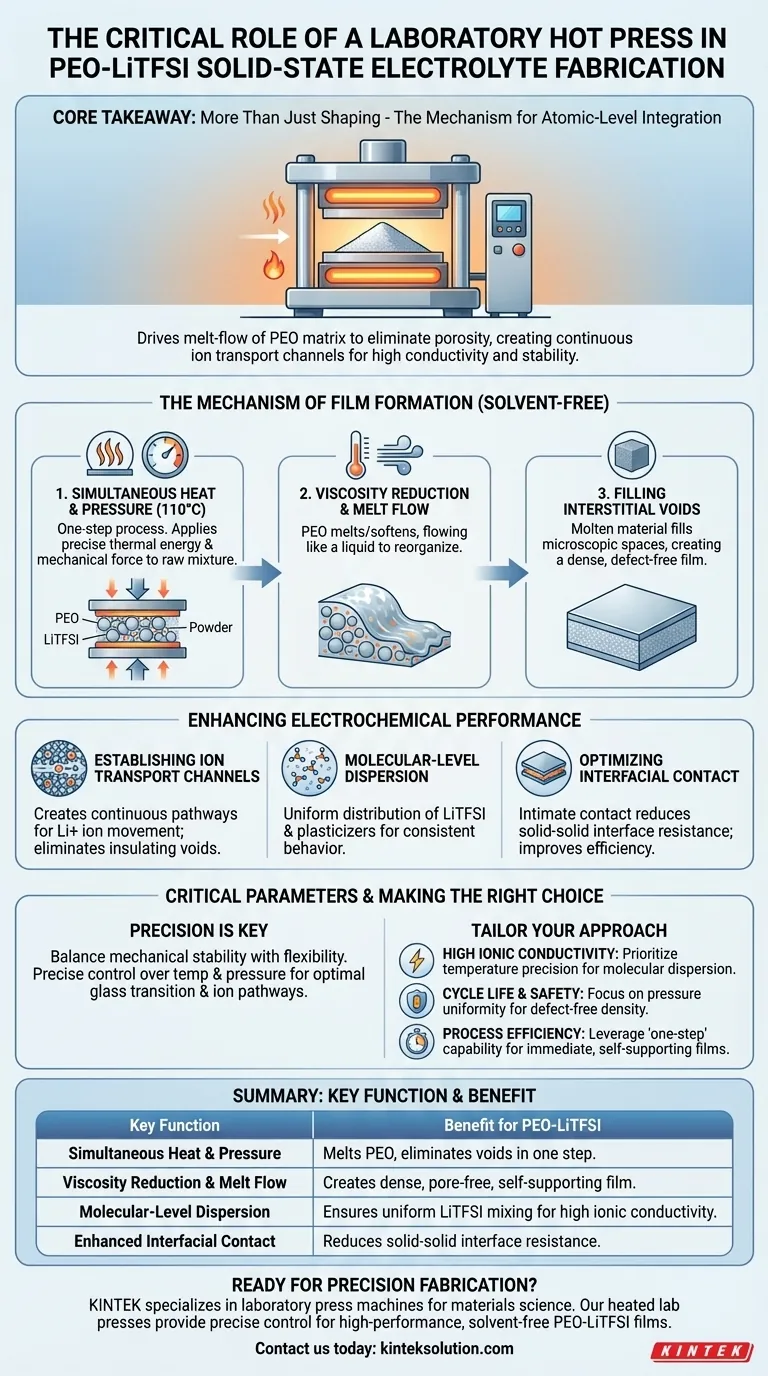
The laboratory hot press serves as the definitive shaping tool in the solvent-free fabrication of PEO-LiTFSI solid-state electrolytes, effectively transforming raw mixtures into functional components in a single step. By applying simultaneous heat and pressure, typically at 110°C, the machine melts the polymer matrix, forcing it to flow into interstitial voids. This process yields a dense, pore-free, and self-supporting film that is immediately ready for battery assembly, eliminating the need for volatile solvents.
Core Takeaway The hot press is not merely a shaping device; it is the mechanism that ensures atomic-level integration of the polymer and lithium salts. Its primary function is to drive the melt-flow of the PEO matrix to eliminate porosity, thereby creating the continuous ion transport channels required for high conductivity and mechanical stability.
The Mechanism of Film Formation
Simultaneous Application of Heat and Pressure
The defining characteristic of this fabrication method is the "one-step" nature of the process. The hot press applies precise thermal energy alongside mechanical force to the homogenized electrolyte mixture.
This simultaneous action removes the complexity of solvent casting. It allows for the direct processing of PEO, plasticizers, and lithium salts into a finished form.
Viscosity Reduction and Melt Flow
Temperature control is critical to the machine's function, specifically heating the material to approximately 110°C. At this temperature, the PEO polymer matrix melts or softens significantly.
The heat reduces the polymer's viscosity, allowing it to flow like a liquid. This transition is essential for the material to reorganize and distribute itself evenly under the applied load.
Filling Interstitial Voids
Once the polymer has softened, the mechanical pressure forces the molten material into the microscopic spaces between solid particles.
This action eliminates the voids that naturally exist in a loose powder mixture. The result is a fully dense, defect-free monolithic film that lacks the internal porosity which often hampers battery performance.
Enhancing Electrochemical Performance
Establishing Ion Transport Channels
The primary goal of the hot-pressing process is to facilitate the movement of lithium ions. By creating a dense, non-porous structure, the machine ensures continuous pathways for ion transport.
Without this densification, voids would act as insulators, blocking ion movement. The hot press creates the physical architecture necessary for high ionic conductivity.
Molecular-Level Dispersion
Beyond macroscopic shaping, the heating process promotes the uniform dispersion of all components.
The melting of the PEO matrix allows the lithium salts (LiTFSI) and plasticizers to mix at a molecular level. This homogeneity is vital for consistent electrochemical behavior across the entire surface of the film.
Optimizing Interfacial Contact
In solid-state batteries, high solid-solid interface resistance is a major hurdle. The hot press addresses this by creating intimate contact between materials.
The pressurized melt-flow ensures the electrolyte bonds securely, potentially even to electrode layers if co-pressed. This maximizes the contact area, reducing resistance and improving the overall efficiency of the battery.
Understanding the Critical Parameters
The Necessity of Precision
While the process is efficient, the hot press acts as a precise environmental controller. It is used to simulate specific operating conditions and optimize physical properties like the glass transition temperature.
If the temperature is too low, the PEO will not flow sufficiently to fill voids. If the pressure is uneven, the film creates inconsistent ion pathways.
Mechanical Stability vs. Flexibility
The process produces a self-supporting film, meaning it is mechanically robust enough to be handled without a substrate.
However, achieving this stability requires balancing the compaction force. The press must compact the material enough to be robust, but maintain the polymer's inherent flexibility to prevent cracking during battery assembly.
Making the Right Choice for Your Goal
To maximize the effectiveness of your PEO-LiTFSI fabrication, tailor your approach based on your specific performance targets:
- If your primary focus is High Ionic Conductivity: Prioritize temperature precision to ensure complete melting and molecular dispersion of the lithium salts, creating uninterrupted ion channels.
- If your primary focus is Cycle Life and Safety: Focus on pressure uniformity to eliminate all internal pores, as a defect-free density prevents dendrite growth and mechanical failure.
- If your primary focus is Process Efficiency: Leverage the "one-step" capability to produce finished, self-supporting films immediately, bypassing the drying time and environmental controls required for solvent-based methods.
By controlling the melt-flow dynamics through precise heat and pressure, the hot press transforms a simple powder mixture into a high-performance, conductive solid electrolyte.
Summary Table:
| Key Function | Benefit for PEO-LiTFSI Electrolytes |
|---|---|
| Simultaneous Heat & Pressure | Melts PEO matrix (110°C) and eliminates voids in a single step. |
| Viscosity Reduction & Melt Flow | Creates a dense, pore-free, and self-supporting film. |
| Molecular-Level Dispersion | Ensures uniform mixing of lithium salts for high ionic conductivity. |
| Enhanced Interfacial Contact | Reduces solid-solid interface resistance in battery assemblies. |
Ready to transform your solid-state battery research with precision fabrication?
KINTEK specializes in laboratory press machines, including automatic, isostatic, and heated lab presses designed for the exacting demands of materials science. Our heated lab presses provide the precise temperature and pressure control you need to fabricate high-performance, solvent-free PEO-LiTFSI electrolyte films efficiently and reliably.
Contact us today using the form below to discuss how our solutions can enhance your lab's capabilities and accelerate your development cycle.
Visual Guide
Related Products
- Laboratory Split Manual Heated Hydraulic Press Machine with Hot Plates
- 24T 30T 60T Heated Hydraulic Lab Press Machine with Hot Plates for Laboratory
- Heated Hydraulic Press Machine with Heated Plates for Vacuum Box Laboratory Hot Press
- Automatic Heated Hydraulic Press Machine with Hot Plates for Laboratory
- Laboratory Manual Heated Hydraulic Press Machine with Hot Plates
People Also Ask
- Why is a laboratory hydraulic press with heating plates required for PLA/TEC films? Achieve Precise Sample Integrity
- Why reduce load when applying composite strengthening tabs? Protect Specimen Integrity and Data Accuracy
- What role does a laboratory heated hydraulic press play in LTCC? Essential for High-Density Ceramic Lamination
- Why is a laboratory heated hydraulic press required? Ensure Precise Vulcanization for NBR/EPDM Nanocomposites
- What is the critical role of a laboratory heated hydraulic press? Mastering PVC Sample Prep for Testing



















