
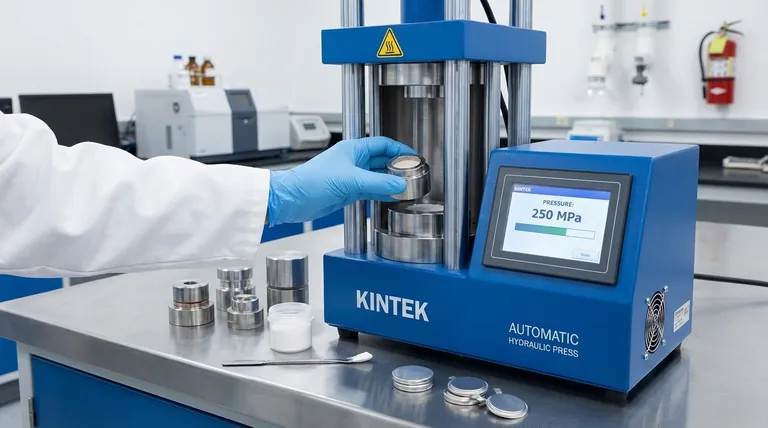
The primary role of a laboratory hydraulic press in the assembly of all-solid-state batteries (ASSBs) is to apply precise, high-magnitude mechanical pressure to consolidate powdered materials and bond distinct cell layers. By exerting forces ranging typically from 40 MPa to 500 MPa, the press eliminates internal voids and creates the dense, continuous solid-solid interfaces required for efficient ion transport.
In an all-solid-state system, ions cannot flow through liquid; they must traverse solid boundaries. The hydraulic press serves as the fundamental tool to mechanically force these solid components into the "intimate contact" necessary to minimize impedance and enable electrochemical performance.
The Core Challenge: Creating the Solid-Solid Interface
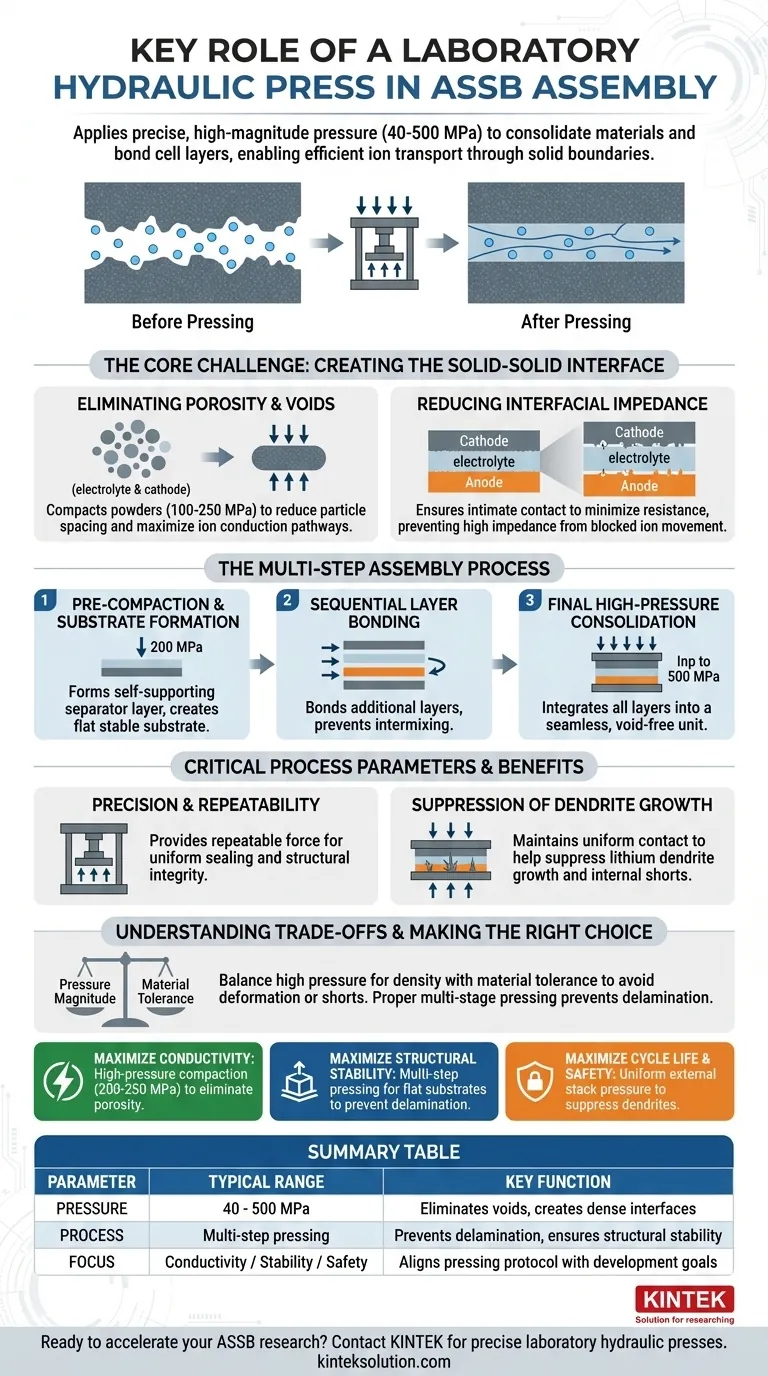
Eliminating Porosity and Voids
Unlike traditional batteries that use liquid electrolytes to wet pores, solid-state batteries rely on physical density. A hydraulic press compacts electrolyte and cathode composite powders into dense pellets or membranes.
By applying pressure (often 100–250 MPa), the press reduces the spacing between particles. This compaction creates maximal ion conduction pathways within the material itself.
Reducing Interfacial Impedance
The most critical function of the press is minimizing resistance where layers meet. It ensures "intimate" physical contact between the cathode, solid electrolyte, and anode.
Without sufficient pressure, microscopic voids remain at these interfaces. These voids block ion movement, resulting in high interfacial impedance that cripples battery performance.
The Multi-Step Assembly Process
Pre-Compaction and Substrate Formation
Fabrication is rarely a single-step event. The press is often used to "pre-form" the electrolyte powder into a self-supporting separator layer using lower pressure (e.g., 200 MPa).
This initial step creates a flat, mechanically stable substrate. According to technical protocols, this prevents intermixing or delamination when subsequent layers are added.
Sequential Layer Bonding
Once the substrate is formed, the press bonds additional layers. This involves pressing the composite cathode material firmly onto the electrolyte, followed by the lithium metal anode.
In complex assemblies like lithium-sulfur solid-state batteries, a final high-pressure consolidation (up to 500 MPa) is applied to the full stack. This integrates the anode, cathode, and electrolyte into a seamless, void-free unit.
Critical Process Parameters
Precision and Repeatability
Developing prototypes requires consistency. The laboratory press provides the repeatable force necessary to seal the anode, cathode, separator, and casing tightly and uniformly.
This structural integrity is essential for stable cycling. It allows researchers to attribute performance changes to material chemistry rather than inconsistent assembly pressure.
Suppression of Dendrite Growth
The application of external stack pressure is not just for assembly; it influences long-term safety. A well-pressed interface helps suppress lithium dendrite growth.
By maintaining uniform contact, the press enables the systematic investigation of how mechanical pressure correlates with preventing internal short circuits.
Understanding the Trade-offs
Balancing Pressure Magnitude
While high pressure is necessary for density, it must be calibrated to the material's tolerance. References indicate a wide operational range, from 40 MPa for softer materials to 500 MPa for consolidation.
Insufficient pressure leads to high-resistance voids. However, incorrect staging of pressure can lead to layer deformation or internal shorts.
The Risk of Delamination
Creating a bilayer structure (such as a cathode on an electrolyte) carries the risk of layer separation.
If the initial layer is not pre-compacted to create a flat interface, the subsequent high-temperature sintering or high-pressure steps can cause delamination. Proper multi-stage pressing is required to mechanically stabilize these boundaries before final processing.
Making the Right Choice for Your Goal
To maximize the utility of your hydraulic press operations, align your pressing protocol with your specific development objectives:
- If your primary focus is maximizing conductivity: Prioritize high-pressure compaction (200-250 MPa) to eliminate internal porosity and maximize particle-to-particle contact within the electrolyte pellets.
- If your primary focus is structural stability: Utilize a multi-step pressing strategy, starting with low-pressure pre-compaction to create flat substrates that prevent intermixing and delamination.
- If your primary focus is cycle life and safety: Focus on achieving uniform external stack pressure to suppress lithium dendrite growth and prevent internal short circuits.
Ultimately, the laboratory hydraulic press transforms discontinuous powders into a unified electrochemical system, acting as the critical enabler for high-performance solid-state energy storage.
Summary Table:
| Parameter | Typical Range | Key Function |
|---|---|---|
| Pressure | 40 - 500 MPa | Eliminates voids, creates dense interfaces |
| Process | Multi-step pressing | Prevents delamination, ensures structural stability |
| Focus | Conductivity / Stability / Safety | Aligns pressing protocol with development goals |
Ready to accelerate your all-solid-state battery research with precision pressing? KINTEK specializes in laboratory hydraulic presses (including automatic, isostatic, and heated lab presses) designed to meet the exacting demands of ASSB assembly. Our equipment delivers the precise, repeatable pressure control you need to create dense, high-performance solid-state cells, enabling breakthroughs in energy storage. Contact our experts today to discuss how our lab press solutions can enhance your R&D process and help you achieve superior battery performance.
Visual Guide
Related Products
- Laboratory Hydraulic Press Lab Pellet Press Button Battery Press
- Laboratory Hydraulic Press 2T Lab Pellet Press for KBR FTIR
- Laboratory Hydraulic Press Lab Pellet Press Machine for Glove Box
- 24T 30T 60T Heated Hydraulic Lab Press Machine with Hot Plates for Laboratory
- Automatic Laboratory Hydraulic Press Lab Pellet Press Machine
People Also Ask
- How is a laboratory hydraulic press used for HAP composite gels? Master Mineral Substrate Standardization
- What role does a laboratory hydraulic press play in the preparation of piezoelectric ceramic discs for DC-PG? | KINTEK
- What role does a laboratory hydraulic press play in reaction pellets? Optimizing Lunar Soil and Metal Fuel Density
- Why is a laboratory hydraulic press required for PBAT and PLA sample preparation? Achieve Flawless Characterization
- What role does a laboratory hydraulic press play in the assembly of all-solid-state battery test cells? Expert Guide



















