
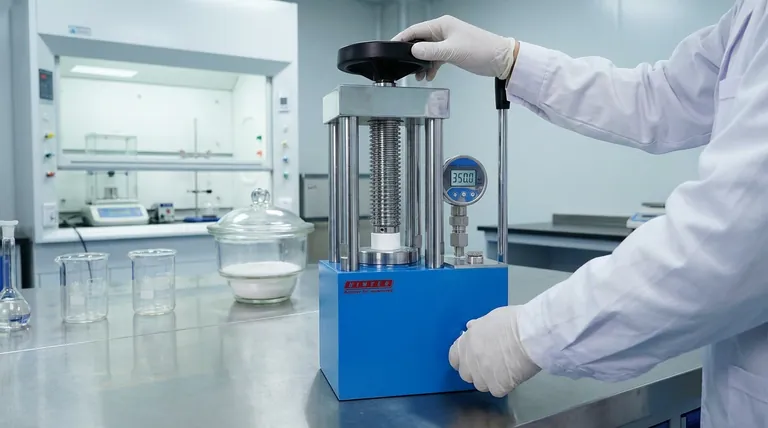
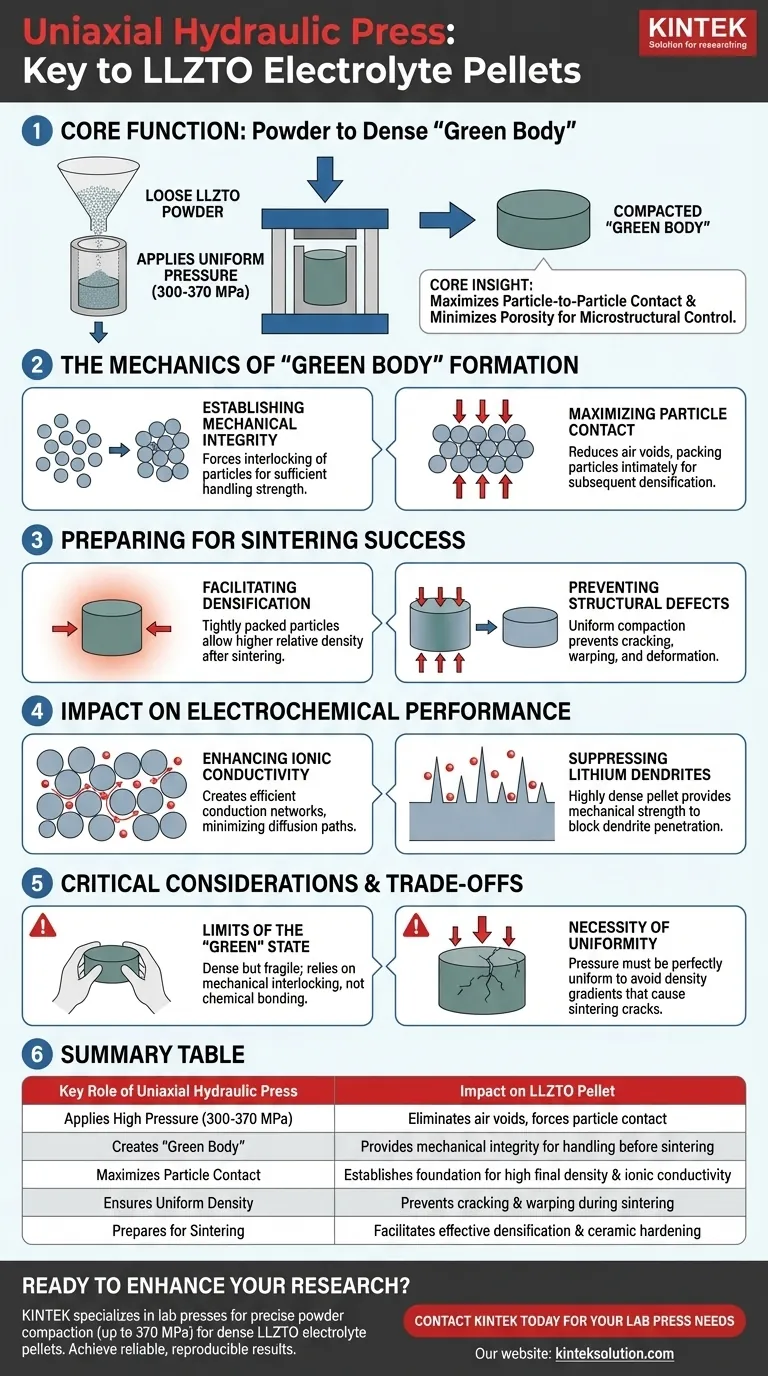
The fundamental function of a uniaxial hydraulic press in LLZTO fabrication is to convert loose powder into a compacted "green body" with high initial density. By applying precise, uniform pressure—often between 300 and 370 MPa—the press eliminates air voids and forces particles into close contact. This step is the non-negotiable prerequisite for achieving a dense, conductive ceramic electrolyte during final sintering.
Core Insight While the press gives the pellet its shape, its true value lies in microstructural control. By maximizing particle-to-particle contact and minimizing porosity at the cold-pressing stage, the hydraulic press establishes the physical network required for high ionic conductivity and mechanical resistance against lithium dendrites.
The Mechanics of "Green Body" Formation
The immediate output of the hydraulic press is known as a "green body"—an unsintered compact that holds its shape but lacks final ceramic hardness.
Establishing Mechanical Integrity
Loose LLZTO powder has no structural cohesion. The hydraulic press applies substantial force to interlock these particles.
This creates a pellet with sufficient mechanical strength to be handled and moved to a furnace without crumbling.
Maximizing Particle Contact
Pressure is the primary driver for reducing the distance between individual grains.
By forcing particles into intimate contact, the press reduces the volume of air trapped within the material. This packing density is critical for the chemical and physical changes that occur later in the process.
Preparing for Sintering Success
The quality of the final ceramic is determined before it ever enters the furnace. The hydraulic press sets the initial conditions for the sintering phase.
Facilitating Densification
A denser green body shrinks more uniformly and effectively during high-temperature sintering.
Because the particles are already tightly packed, the material can achieve a higher relative density after heating. This is essential for creating a solid-state electrolyte that is truly "solid" rather than porous.
Preventing Structural Defects
If the initial compaction is loose or uneven, the pellet is prone to defects during heating.
Proper cold pressing creates a uniform density gradient. This uniformity helps prevent cracking, warping, or deformation as the material shrinks and hardens in the furnace.
Impact on Electrochemical Performance
The physical density achieved by the press directly correlates to the battery's electrical efficiency and safety.
Enhancing Ionic Conductivity
Lithium ions need a continuous path to travel through the electrolyte.
By minimizing inter-particle voids, the press creates efficient conduction networks. In polymer-coated LLZTO composites, this pressure ensures the polymer and ceramic form a continuous interface for ion transport.
Suppressing Lithium Dendrites
One of the main failure modes in solid-state batteries is the penetration of lithium dendrites (metal filaments) through the electrolyte.
A highly dense pellet, achieved through rigorous pressing and subsequent sintering, provides the mechanical strength necessary to physically block these dendrites.
Critical Considerations and Trade-offs
While the hydraulic press is vital, it is important to understand the variables that affect the outcome.
The Limits of the "Green" State
It is crucial to remember that the pellet formed by the press is an intermediate stage.
While dense, the green body is not yet chemically fused. It relies on mechanical interlocking rather than chemical bonding, meaning it remains relatively fragile until sintered.
The Necessity of Uniformity
Applying high pressure is not enough; the pressure must be uniform.
If the pressure is uneven across the surface, the pellet will have density gradients. These gradients create stress points that invariably lead to cracks during the sintering process, rendering the pellet useless.
Making the Right Choice for Your Goal
The way you utilize the hydraulic press should be dictated by your specific research or manufacturing objectives.
- If your primary focus is Ionic Conductivity: Prioritize maximizing pressure (up to ~370 MPa) to minimize internal porosity and shorten ion diffusion paths.
- If your primary focus is Structural Integrity: Ensure the pressure application is perfectly uniform to prevent density gradients that cause cracking during sintering.
- If your primary focus is Hybrid/Polymer Electrolytes: Focus on particle-to-particle contact to establish a continuous conduction network without relying solely on high-temperature sintering.
Summary: The uniaxial hydraulic press is not merely a shaping tool; it is the density-determining instrument that dictates the final efficiency, safety, and longevity of the LLZTO electrolyte.
Summary Table:
| Key Role of Uniaxial Hydraulic Press | Impact on LLZTO Pellet |
|---|---|
| Applies High Pressure (300-370 MPa) | Eliminates air voids, forces particle contact |
| Creates 'Green Body' | Provides mechanical integrity for handling before sintering |
| Maximizes Particle Contact | Establishes foundation for high final density and ionic conductivity |
| Ensures Uniform Density | Prevents cracking and warping during sintering |
| Prepares for Sintering | Facilitates effective densification and ceramic hardening |
Ready to enhance your solid-state battery research with precise powder compaction? KINTEK specializes in lab press machines, including automatic and heated lab presses, designed to meet the exacting demands of laboratory-scale material fabrication. Our uniaxial hydraulic presses deliver the uniform, high-pressure compaction (up to 370 MPa) essential for forming dense LLZTO electrolyte pellets with optimal microstructural control. Achieve reliable, reproducible results for your most critical energy storage projects. Contact KINTEK today to discuss your specific lab press needs.
Visual Guide
References
- Aigul Tugelbayeva, E. Nurgaziyeva. Synthesis and characterization of LLZTO solid electrolyte via the solid-state ball-milling method. DOI: 10.18321/cpc23(2)163-171
This article is also based on technical information from Kintek Solution Knowledge Base .
Related Products
- Manual Laboratory Hydraulic Pellet Press Lab Hydraulic Press
- Laboratory Hydraulic Split Electric Lab Pellet Press
- Automatic Laboratory Hydraulic Press Lab Pellet Press Machine
- Automatic Laboratory Hydraulic Press for XRF and KBR Pellet Pressing
- Manual Laboratory Hydraulic Press Lab Pellet Press
People Also Ask
- What is the primary purpose of manual lab hydraulic pellet presses? Achieve High-Precision Sample Preparation for Spectroscopy
- What is the primary purpose of a manual lab hydraulic pellet press? Ensure Accurate Sample Prep for XRF and FTIR
- What is the purpose of initial axial molding using a lab hydraulic press? Optimizing Electrolyte Green Bodies
- What role does a lab hydraulic press play in researching squishy granular matter? Expert Insights into Material Physics
- What is the primary function of a laboratory hydraulic press in evaluating the ionic conductivity of Li6PS5X (LMSX)?



















