
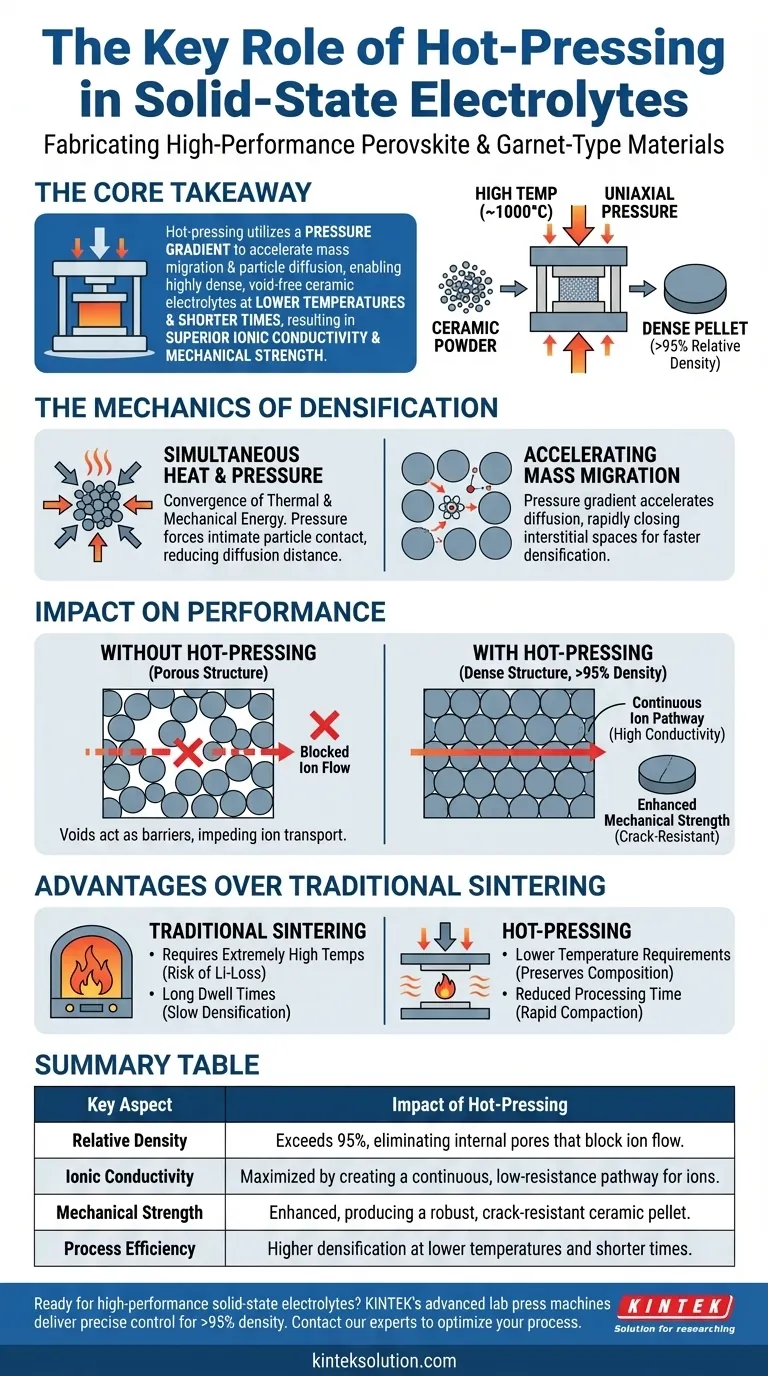
The primary role of the hot-pressing process in fabricating Perovskite or Garnet-type solid-state electrolytes is to achieve maximum material densification through the simultaneous application of high temperature and uniaxial pressure. By subjecting the ceramic powder to forces such as 1000°C combined with mechanical compression, this technique drives the relative density of the final pellet to exceed 95%. This high density is the fundamental prerequisite for eliminating internal pores that otherwise impede ion flow and weaken the material structure.
Core Takeaway Hot-pressing utilizes a pressure gradient to accelerate mass migration and particle diffusion far more effectively than heat alone. This process enables the production of highly dense, void-free ceramic electrolytes at lower temperatures and shorter processing times than traditional sintering, directly resulting in superior ionic conductivity and mechanical strength.
The Mechanics of Densification
Simultaneous Heat and Pressure
The defining characteristic of the hot-pressing process is the convergence of thermal and mechanical energy. Unlike conventional methods that rely solely on heat, a hot press machine applies uniaxial pressure to the solid-state electrolyte powder while it is being heated.
This dual application typically occurs at temperatures around 1000°C for these ceramic materials. The external pressure forces the powder particles into intimate contact, reducing the distance atoms must diffuse to close gaps.
Accelerating Mass Migration
The application of pressure creates a significant driving force for densification. It establishes a pressure gradient that accelerates mass migration and diffusion between the ceramic particles.
This accelerated diffusion is critical for materials like LLZO (Garnet-type). It promotes the rapid closing of interstitial spaces, allowing the material to reach full density much faster than it would under pressure-less sintering conditions.
Impact on Electrolyte Performance
Eliminating Porosity
The most immediate benefit of hot-pressing is the effective elimination of internal pores. Porosity is detrimental to solid-state batteries as voids act as barriers to lithium-ion transport.
By achieving a relative density exceeding 95%, hot-pressing ensures a continuous pathway for ions. This directly translates to high ionic conductivity, which is the primary performance metric for any solid-state electrolyte.
Enhancing Mechanical Properties
Beyond conductivity, the structural integrity of the electrolyte is vital. A porous ceramic is brittle and prone to fracture during battery assembly or operation.
Hot-pressing fuses the powder particles into a robust, cohesive pellet. This superior mechanical strength ensures the electrolyte can withstand physical stresses and maintain contact with electrodes without cracking.
Advantages Over Traditional Sintering
Lower Temperature Requirements
Traditional sintering often requires extremely high temperatures to induce densification, which can lead to volatile lithium loss or phase instability.
Hot-pressing leverages mechanical pressure to compensate for thermal energy. This allows for high densification at comparatively lower temperatures, preserving the chemical composition of the ceramic.
Reduced Processing Time
The pressure gradient induced by hot-pressing significantly shortens the time required to sinter the material.
While traditional methods might require long dwell times to slowly remove pores, hot-pressing forces the material to compact rapidly. This efficiency is crucial for preparing high-performance ceramic electrolyte sheets in a production environment.
Making the Right Choice for Your Goal
To optimize your solid-state electrolyte fabrication, consider how the specific benefits of hot-pressing align with your performance targets.
- If your primary focus is maximizing Ionic Conductivity: Prioritize hot-pressing to achieve >95% relative density, as eliminating pore volume is the single most effective way to reduce resistance.
- If your primary focus is Process Efficiency: Utilize hot-pressing to reduce thermal dwell times and sintering temperatures, which accelerates throughput while maintaining phase purity.
By mechanically forcing particle coalescence, hot-pressing transforms a loose ceramic powder into a highly conductive, structurally sound electrolyte capable of supporting high-performance battery operation.
Summary Table:
| Key Aspect | Impact of Hot-Pressing |
|---|---|
| Relative Density | Exceeds 95%, eliminating internal pores that block ion flow. |
| Ionic Conductivity | Maximized by creating a continuous, low-resistance pathway for ions. |
| Mechanical Strength | Enhanced, producing a robust, crack-resistant ceramic pellet. |
| Process Efficiency | Higher densification at lower temperatures and shorter times than traditional sintering. |
Ready to fabricate high-performance solid-state electrolytes with superior density and conductivity? KINTEK's advanced lab press machines, including automatic and heated lab presses, are engineered to deliver the precise temperature and uniaxial pressure control required for your Perovskite or Garnet-type materials. Our expertise ensures you achieve >95% relative density efficiently, accelerating your battery research and development. Contact our experts today to discuss how our presses can optimize your fabrication process.
Visual Guide
Related Products
- Warm Isostatic Press for Solid State Battery Research Warm Isostatic Press
- Lab Heat Press Special Mold
- Automatic High Temperature Heated Hydraulic Press Machine with Heated Plates for Lab
- Automatic Heated Hydraulic Press Machine with Hot Plates for Laboratory
- Automatic Heated Hydraulic Press Machine with Heated Plates for Laboratory
People Also Ask
- Why must composite cathodes be sealed in vacuum lamination bags for WIP? Ensure Battery Stability and Density
- What is the function of elastic molds in warm isostatic pressing? Achieve Uniform Density in Composite Particles
- How do sacrificial volume materials (SVM) maintain microchannels in isostatic pressing? Ensure Structural Integrity
- What is the significance of temperature control in Warm Isostatic Pressing? Unlock Uniform Densification and Process Stability
- How does Warm Isostatic Pressing differ from traditional pressing methods? Unlock Uniform Density for Complex Parts
















