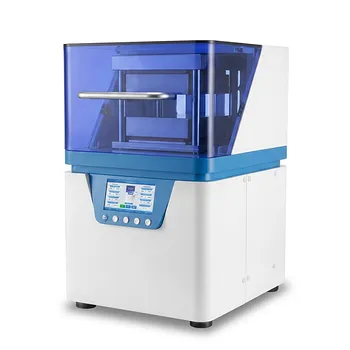
The definitive limiting factor when integrating a hydraulic press into a glove box is the physical accessibility of the workspace. Specifically, the inner diameter of the antechamber dictates whether the equipment can actually be installed. If the press cannot pass through this airlock, it cannot be used, regardless of its performance specifications.
Core Takeaway The operational volume inside the glove box is secondary to the entry dimensions; the antechamber diameter is the hard "go/no-go" constraint. You must verify that the press’s dimensions are smaller than the antechamber's opening before acquisition.
The Logistics of Containment
The Gateway Bottleneck
Glove boxes are hermetically sealed environments designed to maintain precise atmospheric conditions.
The antechamber functions as an airlock, allowing materials to be transferred in and out without compromising the internal atmosphere.
Because the main viewing window and structural panels are generally fixed, this cylindrical port is often the only viable entry point for equipment.
Dimensional Compatibility
Unlike soft materials or small tools, a hydraulic press is a rigid, heavy assembly.
You cannot compress or fold the frame of the press to navigate a tight space.
Therefore, the inner diameter of the antechamber serves as a strict physical filter for your equipment selection.
Critical Verification
It is not enough to measure the height or width of the press in isolation.
You must compare the largest diagonal dimension of the press assembly against the diameter of the antechamber.
Failing to account for protruding components, such as handles or pressure gauges, can result in equipment that fails to load.
Understanding the Trade-offs
Compactness vs. Capacity
The requirement to fit through a standard antechamber often necessitates the use of a compact press model.
This physical constraint may limit the maximum tonnage or die space available to you compared to a benchtop unit used in an open lab.
You are effectively trading raw size and potential power for the capability to process samples in a controlled, inert environment.
Installation Complexity
Some larger presses may technically fit into the workspace but fail the antechamber test.
While some users attempt to disassemble equipment to bypass this, it introduces significant risk and complexity inside a glove box environment.
Relying on disassembly is generally not recommended unless the manufacturer explicitly supports it; the safest route is ensuring the fully assembled unit fits the antechamber.
Ensuring Seamless Integration
To avoid costly procurement errors, assess your requirements against your facility's constraints.
- If your primary focus is standard installation: Ensure the press's maximum diagonal dimension is clearly smaller than the antechamber's inner diameter to allow for easy loading.
- If your primary focus is maximizing press size: Consult with the manufacturer to see if a specific model is designed to be passed through an antechamber in smaller sub-assemblies.
Accurate pre-purchase dimensional verification is the only way to guarantee your hydraulic press can successfully enter its operational environment.
Summary Table:
| Factor | Description | Importance |
|---|---|---|
| Antechamber Diameter | The physical entry port size of the glove box. | High (Go/No-Go) |
| Max Diagonal Dimension | The widest point of the press (including handles/gauges). | Critical for entry |
| Internal Workspace | The operational volume available for the press frame. | Secondary to entry |
| Assembly Type | Whether the press is a rigid unit or modular. | Affects installation ease |
Maximize Your Glovebox Efficiency with KINTEK
Don't let installation bottlenecks stall your research. KINTEK specializes in comprehensive laboratory pressing solutions, offering a precision-engineered range of manual, automatic, heated, and multifunctional models specifically designed for glovebox compatibility.
Whether you are advancing battery research with our cold and warm isostatic presses or need a compact solution for inert atmosphere processing, our experts are here to ensure a seamless fit for your facility.
Ready to upgrade your lab? Contact us today to find the perfect press for your workspace!
Related Products
- Laboratory Hydraulic Press Lab Pellet Press Machine for Glove Box
- Heated Hydraulic Press Machine with Heated Plates for Vacuum Box Laboratory Hot Press
- Heated Hydraulic Press Machine With Heated Plates For Vacuum Box Laboratory Hot Press
- Automatic Hydraulic Heat Press Machine with Multi Stage Programmable Control and Integrated Water Cooling Plate Size 180x180mm
- Automatic Hydraulic Hot Press with Large Plate and Precision Temperature Control for Advanced Material Sample Preparation and Industrial Research
People Also Ask
- How does a laboratory hydraulic press contribute to the preparation of Li3-3xScxSb samples? Optimize Ionic Conductivity
- What is the function of a laboratory hydraulic press in FT-IR of curcumin-coated MWCNTs? Achieve Optical Clarity.
- Why is a laboratory hydraulic press required for compression molding boron-siloxane? Solve High-Loading Density Challenges
- What role does a laboratory hydraulic press play in reaction pellets? Optimizing Lunar Soil and Metal Fuel Density
- What role does a laboratory hydraulic press play in the preparation of piezoelectric ceramic discs for DC-PG? | KINTEK