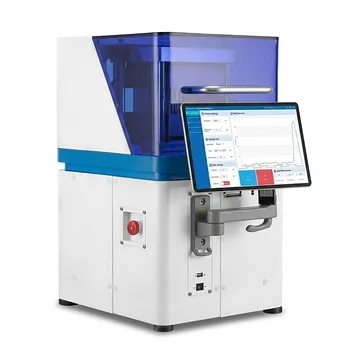
High-performance laboratory presses are capable of reaching extreme thermal levels to accommodate advanced material testing. Certain specialized models are equipped with temperature control capabilities that reach a maximum of 500 degrees Celsius (approximately 932 degrees Fahrenheit). This upper limit is critical for applications involving high-performance engineering thermoplastics and specific sintering processes.
While standard units often operate within more moderate ranges (such as up to 600°F), advanced laboratory presses can be precisely controlled up to 500°C. This high thermal ceiling transforms the equipment from a simple molding tool into a versatile instrument for complex material synthesis.
The Scope of Temperature Capabilities
High-Temperature Limits
The primary reference indicates that the most capable laboratory presses push the boundaries of thermal control up to 500°C.
This capacity is designed for materials that require high melting points or extreme heat for lamination and compression molding. It ensures that researchers can work with next-generation polymers without equipment limitations.
Standard Operating Ranges
It is important to note that not all presses require or possess this extreme range.
Many standard laboratory presses offer precise control within a lower spectrum, typically ranging from 100°F to 600°F (approximately 38°C to 315°C). This range is generally sufficient for routine sample preparation and standard polymer testing.
Understanding the Trade-offs
Equipment Complexity and Cost
Selecting a press capable of reaching 500°C often involves a more complex machine architecture.
High-temperature units require specialized heating elements, superior insulation, and robust platen materials to prevent warping. Consequently, the initial investment is typically higher than that of a standard 600°F unit.
Thermal Stability Challenges
As the operating temperature rises, maintaining precise temperature uniformity across the platen surface becomes more difficult.
At 500°C, even minor fluctuations can impact the integrity of a sample. Operators must ensure the press features advanced controllers to manage these thermal gradients effectively.
Making the Right Choice for Your Goal
To select the correct press, you must map the machine's thermal ceiling against the melting and degradation points of your specific materials.
- If your primary focus is routine polymer testing: A standard press with a range up to 600°F offers a balance of precision and cost-effectiveness.
- If your primary focus is advanced engineering materials: You must specify a unit capable of reaching 500°C to ensure you can process high-temperature thermoplastics.
Aligning your equipment's maximum temperature with your material's physical properties is the single most important step in ensuring accurate, reproducible data.
Summary Table:
| Press Type | Max Temperature (°C) | Max Temperature (°F) | Typical Applications |
|---|---|---|---|
| Standard Lab Press | ~315°C | 600°F | Routine polymer testing, sample preparation |
| High-Performance Press | 500°C | 932°F | Advanced engineering plastics, sintering, lamination |
| Operating Range | 38°C - 500°C | 100°F - 932°F | Versatile material synthesis & research |
Elevate Your Material Research with KINTEK Precision
Don't let thermal limitations stall your innovation. KINTEK specializes in comprehensive laboratory pressing solutions tailored to your specific research needs. Whether you require manual, automatic, heated, or multifunctional models—including glovebox-compatible designs and advanced isostatic presses—our equipment delivers the precise temperature control and stability required for cutting-edge battery research and material science.
Ready to find the perfect thermal solution for your lab?
Contact KINTEK Today to Consult with Our Experts
Related Products
- Laboratory Hydraulic Press Lab Pellet Press Button Battery Press
- Laboratory Hydraulic Press Lab Pellet Press Machine for Glove Box
- Laboratory Split Manual Heated Hydraulic Press Machine with Hot Plates
- Laboratory Hydraulic Pellet Press for XRF KBR FTIR Lab Press
- Laboratory Hydraulic Split Electric Lab Pellet Press
People Also Ask
- How is a laboratory hydraulic press used for HAP composite gels? Master Mineral Substrate Standardization
- What role does a laboratory hydraulic press play in the preparation of piezoelectric ceramic discs for DC-PG? | KINTEK
- What role does a laboratory hydraulic press play in reaction pellets? Optimizing Lunar Soil and Metal Fuel Density
- Why is a laboratory hydraulic press required for PBAT and PLA sample preparation? Achieve Flawless Characterization
- What role does a laboratory hydraulic press play in the assembly of all-solid-state battery test cells? Expert Guide