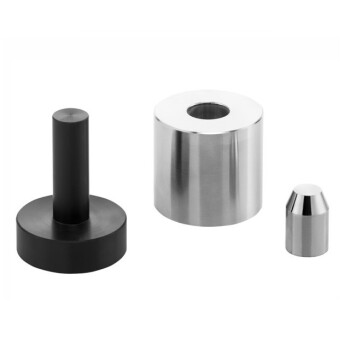
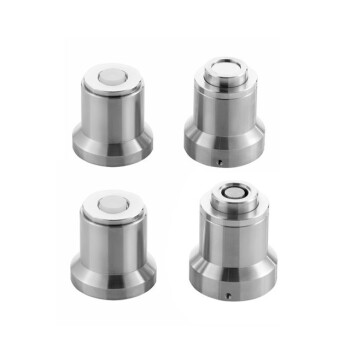
Applying high pressure is strictly necessary to force solid particles into intimate physical contact, compensating for the lack of liquid "wetting" found in traditional batteries. This process, often requiring pressures around 375 MPa, induces microscopic plastic deformation in the cathode and electrolyte materials to eliminate voids, reduce impedance, and create continuous pathways for ion transport.
Core Takeaway In all-solid-state batteries, ion transport depends entirely on physical contact between solid particles rather than liquid infiltration. High-pressure processing is the primary mechanism used to close microscopic gaps and maximize the active contact area, which is essential for low resistance and mechanical stability.
The Physics of the Solid-Solid Interface
Overcoming the Lack of Wetting
In conventional batteries, liquid electrolytes naturally flow into porous electrodes, filling gaps and ensuring contact.
Solid-state batteries lack this fluidity. Without external intervention, the interface between the cathode and the solid electrolyte remains rough and full of voids.
Inducing Plastic Deformation
To bridge these gaps, you must apply significant mechanical force, typically using a high-precision laboratory press.
Pressures reaching 360–380 MPa force the material particles to undergo plastic deformation. This effectively "squishes" the particles together, changing their shape to interlock tightly.
This is particularly effective when working with low-hardness organic particles or sulfide electrolytes, which are malleable enough to form a highly conformal interface under pressure.
Critical Performance Outcomes
Reducing Electrochemical Impedance
The primary adversary in solid-state battery performance is high interfacial resistance.
Microscopic gaps act as insulators, blocking the flow of ions. By eliminating these voids through high-pressure compression, you significantly reduce the charge transfer impedance.
This ensures that ions can move freely between the active material and the electrolyte, which is vital for the battery's power capability.
Ensuring Mechanical Stability
Beyond electrical performance, pressure creates a unified, dense structure.
High-pressure assembly densifies the electrolyte layer and creates a cohesive bond with the cathode. This mechanical integrity prevents the layers from delaminating during handling or operation.
It also establishes a robust framework that helps suppress the growth of lithium dendrites, which can cause short circuits.
Understanding the Trade-offs
The Risk of Anode Damage
While high pressure is beneficial for the cathode and electrolyte, it can be detrimental to the anode, particularly if you use Lithium metal.
Lithium metal is soft; applying excessive pressure (e.g., >300 MPa) can cause excessive deformation or puncture the electrolyte layer.
Variable pressure strategies are often employed to solve this. For example, a high pressure (380 MPa) is applied to the cathode/electrolyte interface to maximize density, while a lower pressure (approx. 120 MPa) is used for the anode to maintain contact without structural damage.
The Role of Temperature
Pressure alone is not always efficient for every material type.
Hot pressing (e.g., 100°C at 240 MPa) is frequently used to augment the mechanical force.
Heat softens the materials, allowing for better flow and consolidation at lower pressures than would be required at room temperature. This results in a seamless, "fused" interface that maximizes ion transport.
Making the Right Choice for Your Goal
Ideally, your assembly process should balance maximum densification with the mechanical limits of your specific materials.
- If your primary focus is maximizing ion conductivity: Prioritize high-pressure cold pressing (300–375 MPa) on the cathode-electrolyte stack to ensure maximum particle deformation and void elimination.
- If your primary focus is preventing anode failure: Implement a variable-pressure assembly method, applying high pressure to the cathode side but limiting anode pressure (approx. 120 MPa) to avoid puncturing the electrolyte.
- If your primary focus is fabrication efficiency: Utilize hot pressing to achieve intimate contact and high density at lower total pressures, reducing mechanical stress on your equipment.
Successful solid-state battery assembly relies on using pressure not just to hold parts together, but to physically alter material interfaces for seamless ion flow.
Summary Table:
| Factor | Requirement | Impact on Performance |
|---|---|---|
| Pressure Range | 360 – 380 MPa | Induces plastic deformation to eliminate voids |
| Interface Goal | Intimate Physical Contact | Reduces electrochemical impedance & resistance |
| Assembly Tech | Cold or Hot Pressing | Ensures mechanical stability and prevents delamination |
| Strategy | Variable Pressure | Protects soft anodes while maximizing cathode density |
Maximize Ion Transport with KINTEK Precision Pressing
Don't let interfacial resistance hinder your solid-state battery research. KINTEK specializes in comprehensive laboratory pressing solutions designed to meet the extreme demands of SSBs. Whether you require manual, automatic, heated, or glovebox-compatible models, our equipment delivers the precise 375+ MPa force necessary to achieve seamless solid-solid interfaces.
From high-pressure cold pressing to advanced warm isostatic presses, we help battery researchers achieve the density and mechanical stability required for next-generation energy storage. Contact KINTEK today to find the perfect pressing solution for your lab!
References
- Zhaoyang Chen, Yan Yao. Low-Pressure Operation of All-Solid-State Batteries Enabled by Low-Hardness Creep-Prone Electrodes. DOI: 10.26434/chemrxiv-2025-0fvvk
This article is also based on technical information from Kintek Solution Knowledge Base .
Related Products
- Warm Isostatic Press for Solid State Battery Research Warm Isostatic Press
- Lab Button Battery Tablet Press Sealing Mold
- Laboratory Hydraulic Press Lab Pellet Press Button Battery Press
- Button Battery Sealing Press Machine for Lab
- Lab Infrared Press Mold for Laboratory Applications
People Also Ask
- Why must composite cathodes be sealed in vacuum lamination bags for WIP? Ensure Battery Stability and Density
- What is the function of elastic molds in warm isostatic pressing? Achieve Uniform Density in Composite Particles
- How do sacrificial volume materials (SVM) maintain microchannels in isostatic pressing? Ensure Structural Integrity
- What is the function of hydraulic pressure in warm isostatic pressing? Achieve Uniform Material Density
- What is the significance of temperature control in Warm Isostatic Pressing? Unlock Uniform Densification and Process Stability