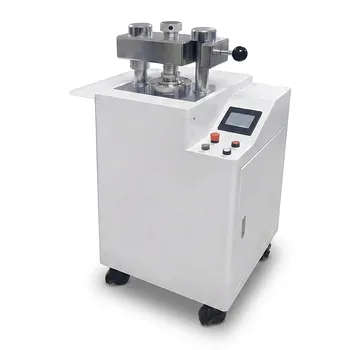
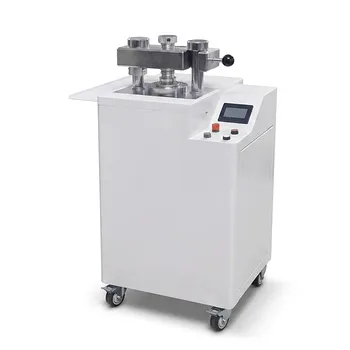
A lab pellet press is a precision instrument designed to compact powdered materials into solid, uniform pellets through mechanical force. While its fundamental role is densification, its primary utility lies in preparing stable, standardized samples for critical analytical techniques such as XRF analysis and FTIR spectroscopy.
The lab pellet press transforms loose, variable powders into high-density solids. By eliminating air gaps and particle irregularity, it ensures that scientific data remains reproducible, consistent, and reliable across experiments.
The Core Mechanism: From Powder to Solid
The Science of Densification
The utility of a pellet press relies on plastic deformation. When raw powder is subjected to immense pressure, the gaps between particles are reduced, forcing them to bond through friction and deformation.
The Component Ecosystem
A standard press consists of a mainframe for stability and a pressing system—often hydraulic, pneumatic, or mechanical. The raw material is loaded into a specific die, which determines the final shape and dimensions of the pellet.
Controlled Application
The process is methodical: material loading, pressure application, and pressure release. A high-quality press allows for specific control over these stages, ensuring the final pellet holds its shape without cracking or reverting to powder.
Functional Utility in Research
Analytical Sample Preparation
As noted in the primary reference, the press is indispensable for XRF (X-ray Fluorescence) and FTIR (Fourier Transform Infrared Spectroscopy). These methods require samples with flat, uniform surfaces to prevent scattering light or X-rays, which would skew results.
Biomass and Energy Research
In biomass densification, the press increases the energy density of bulk materials. Compressing biomass reduces its capacity to absorb moisture and improves mechanical strength, simulating how materials will behave during transport or thermal conversion.
Material Engineering
Beyond simple compaction, the press is used to create composite materials. By combining different powders before pressing, researchers can engineer new materials with specific mechanical or thermal properties for testing.
Key Features for Precision Control
Force Gauges and Monitoring
To achieve reproducibility, a press must have a force gauge. This allows the user to apply the exact same amount of pressure (often ranging from 15 to over 100 tons) to every batch, ensuring standardization.
Thermal Capabilities
Advanced applications often require heated platens. Some presses can reach temperatures between 600°F and 1200°F, allowing for the study of materials that require heat to bond or change state during compression.
Interchangeability
Versatility is a key utility. Customization options, such as interchangeable dies and plungers, allow a single machine to adapt to various sample sizes and shapes, maximizing laboratory efficiency.
Understanding the Trade-offs
Space vs. Power
There is often a trade-off between laboratory real estate and capability. Benchtop models save space but may offer lower maximum pressure (e.g., 15-25 tons), whereas floor models offer high pressure (100+ tons) but require significant footprint planning.
Manual vs. Automated
Manual presses are cost-effective and durable but introduce human error regarding the rate of pressure application. Automated systems ensure perfect consistency and batch efficiency but come with higher complexity and cost.
Sample Volume Limits
While efficient for research, lab presses are batch-process tools. They are designed for creating individual or small groups of samples, making them unsuitable for high-volume industrial production without significant time investment.
Making the Right Choice for Your Goal
To select the correct equipment, you must match the press's capabilities to your specific research outcomes.
- If your primary focus is Analytical Chemistry (XRF/FTIR): Prioritize a press with high-precision dies and smooth pressure release to ensure defect-free optical surfaces.
- If your primary focus is Biomass or Geotechnical Studies: Look for high-tonnage floor models capable of exerting extreme pressure to maximize density and durability.
- If your primary focus is Material Synthesis: Choose a model with heated platens and programmable ramp rates to observe material behavior under simultaneous heat and stress.
Success with a lab pellet press comes not just from applying force, but from controlling that force to create a repeatable standard for your science.
Summary Table:
| Feature | Functionality & Utility |
|---|---|
| Core Purpose | Compacting powders into uniform, high-density solid pellets |
| Key Applications | XRF analysis, FTIR spectroscopy, biomass research, material synthesis |
| Pressure Range | Benchtop (15-25 tons) to high-capacity floor models (100+ tons) |
| Precision Tools | Integrated force gauges, heated platens, and interchangeable die sets |
| Control Options | Manual (cost-effective) or Automated (maximum consistency/efficiency) |
Elevate Your Research Precision with KINTEK
Don't let inconsistent sample preparation compromise your data. KINTEK specializes in comprehensive laboratory pressing solutions tailored to your specific analytical needs. Whether you require manual durability, automated consistency, heated platens for material synthesis, or glovebox-compatible models for sensitive environments, our range includes:
- Manual & Automatic Presses for XRF/FTIR sample prep.
- Heated & Multifunctional Models for advanced material engineering.
- Cold and Warm Isostatic Presses for high-performance battery research.
Ready to achieve superior sample uniformity? Contact KINTEK today to find the perfect pressing solution for your lab!
Related Products
- Automatic Fluorescence Sample Preparation Press 40 Ton Lab Pellet Press for XRF Analysis
- Automatic Laboratory Hydraulic Press Lab Pellet Press Machine
- Laboratory Hydraulic Press 2T Lab Pellet Press for KBR FTIR
- Laboratory Hydraulic Pellet Press for XRF KBR FTIR Lab Press
- Laboratory Hydraulic Press Lab Pellet Press Machine for Glove Box
People Also Ask
- What is the general process for preparing a sample pellet for XRF? Master Consistency for Accurate Analysis
- What are the advantages of preparing a sample as a dense pellet for XRF? Unlock High-Precision Trace Element Analysis
- What are the common operational types of lab pellet presses? Choosing the Right Manual, Automatic, or Hydraulic System
- What are the emerging trends in the design and materials of lab pellet presses? Modernize Your Lab Efficiency
- What are common lab pellet press issues? Expert Troubleshooting Guide for Reliable Material Research