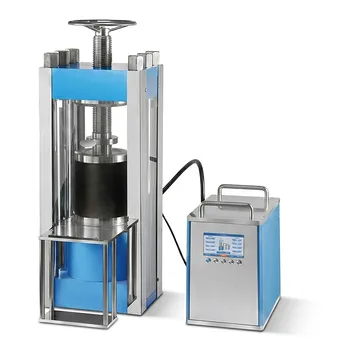
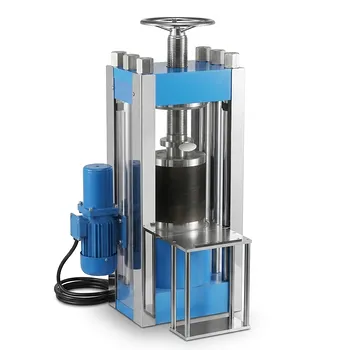
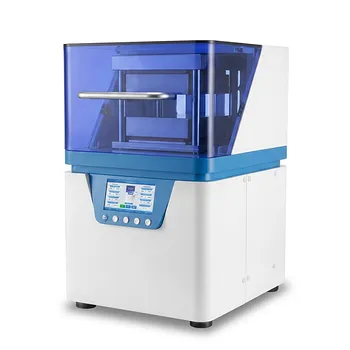
The primary function of a high-temperature hot press is to provide a controlled environment of simultaneous heat and pressure to achieve material consolidation. This equipment melts the thermoplastic polypropylene matrix—typically at temperatures between 160°C and 180°C—enabling it to flow and fully encapsulate reinforcing fibers such as jute, coconut husk, or carbon materials. By applying high pressure, often reaching tens of kilonewtons, the press eliminates internal air voids and ensures a high-strength interfacial bond between the polymer and the reinforcement.
Core Takeaway: The high-temperature hot press is the essential tool for transforming loose polymer and reinforcement layers into a dense, unified composite. It uses thermal energy to induce liquid flow and mechanical force to ensure total impregnation safely and uniformly.
The Dual Mechanism of Consolidation
Thermal Energy and Phase Transformation
The hot press must raise the temperature of the material precisely to the melting point of the polypropylene matrix, which generally occurs around 165°C to 167°C. This transition from a solid state to a molten flow is necessary for the polymer to move through the gaps in the reinforcing fabric or fibers.
Mechanical Force and Impregnation
While the polymer is molten, the hydraulic system applies segmented or constant pressure (often ranging from 6 MPa to 15 MPa). This force drives the liquid polypropylene into the microscopic structures of the reinforcement, ensuring that every fiber is completely coated and "wetted" by the matrix.
Elimination of Internal Defects
High-pressure application is the primary defense against internal voids and air pockets. By squeezing the material layers together, the press forces out trapped air, which significantly increases the final density and mechanical integrity of the composite part.
Enhancing Material Properties
Optimizing Interfacial Bonding
Superior mechanical strength in a composite depends on how well the matrix grips the reinforcement. The hot press facilitates physical entanglement and molecular diffusion at the interface, creating a "bridge" between the two different materials that prevents delamination under stress.
Achieving Dimensional Precision
Through the use of high-precision molds and spacers, the press ensures the final product meets exact thickness and geometric requirements. This control is vital for creating orthotropic plates or functional films that must fit into larger industrial assemblies.
Controlled Cooling and Stabilization
Many advanced hot presses manage the cooling cycle after the heating phase to ensure tight interlayer bonding. A gradual, controlled reduction in temperature prevents the polypropylene from shrinking or warping unevenly, resulting in a more stable and uniform product.
Understanding the Trade-offs and Risks
Thermal Degradation vs. Flow
If the temperature is set too high in an attempt to speed up the process, the polypropylene chain can degrade, weakening the material. Furthermore, if natural reinforcements like jute or coconut husk are used, excessive heat can char the fibers and destroy their structural value.
Pressure Sensitivity and Fiber Damage
Excessive pressure can lead to "fiber wash," where the reinforcement is displaced or crushed by the force of the flowing polymer. While high pressure is necessary to remove voids, it must be balanced to maintain the structural orientation of the reinforcing phase.
Processing Time and Cost
Achieving a perfect bond often requires a specific dwell time where the temperature and pressure are held constant. Choosing a faster cycle time to increase production throughput often results in incomplete impregnation and a higher rate of internal defects.
Applying This Technology to Your Project
Recommendations Based on Material Goals
- If your primary focus is Maximum Mechanical Strength: Prioritize the "dwell time" at the matrix melting point and use higher, segmented pressure cycles to ensure the elimination of all microscopic voids.
- If your primary focus is Natural Fiber Preservation: Use the lower end of the polypropylene melting range (approximately 160°C) to prevent thermal damage to the organic reinforcements while extending the pressing duration.
- If your primary focus is Dimensional Accuracy: Utilize a press with high-precision heated plates and a controlled cooling system to prevent warping as the composite solidifies.
The high-temperature hot press remains the definitive tool for composite manufacturing, turning the theoretical potential of combined materials into a high-performance, physical reality.
Summary Table:
| Feature | Description |
|---|---|
| Primary Function | Simultaneous heat and pressure for material consolidation |
| Thermal Range | 160°C - 180°C (optimized for polypropylene melting) |
| Pressure Range | 6 MPa - 15 MPa (ensures full fiber impregnation) |
| Key Outcome | High-strength interfacial bonding and elimination of voids |
| Materials | PP matrix with jute, coconut husk, or carbon reinforcements |
Elevate Your Composite Research with KINTEK Precision
Maximize the mechanical integrity of your materials with KINTEK’s industry-leading pressing solutions. Whether you are conducting advanced battery research or developing high-performance thermoplastic composites, our equipment ensures precise control over every thermal and mechanical variable.
Our Comprehensive Lab Solutions Include:
- Manual & Automatic Presses: For versatile laboratory needs.
- Heated & Multifunctional Models: Perfect for complex phase transformations.
- Specialized Systems: Glovebox-compatible models and Cold/Warm Isostatic Presses (CIP/WIP).
Don't settle for internal defects—achieve total impregnation and superior dimensional accuracy today. Contact KINTEK for a Consultation and discover the ideal pressing solution for your target application.
References
- Danish Anis Beg. Study of Mechanical Properties of Polypropylene Natural Fiber Composite. DOI: 10.22214/ijraset.2020.31453
This article is also based on technical information from Kintek Solution Knowledge Base .
Related Products
- Automatic Hydraulic Hot Press with Large Plate and Precision Temperature Control for Advanced Material Sample Preparation and Industrial Research
- Automatic High Temperature Heated Hydraulic Press Machine with Heated Plates for Lab
- Lab Polygon Press Mold
- Lab Heat Press Special Mold
- Warm Isostatic Press for Solid State Battery Research Warm Isostatic Press
People Also Ask
- What are the specific features and applications of hydraulic hot press machines? Precision Solutions for Modern Labs
- How does an automatic hydraulic press operate? Achieve Precision and Consistency in Lab Pelleting
- What are the advantages and common applications of an automatic hydraulic press? Elevate Your Lab's Precision
- What is the technical significance of setting a precise dwell time? Achieve Peak Material Density and Stability
- When is an automatic hydraulic press more suitable than a manual press? Scale Your Lab with Precision & Speed