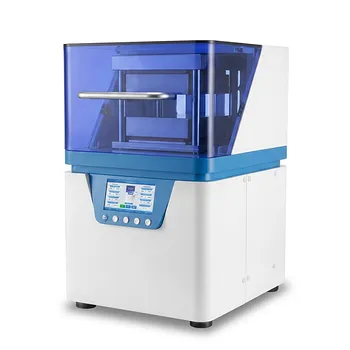
The primary function of a hydraulic press in sample preparation is to consolidate loose powder materials into a solid, flattened disc or pellet. By applying substantial compressive force, the press transforms variable raw materials into a unified form with consistent flatness and density. This physical standardization is a critical prerequisite for accurate results in analytical techniques such as X-ray fluorescence (XRF) and Fourier-transform infrared spectroscopy (FTIR).
By converting loose powders into uniform solids, a hydraulic press eliminates physical inconsistencies that would otherwise distort analytical data. It ensures that the sample—not the preparation method—is what determines the test results.
The Mechanics of Consolidation
Rearrangement and Displacement
When pressure is first applied to a powder sample within a die, the individual particles undergo displacement. They shift and rearrange themselves to fill the empty spaces within the mold, beginning the process of densification.
Plastic Deformation
As the hydraulic press applies higher pressure, the material is forced beyond simple rearrangement. The powder particles undergo plastic deformation, changing shape to interlock with one another. This effectively expels air trapped between particles and increases the contact area between them.
Creation of the "Green Body"
The result of this compression is often referred to as a "green body." This is a solid block or pellet that possesses specific geometric purity and sufficient mechanical strength to be handled. It is now structurally integral enough to undergo subsequent steps, such as high-temperature sintering or mechanical testing, without collapsing.
Why Uniformity Drives Accuracy
Ensuring Analytical Repeatability
Techniques like XRF rely on the sample surface being perfectly flat and the internal density being homogenous. If a sample has an uneven surface or internal voids, the scattering of X-rays will be inconsistent, leading to unreliable data. The hydraulic press ensures that every pellet created has the same physical characteristics, allowing for repeatable comparisons between different samples.
Eliminating Density Gradients
Loose powders naturally have gaps and density variations. A hydraulic press ensures uniform pressure distribution throughout the mold. This eliminates internal density gradients, providing a homogenous material structure that accurately represents the substance being tested.
Understanding the Trade-offs
The Importance of Dwell Time
Achieving a high-quality sample is not just about the amount of pressure, but also the duration. Users must control the "dwelling time"—how long the pressure is held—to allow the material to fully relax into its new shape. Releasing pressure too quickly can cause the sample to crack or rebound, ruining the structural integrity.
Balancing Force and Fragility
While high pressure is necessary for consolidation, excessive force can damage the die or the sample itself. Conversely, insufficient pressure results in a pellet that crumbles upon handling. The operator must precisely calibrate the force to match the specific compressibility of the powder being used.
Making the Right Choice for Your Goal
To get the most out of your hydraulic press, align your methodology with your specific analytical objective:
- If your primary focus is Spectroscopic Analysis (XRF/FTIR): Prioritize surface flatness and extreme homogeneity to ensure the light or X-rays interact uniformly with the sample.
- If your primary focus is Solid-State Reactions or Sintering: Focus on achieving a specific "green density" that maximizes particle contact without introducing stress fractures.
- If your primary focus is Mechanical Testing: Ensure the aspect ratio of the pressed sample meets the exact geometric standards required for the strength test you are performing.
Mastering the hydraulic press allows you to remove physical variability from your experiments, leaving you with pure, actionable data.
Summary Table:
| Process Phase | Action Taken | Resulting Benefit |
|---|---|---|
| Rearrangement | Particles shift to fill voids | Initial densification of powder |
| Deformation | Particles interlock under high pressure | Air expulsion and structural integrity |
| Consolidation | Creation of a 'Green Body' | Mechanically strong, handleable pellet |
| Dwell Time | Pressure held for specific duration | Prevention of cracks and elastic rebound |
| Standardization | Uniform surface and density | High repeatability for XRF/FTIR data |
Elevate Your Analytical Precision with KINTEK
Don't let poor sample preparation compromise your research results. KINTEK specializes in comprehensive laboratory pressing solutions designed for the most demanding applications. Whether you are conducting advanced battery research or routine spectroscopic analysis, our range of manual, automatic, heated, and multifunctional models—including specialized cold and warm isostatic presses—ensures perfect sample homogeneity every time.
Why choose KINTEK?
- Versatility: Glovebox-compatible and multifunctional designs.
- Precision: Precise control over dwell time and compression force.
- Expertise: Solutions tailored for XRF, FTIR, and sintering applications.
Contact KINTEK today to find the perfect press for your lab!
Related Products
- Automatic Hydraulic Hot Press with Large Plate and Precision Temperature Control for Advanced Material Sample Preparation and Industrial Research
- Automatic Hydraulic Heat Press Machine with Multi Stage Programmable Control and Integrated Water Cooling Plate Size 180x180mm
- Automatic High Temperature Heated Hydraulic Press Machine with Heated Plates for Lab
- Automatic Heated Hydraulic Lab Press with Programmable Touch Screen Controls and Precision Temperature Regulation
- Manual Heated Hydraulic Lab Press with Integrated Hot Plates Hydraulic Press Machine
People Also Ask
- What are the specific features and applications of hydraulic hot press machines? Precision Solutions for Modern Labs
- How does an automatic hydraulic press operate? Achieve Precision and Consistency in Lab Pelleting
- What are the advantages and common applications of an automatic hydraulic press? Elevate Your Lab's Precision
- What is the technical significance of setting a precise dwell time? Achieve Peak Material Density and Stability
- When is an automatic hydraulic press more suitable than a manual press? Scale Your Lab with Precision & Speed