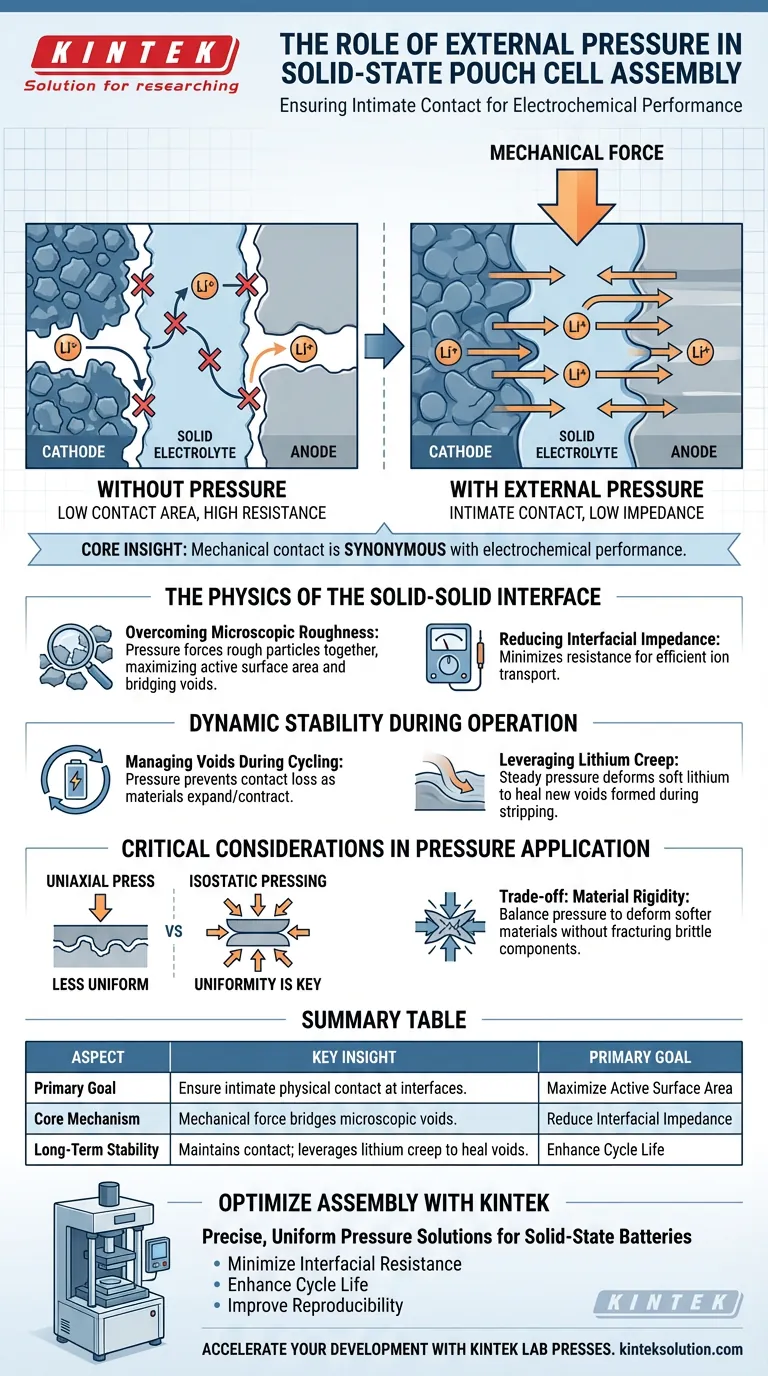
The primary purpose of applying external pressure during the assembly of solid-state pouch cells is to ensure intimate physical contact at the solid-solid interfaces between the electrodes and the solid electrolyte. Unlike traditional batteries that use liquid electrolytes to wet surfaces and fill gaps, solid-state systems rely entirely on mechanical force to bridge the microscopic voids between rigid components. Without this pressure, the contact area remains low, resulting in high interfacial resistance and poor ion transport.
Core Insight In solid-state batteries, mechanical contact is synonymous with electrochemical performance. Applying pressure is not merely for structural integrity; it is the fundamental mechanism required to create a low-impedance path for lithium ions to move between the cathode, electrolyte, and anode.
The Physics of the Solid-Solid Interface
Overcoming Microscopic Roughness
On a microscopic level, solid electrode and electrolyte materials are rough and rigid. When placed together without force, they touch only at specific high points, leaving significant gaps (voids) between them.
External pressure forces these particles together, maximizing the active surface area. This physical connection is the only bridge available for ions to travel across the cell layers.
Reducing Interfacial Impedance
The primary barrier to performance in solid-state cells is interfacial impedance—the resistance ions face when crossing from one material to another.
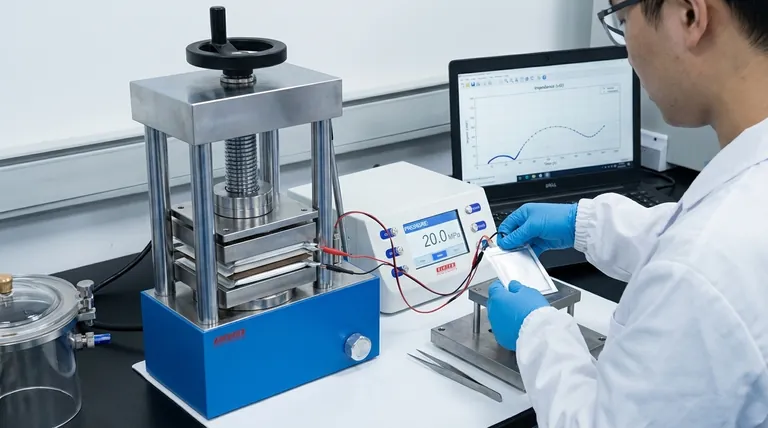
By applying high pressure, typically via a laboratory press, you minimize this resistance. A well-formed, low-impedance interface is a prerequisite for achieving efficient lithium-ion transport and overall high battery performance.
Dynamic Stability During Operation
Managing Voids During Cycling
The need for pressure extends beyond initial assembly; it is critical for long-term stability. During charge and discharge cycles, lithium is stripped from and deposited onto the anode.
This movement of material can create new voids at the interface, leading to contact loss and a spike in resistance.
Leveraging Lithium Creep
Applying and maintaining constant external pressure utilizes the "creep" properties of lithium metal. Because lithium is relatively soft, steady pressure forces it to deform and flow into the voids created during stripping.
This ensures that the intimate contact established during assembly is maintained throughout the battery's life, preventing performance degradation.
Critical Considerations in Pressure Application
Uniformity is Key
Not all pressure is applied equal. While uniaxial presses are common, they apply force in only one direction, which can be insufficient for complex interfaces.
Isostatic pressing, which applies uniform pressure from all directions (often via liquid or gas), is generally superior. It ensures void-free contact, particularly between soft metal electrodes and rigid ceramic electrolytes.
The Trade-off of Material Rigidity
While pressure is necessary, the rigidity of the components poses a challenge. The pressure must be high enough to deform the softer materials (like lithium) into the harder ones (like ceramics) without fracturing the brittle electrolyte layers.
Balancing the magnitude of pressure to ensure contact without compromising mechanical integrity is a precise requirement of the assembly process.
Optimizing Assembly for Performance
To achieve the best results in solid-state pouch cell assembly, you must align your pressure strategy with your specific performance goals.
- If your primary focus is lowering initial resistance: Prioritize high-pressure assembly techniques to maximize the initial solid-solid contact area and minimize impedance.
- If your primary focus is cycle life and stability: Ensure your assembly fixture can maintain constant pressure during operation to utilize lithium creep and heal voids formed during cycling.
- If your primary focus is interface quality: Utilize isostatic pressing rather than uniaxial methods to achieve uniform, void-free contact across irregular surfaces.
Success in solid-state assembly depends on treating pressure as a dynamic, active component of the battery's electrochemical system.
Summary Table:
| Aspect | Key Insight |
|---|---|
| Primary Goal | Ensure intimate physical contact at solid-solid interfaces (electrode/electrolyte). |
| Core Mechanism | Mechanical force bridges microscopic voids, replacing the wetting function of liquid electrolytes. |
| Key Benefit | Drastically reduces interfacial impedance for efficient lithium-ion transport. |
| Long-Term Stability | Maintains contact during cycling by leveraging lithium creep to heal voids. |
| Optimal Method | Isostatic pressing provides uniform, void-free contact superior to uniaxial methods. |
Ready to perfect your solid-state battery assembly?
Achieving the precise, uniform pressure required for high-performance solid-state pouch cells is a fundamental challenge. KINTEK specializes in laboratory press solutions, including isostatic presses and automatic lab presses, designed to meet the exacting demands of battery research and development.
Our equipment helps you:
- Minimize Interfacial Resistance: Apply controlled, uniform pressure to create optimal solid-solid contact.
- Enhance Cycle Life: Maintain consistent pressure to utilize lithium creep and stabilize interfaces during long-term testing.
- Improve Reproducibility: Achieve reliable and repeatable results with our precision-engineered lab presses.
Let KINTEK be your partner in innovation. Contact our experts today to discuss how our lab press machines can accelerate your development of next-generation solid-state batteries.
Visual Guide
Related Products
- Warm Isostatic Press for Solid State Battery Research Warm Isostatic Press
- Lab Button Battery Tablet Press Sealing Mold
- Button Battery Sealing Press Machine for Lab
- Assemble Lab Cylindrical Press Mold for Laboratory Use
- Assemble Square Lab Press Mold for Laboratory Use
People Also Ask
- Why must composite cathodes be sealed in vacuum lamination bags for WIP? Ensure Battery Stability and Density
- How do sacrificial volume materials (SVM) maintain microchannels in isostatic pressing? Ensure Structural Integrity
- What is the function of elastic molds in warm isostatic pressing? Achieve Uniform Density in Composite Particles
- What is the function of hydraulic pressure in warm isostatic pressing? Achieve Uniform Material Density
- What is the mechanism of a Warm Isostatic Press (WIP) on cheese? Master Cold Pasteurization for Superior Safety