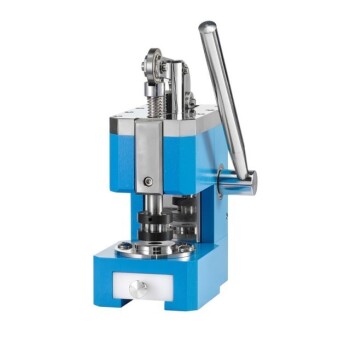
The primary function of grinding and polishing equipment in solid-state battery manufacturing is the physical removal of insulating impurity layers. Specifically, these machines target lithium carbonate ($Li_2CO_3$) contaminants that naturally form on garnet-type solid electrolytes, such as LLZO, upon exposure to air. This mechanical conditioning is the first step in establishing a functional electrochemical interface.
The core value of this process lies in minimizing interfacial contact resistance. By creating a pristine, smooth surface, this equipment enhances lithiophilicity, ensuring superior adhesion and ion transfer between the solid electrolyte and the lithium metal anode.
Eliminating Chemical Barriers
Addressing Air Reactivity
Garnet-type solid electrolytes are chemically sensitive to the atmosphere. When exposed to air, they react to form a lithium carbonate ($Li_2CO_3$) layer on the surface.
The Impact of Impurities
This carbonate layer acts as an insulator, impeding the flow of ions. Grinding equipment is deployed to physically strip away this passivation layer, exposing the active ceramic material beneath.
Optimizing Surface Topography
Reducing Surface Roughness
Beyond cleaning, the polishing phase is critical for geometry. It significantly lowers the surface roughness of the electrolyte pellet or sheet.
Enhancing Lithiophilicity
A smoother, cleaner surface is more "lithiophilic," meaning it is more easily wetted by lithium metal. This physical change is essential for reducing the microscopic gaps that lead to high resistance.
Improving Contact Mechanics
The ultimate goal of this surface conditioning is to maximize the physical contact area. This minimizes the interfacial contact resistance, allowing the battery to function efficiently.
Critical Considerations and Trade-offs
Mechanical Stress and Integrity
While removing impurities is vital, solid electrolytes are often brittle ceramics. Over-aggressive grinding can introduce micro-cracks or surface defects that compromise the mechanical integrity of the separator.
Balancing Material Loss
The process involves removing material to reach a pristine state. Engineers must balance the need for a clean surface with the requirement to maintain the specific thickness dimensions of the electrolyte layer.
Making the Right Choice for Your Goal
Effective interface treatment requires balancing thorough contaminant removal with the preservation of the ceramic structure.
- If your primary focus is electrochemical performance: Prioritize polishing protocols that achieve the lowest possible surface roughness to maximize lithiophilicity and minimize resistance.
- If your primary focus is mechanical durability: Use gentler grinding parameters to remove the carbonate layer without introducing micro-cracks into the brittle ceramic electrolyte.
Precise physical surface treatment is the non-negotiable prerequisite for achieving high-performance solid-state battery interfaces.
Summary Table:
| Process Step | Primary Objective | Key Impact on Battery |
|---|---|---|
| Grinding | Removal of $Li_2CO_3$ impurity layers | Eliminates ionic insulation/chemical barriers |
| Polishing | Reduction of surface roughness | Enhances lithiophilicity and wetting |
| Final Surface Treatment | Maximizing physical contact area | Minimizes interfacial contact resistance |
Elevate Your Solid-State Battery Research with KINTEK
Precise interface treatment is the cornerstone of high-performance energy storage. KINTEK specializes in comprehensive laboratory pressing and material preparation solutions, offering a versatile range of manual, automatic, heated, and multifunctional presses, as well as cold and warm isostatic presses engineered specifically for the rigors of battery research.
Whether you are working with brittle garnet-type electrolytes or advanced lithium metal anodes, our equipment ensures the mechanical integrity and surface precision your research demands.
Ready to minimize resistance and maximize your lab's efficiency? Contact KINTEK today to find the perfect pressing and surface treatment solution for your next breakthrough.
References
- Jianfang Yang, Xia Lu. Research Advances in Interface Engineering of Solid‐State Lithium Batteries. DOI: 10.1002/cnl2.188
This article is also based on technical information from Kintek Solution Knowledge Base .
Related Products
- Lab Ball Press Mold
- Lab Manual Microtome Slicer for Tissue Sectioning
- Manual Cold Isostatic Pressing CIP Machine Pellet Press
- Electric Lab Cold Isostatic Press CIP Machine
- Lab Cylindrical Press Mold with Scale
People Also Ask
- What is the purpose of incorporating cartridge heaters into a lab press mold for MLCC block compression? Optimize Results
- What are the requirements for pressing molds when using SSCG? Key Materials for Complex Single Crystal Production
- How do the design and geometric precision of pressing molds and mandrels affect the quality of PTFE composite samples?
- How does the geometry of laboratory molds influence mycelium-based composites? Optimize Density and Strength
- What role do precision positioning and pressure molds play in single-lap joints? Ensure 100% Data Integrity