To create a KBr pellet for FTIR analysis using a hydraulic press, you must thoroughly mix your sample with potassium bromide (KBr) powder, typically at a ratio of 1 part sample to 100 parts KBr. This mixture is loaded into a pellet die and compressed using a hydraulic press to form a solid, transparent disc that allows infrared light to pass through for accurate spectral analysis.
The success of a KBr pellet relies on achieving a transparent medium that suspends the sample without saturating the detector; this requires precise ratios and strict moisture control during the mixing process.
Essential Preparation and Mixing
Before applying pressure, the quality of your spectral data is determined by how well you prepare the mixture. Contamination or improper ratios will result in opaque pellets and poor resolution.
Equipment Hygiene
Thoroughly clean the die set, pestle, and mortar before use. Wash them with a suitable solvent and deionized water to remove previous residues.
Once washed, dry the tools in a warm oven. This step is critical because KBr is hygroscopic (absorbs water), and any residual moisture will appear as broad peaks in your final infrared spectrum.
The Correct Ratio
The standard ratio for a successful pellet is approximately 1:100 (sample to KBr).
For a standard 1/2 inch (13 mm) diameter pellet, this translates to roughly 1–2 mg of sample mixed with 200–250 mg of KBr powder. Adhering to this dilution prevents the sample from blocking the IR beam completely.
Grinding Strategy
Begin by grinding the sample powder alone in an agate pestle and mortar. Agate is preferred for its hardness and smooth surface, which minimizes sample loss and contamination.
Add the KBr powder to the ground sample. Grind them together briefly to ensure homogeneity. Do not over-grind the mixture at this stage; excessive grinding increases the surface area of the KBr, making it more likely to absorb atmospheric moisture.
The Pressing Procedure
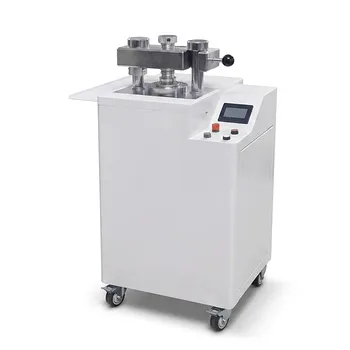
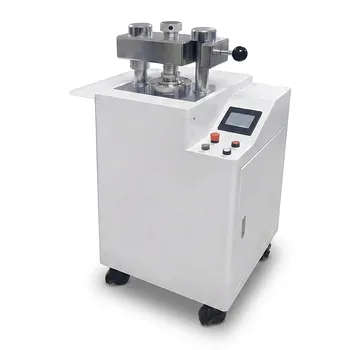
Once the mixture is prepared, the hydraulic press is used to fuse the powder into a solid optical window.
Assembling the Die
Place the die sleeve onto the base plate of your pellet die set. Carefully transfer the ground KBr/sample mixture into the bore of the die.
Insert the plunger on top of the powder mixture. Ensure the assembly is level to prevent uneven pressure distribution, which can cause the pellet to crack.
Applying Hydraulic Force
Place the assembled die into the hydraulic press. Apply a load sufficient to fuse the KBr crystals—typically around 10 tonnes for a 13 mm die, or a pressure of approximately 8,000 to 10,000 psi (55–69 MPa).
The hydraulic press applies uniform force, compacting the powder into a dense, thin pellet. Hold the pressure for a short duration to ensure the crystals flow together completely.
Ejecting the Pellet
Release the pressure and remove the die from the press. To eject the pellet, remove the base plate and invert the die sleeve.
Place a release ring on top of the assembly and use the press (or a manual ejection tool) to gently push the pellet out. The result should be a largely transparent disc ready for the FTIR instrument.
Understanding the Trade-offs
Creating KBr pellets is a standard technique, but it introduces specific variables that can compromise your data if ignored.
Moisture Contamination
The most common failure point is water absorption. Because KBr aggressively pulls moisture from the air, you may see large hydroxyl (-OH) bands in your spectrum that mask your actual sample data. Trade-off: You must work quickly or use a glove box to minimize atmospheric exposure.
Sample Concentration Issues
There is a fine line between a good signal and a "black" pellet.
- Too much sample: The pellet will be opaque or dark, causing detector saturation and distorted peaks.
- Too little sample: The signal-to-noise ratio will be poor, making it difficult to identify trace features.
Making the Right Choice for Your Goal
The way you execute this process should shift slightly depending on your analytical priorities.
- If your primary focus is spectral purity: Prioritize using a glove box and minimize grinding time after adding KBr to eliminate water bands from the background.
- If your primary focus is quantitative analysis: Weigh your sample and KBr precisely (e.g., exactly 200 mg total weight) to ensure path length and concentration are consistent across different runs.
Your goal is not just a solid disc, but a transparent optical window that renders the sample visible to the instrument.
Summary Table:
| Stage | Key Parameter | Requirement / Action |
|---|---|---|
| Mixing | Sample-to-KBr Ratio | 1:100 (1-2mg sample to 200-250mg KBr) |
| Grinding | Material & Timing | Use agate mortar; grind briefly to avoid moisture |
| Pressing | Applied Force | 8,000 – 10,000 psi (approx. 10 tonnes) |
| Environment | Moisture Control | Work quickly or use a glovebox to prevent -OH bands |
| Result | Visual Appearance | Transparent, uniform disc without cracks |
Elevate Your Spectroscopic Precision with Kintek
High-quality FTIR data begins with the perfect pellet. KINTEK specializes in comprehensive laboratory pressing solutions, offering a versatile range of manual, automatic, heated, and multifunctional presses, as well as glovebox-compatible models for moisture-sensitive KBr preparation. Whether you are conducting fundamental research or advanced battery studies with cold and warm isostatic presses, our equipment ensures uniform pressure distribution and repeatable results every time.
Ready to optimize your sample preparation? Contact us today to find the ideal pressing solution for your lab!
Related Products
- Laboratory Hydraulic Press 2T Lab Pellet Press for KBR FTIR
- Laboratory Hydraulic Pellet Press for XRF KBR FTIR Lab Press
- Automatic Laboratory Hydraulic Press for XRF and KBR Pellet Pressing
- Manual Laboratory Hydraulic Pellet Press Lab Hydraulic Press
- Automatic Laboratory Hydraulic Press Lab Pellet Press Machine
People Also Ask
- What is the role of a laboratory pressure machine and KBr in FTIR? Master Sample Preparation for Flame Retardants
- What is the role of a laboratory hydraulic press in high-loading NCM811 cathode prep for solid-state batteries?
- What role does a laboratory hydraulic press play in reaction pellets? Optimizing Lunar Soil and Metal Fuel Density
- Why is a laboratory hydraulic press necessary for sample preparation? Precise Pelleting for Spiro Heterocyclic Analysis
- Why use a hydraulic press for graphite cone anode plates? Enhance Electrode Density and Conductivity