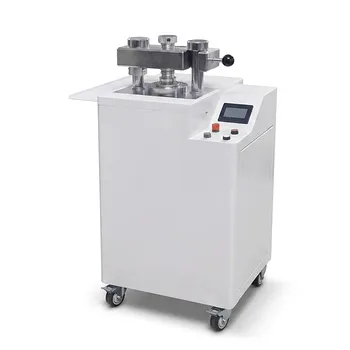
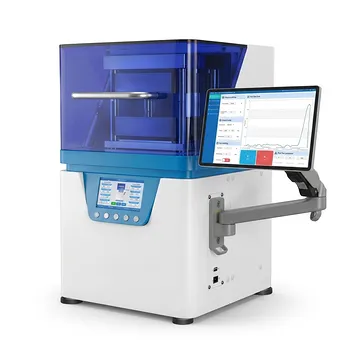
The production of Metal Matrix Composites (MMCs) using a hydraulic press typically follows a standard powder metallurgy workflow. The process begins by blending metal powder with a matrix material (such as ceramic or polymer) and placing this mixture into a specific mold. The hydraulic press then applies controlled force to compact the material into a shape, after which the part is ejected and subjected to a final heat treatment to lock in its mechanical properties.
The success of an MMC depends not just on the materials used, but on the precise application of force. The hydraulic press creates the "green compact"—a physical foundation with minimized porosity—which ensures the component maintains its shape and integrity during the critical sintering phase.
The Manufacturing Workflow
Preparation and Blending
The process starts with the careful selection and mixing of raw materials. Metal powders are thoroughly blended with the desired matrix material to create a uniform mixture.
This step is crucial for consistency. If the matrix material—whether ceramic or polymer—is not evenly distributed, the final product will have weak points.
Compaction and Molding
The blended mixture is transferred into a mold located within the hydraulic press. The press applies significant force, causing the loose powder particles to rearrange and pack tightly together.
This stage transforms the loose powder into a solid shape. The hydraulic press utilizes uniaxial pressure to compress the material, increasing its density significantly compared to its loose state.
Ejection and Heat Treatment
Once the compression cycle is complete, the pressure is released, and the formed composite is removed from the mold. At this stage, the part is solid but not yet fully strengthened.
The final step is a heat treatment, commonly known as sintering. This thermal process bonds the particles at a molecular level, enhancing the overall strength and durability of the composite.
The Critical Role of Pressure Control
Reducing Porosity
The primary technical advantage of using a high-precision hydraulic press is the ability to minimize internal voids. By applying controlled pressure, the press reduces macro-pores between particles.
Supplementary data indicates that precision control is vital for managing the density of the final component. Without sufficient pressure, the composite will retain air gaps that compromise structural integrity.
Creating the "Green Compact"
In technical terms, the object produced by the press before heat treatment is called a green compact. This compact must have enough specific strength to be handled without crumbling.
The hydraulic press establishes the physical foundation for the interface structures between the metal and the reinforcement. For example, in magnesium-titanium composites, this tight packing facilitates the formation of ideal atomic interfaces during subsequent processing.
Understanding the Trade-offs
Uniaxial Pressure Limitations
While hydraulic presses are effective, they typically apply uniaxial pressure (force from one direction). This can sometimes lead to density gradients, where the material is denser closer to the punch face than in the center.
Dependence on Sintering
The hydraulic press does not produce a finished part; it produces a pre-form. The final mechanical properties are heavily dependent on the success of the subsequent heat treatment or sintering stage. If the "green compact" has non-uniform density, it may deform unpredictably during heating.
Making the Right Choice for Your Goal
To achieve the best results with MMCs, you must align your process parameters with your specific engineering targets.
- If your primary focus is mechanical strength: Prioritize high-pressure settings to maximize particle contact and minimize porosity in the green compact stage.
- If your primary focus is dimensional accuracy: Ensure your pressure distribution is as uniform as possible to prevent warping during the final heat treatment.
Precision in the pressing stage is the single most important factor in determining the reliability of the final composite.
Summary Table:
| Stage | Key Action | Technical Objective |
|---|---|---|
| Blending | Mixing metal powder & matrix | Ensure uniform material distribution |
| Compaction | Applying hydraulic force | Create high-density "Green Compact" |
| Ejection | Mold removal | Prepare pre-form for thermal bonding |
| Sintering | Controlled heat treatment | Achieve molecular bonding & final strength |
Elevate Your Material Research with KINTEK Precision
At KINTEK, we specialize in comprehensive laboratory pressing solutions designed for the rigorous demands of MMC production and battery research. Whether you need manual, automatic, heated, or multifunctional models, our equipment provides the precise pressure control necessary to eliminate porosity and ensure structural integrity. From glovebox-compatible presses to advanced cold and warm isostatic systems, we empower researchers to achieve superior density and dimensional accuracy.
Ready to optimize your composite fabrication? Contact our technical experts today to find the perfect press for your lab.
Related Products
- Automatic Hydraulic Hot Press with Large Plate and Precision Temperature Control for Advanced Material Sample Preparation and Industrial Research
- Laboratory Hydraulic Press Lab Pellet Press Button Battery Press
- Automatic Heated Hydraulic Lab Press 120x120mm Plate Fully Automated Material Research Press
- Automatic Laboratory Hydraulic Press for XRF and KBR Pellet Pressing
- Laboratory Hydraulic Pellet Press for XRF KBR FTIR Lab Press
People Also Ask
- What are the specific features and applications of hydraulic hot press machines? Precision Solutions for Modern Labs
- How does an automatic hydraulic press operate? Achieve Precision and Consistency in Lab Pelleting
- What are the advantages and common applications of an automatic hydraulic press? Elevate Your Lab's Precision
- What is the technical significance of setting a precise dwell time? Achieve Peak Material Density and Stability
- When is an automatic hydraulic press more suitable than a manual press? Scale Your Lab with Precision & Speed