Knowledge What is the purpose of applying a high pressure of 240 MPa with a laboratory hydraulic press when fabricating a solid electrolyte layer from Na3SbS3.75Se0.25 powder? Unlock Superior Ionic Conductivity
Author avatar

Tech Team · Kintek Press

Updated 3 days ago

What is the purpose of applying a high pressure of 240 MPa with a laboratory hydraulic press when fabricating a solid electrolyte layer from Na3SbS3.75Se0.25 powder? Unlock Superior Ionic Conductivity


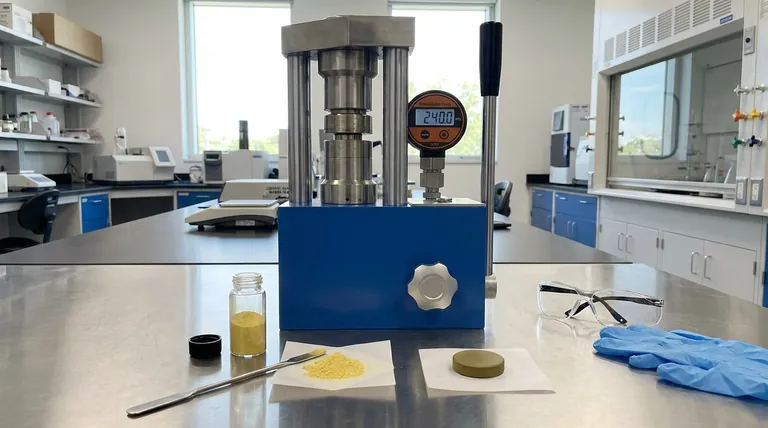
The primary purpose of applying 240 MPa is to mechanically consolidate loose Na3SbS3.75Se0.25 powder into a dense, cohesive solid electrolyte layer. This high-pressure cold pressing eliminates inter-particle voids, transforming a non-conductive powder arrangement into a robust, freestanding separator capable of efficient ion transport.

Pressure is the defining variable that governs the transition from raw material to functional component; without sufficient compaction to minimize porosity, the electrolyte limits battery performance due to high internal resistance.
What is the purpose of applying a high pressure of 240 MPa with a laboratory hydraulic press when fabricating a solid electrolyte layer from Na3SbS3.75Se0.25 powder? Unlock Superior Ionic Conductivity

The Mechanics of Densification

Eliminating Voids

Loose powder consists of individual grains separated by air gaps, which act as insulators against ion flow. Applying 240 MPa forces these particles together, drastically reducing porosity.

Establishing Physical Continuity

The pressure ensures that the electrolyte grains make intimate physical contact with one another. This transforms the material from a collection of discrete particles into a unified "green body" or pellet.

Creating a Freestanding Separator

Beyond electrochemical needs, the layer must be mechanically stable to function as a separator between the anode and cathode. The high pressure creates a mechanically robust sheet that can be handled without crumbling.

Impact on Electrochemical Performance

Minimizing Grain Boundary Resistance

The interfaces between powder particles, known as grain boundaries, are often the points of highest resistance in a solid electrolyte. High-pressure compaction maximizes the contact area between grains, significantly lowering this resistance.

Reducing Bulk Resistance

By increasing the overall density of the material, the intrinsic bulk resistance of the electrolyte layer is minimized. This is a fundamental requirement for the material to exhibit its true ionic conductivity potential.

Facilitating Ion Transport

Sodium ions require continuous pathways to move through the battery. The elimination of voids creates these continuous pathways, allowing for the efficient transport necessary for high-performance batteries.

Understanding the Trade-offs

Density vs. Uniformity

While high pressure is required for density, the application must be uniform. If pressure is applied unevenly, the resulting pellet may suffer from density gradients, leading to warping or cracking during subsequent handling or assembly.

The "Green Body" Limitation

It is important to recognize that cold pressing forms a "green body" with initial mechanical strength. While 240 MPa creates a dense pellet, this step is often a prerequisite for obtaining accurate data; insufficient pressure will yield inaccurate EIS measurements that reflect the porosity of the sample rather than the properties of the material.

Making the Right Choice for Your Goal

To maximize the utility of the Na3SbS3.75Se0.25 electrolyte, consider your primary objective:

  • If your primary focus is Maximizing Ionic Conductivity: Ensure pressure is high enough to minimize grain boundary resistance, allowing you to measure the material's intrinsic transport capability.
  • If your primary focus is Cell Assembly: Prioritize creating a freestanding, mechanically robust layer that provides a smooth interface for contact with the cathode and anode.

Ultimately, the application of 240 MPa is not merely a forming step, but a critical conditioning process that dictates the final efficiency and stability of the all-solid-state battery.

Summary Table:

Objective Role of 240 MPa Pressure
Densification Eliminates inter-particle voids, transforming loose powder into a cohesive solid.
Ionic Conductivity Maximizes grain contact area, minimizing grain boundary resistance for efficient ion transport.
Mechanical Stability Creates a robust, freestanding separator capable of handling and cell assembly.
Accurate Testing Conditions the material to provide reliable Electrochemical Impedance Spectroscopy (EIS) data.

Ready to fabricate high-performance solid electrolyte layers with precise pressure control? KINTEK's laboratory presses, including our automatic and heated lab presses, are engineered to deliver the uniform, high-pressure compaction (like 240 MPa) essential for creating dense, low-resistance samples. Achieve reliable and reproducible results for your battery research. Contact our experts today to find the perfect lab press for your specific electrolyte development needs.

Visual Guide

What is the purpose of applying a high pressure of 240 MPa with a laboratory hydraulic press when fabricating a solid electrolyte layer from Na3SbS3.75Se0.25 powder? Unlock Superior Ionic Conductivity Visual Guide

Related Products

People Also Ask

Related Products

Laboratory Hydraulic Press Lab Pellet Press Button Battery Press

Laboratory Hydraulic Press Lab Pellet Press Button Battery Press

KINTEK Lab Press Machines: Precision hydraulic presses for material research, pharmacy, and electronics. Compact, durable, and low maintenance. Get expert advice today!

Laboratory Hydraulic Press 2T Lab Pellet Press for KBR FTIR

Laboratory Hydraulic Press 2T Lab Pellet Press for KBR FTIR

KINTEK 2T Lab Hydraulic Press for precise FTIR sample prep, durable KBr pellet creation, and versatile material testing. Ideal for research labs.

Automatic High Temperature Heated Hydraulic Press Machine with Heated Plates for Lab

Automatic High Temperature Heated Hydraulic Press Machine with Heated Plates for Lab

KINTEK High Temperature Hot Press: Precision sintering & material processing for labs. Achieve extreme temperatures & consistent results. Custom solutions available.

Manual Laboratory Hydraulic Press Lab Pellet Press

Manual Laboratory Hydraulic Press Lab Pellet Press

KINTEK's Protective Manual Lab Hydraulic Press ensures safe, precise sample preparation with durable construction, versatile applications, and advanced safety features. Ideal for labs.

Laboratory Hydraulic Press Lab Pellet Press Machine for Glove Box

Laboratory Hydraulic Press Lab Pellet Press Machine for Glove Box

Precision lab press for glove boxes: Compact, leak-proof design with digital pressure control. Ideal for inert atmosphere material processing. Explore now!

Manual Laboratory Hydraulic Pellet Press Lab Hydraulic Press

Manual Laboratory Hydraulic Pellet Press Lab Hydraulic Press

Boost lab efficiency with KINTEK's precision hydraulic presses—compact, leak-proof, and ideal for spectroscopy. Custom solutions available.

Automatic Heated Hydraulic Press Machine with Hot Plates for Laboratory

Automatic Heated Hydraulic Press Machine with Hot Plates for Laboratory

KINTEK Automatic Lab Heat Press: Precision heating, programmable control, and rapid cooling for efficient sample preparation. Enhance lab productivity today!

Automatic Laboratory Hydraulic Press for XRF and KBR Pellet Pressing

Automatic Laboratory Hydraulic Press for XRF and KBR Pellet Pressing

KinTek XRF Pellet Press: Automated sample prep for precise XRF/IR analysis. High-quality pellets, programmable pressure, durable design. Boost lab efficiency today!

Automatic Heated Hydraulic Press Machine with Heated Plates for Laboratory

Automatic Heated Hydraulic Press Machine with Heated Plates for Laboratory

KINTEK Automatic Heated Hydraulic Lab Press: Precision heating, uniform pressure, and automated control for superior sample processing. Ideal for labs and research. Contact us today!

24T 30T 60T Heated Hydraulic Lab Press Machine with Hot Plates for Laboratory

24T 30T 60T Heated Hydraulic Lab Press Machine with Hot Plates for Laboratory

High-quality hydraulic lab presses for precise sample preparation. Choose automatic or heated models for material research, pharmacy, and more. Get a quote now!

Laboratory Split Manual Heated Hydraulic Press Machine with Hot Plates

Laboratory Split Manual Heated Hydraulic Press Machine with Hot Plates

Boost lab efficiency with KINTEK's heated lab presses—precise temperature control, durable design, and rapid cooling for consistent results. Explore now!

Heated Hydraulic Press Machine with Heated Plates for Vacuum Box Laboratory Hot Press

Heated Hydraulic Press Machine with Heated Plates for Vacuum Box Laboratory Hot Press

KINTEK Heated Hydraulic Lab Press with Vacuum Box ensures precise sample preparation. Compact, durable, and featuring digital pressure control for superior results.

Laboratory Hydraulic Split Electric Lab Pellet Press

Laboratory Hydraulic Split Electric Lab Pellet Press

KINTEK Split Electric Lab Press: Precision sample preparation for research. Compact, versatile, with advanced pressure control. Ideal for material studies.

Manual Heated Hydraulic Lab Press with Integrated Hot Plates Hydraulic Press Machine

Manual Heated Hydraulic Lab Press with Integrated Hot Plates Hydraulic Press Machine

KINTEK's precision lab presses offer efficient, high-temperature sample prep for material research, pharmacy, and ceramics. Explore models now!

Heated Hydraulic Press Machine With Heated Plates For Vacuum Box Laboratory Hot Press

Heated Hydraulic Press Machine With Heated Plates For Vacuum Box Laboratory Hot Press

Enhance lab precision with KINTEK's Heated Vacuum Lab Press for uniform, oxidation-free samples. Ideal for sensitive materials. Get expert advice now!

Laboratory Hydraulic Pellet Press for XRF KBR FTIR Lab Press

Laboratory Hydraulic Pellet Press for XRF KBR FTIR Lab Press

KINTEK Lab Press Machines: Precision hydraulic presses for sample prep. Automatic, heated, and isostatic models for research labs. Get expert advice now!

Split Automatic Heated Hydraulic Press Machine with Heated Plates

Split Automatic Heated Hydraulic Press Machine with Heated Plates

KINTEK Split Automatic Heated Lab Press: Precision hydraulic press with 300°C heating for efficient sample preparation. Ideal for research labs.

Assemble Lab Cylindrical Press Mold for Laboratory Use

Assemble Lab Cylindrical Press Mold for Laboratory Use

Premium lab cylindrical press mold for flawless sample prep. Prevents delamination, ultra-durable Japanese steel. Custom sizes available. Get yours now!

Special Shape Lab Press Mold for Laboratory Applications

Special Shape Lab Press Mold for Laboratory Applications

Special Shape Press Molds for precise lab applications. Customizable, high-pressure performance, and versatile shapes. Ideal for ceramics, pharmaceuticals, and more. Contact KINTEK today!

Lab Anti-Cracking Press Mold

Lab Anti-Cracking Press Mold

Precision Anti-Cracking Press Mold for lab use. Durable Cr12MoV steel, high-pressure resistant, customizable sizes. Ideal for material testing. Get yours now!


Leave Your Message



















