
The application of 390 MPa of pressure to Li6PS5Cl (LPSCl) powder is a specific cold-pressing technique used to physically densify the material into a functional solid electrolyte.
This high-pressure treatment eliminates the interstitial voids between loose powder particles, forcing them into a cohesive, solid state. This process is the primary mechanism for transforming raw powder into a mechanically robust separator capable of supporting the internal structure of a solid-state battery.
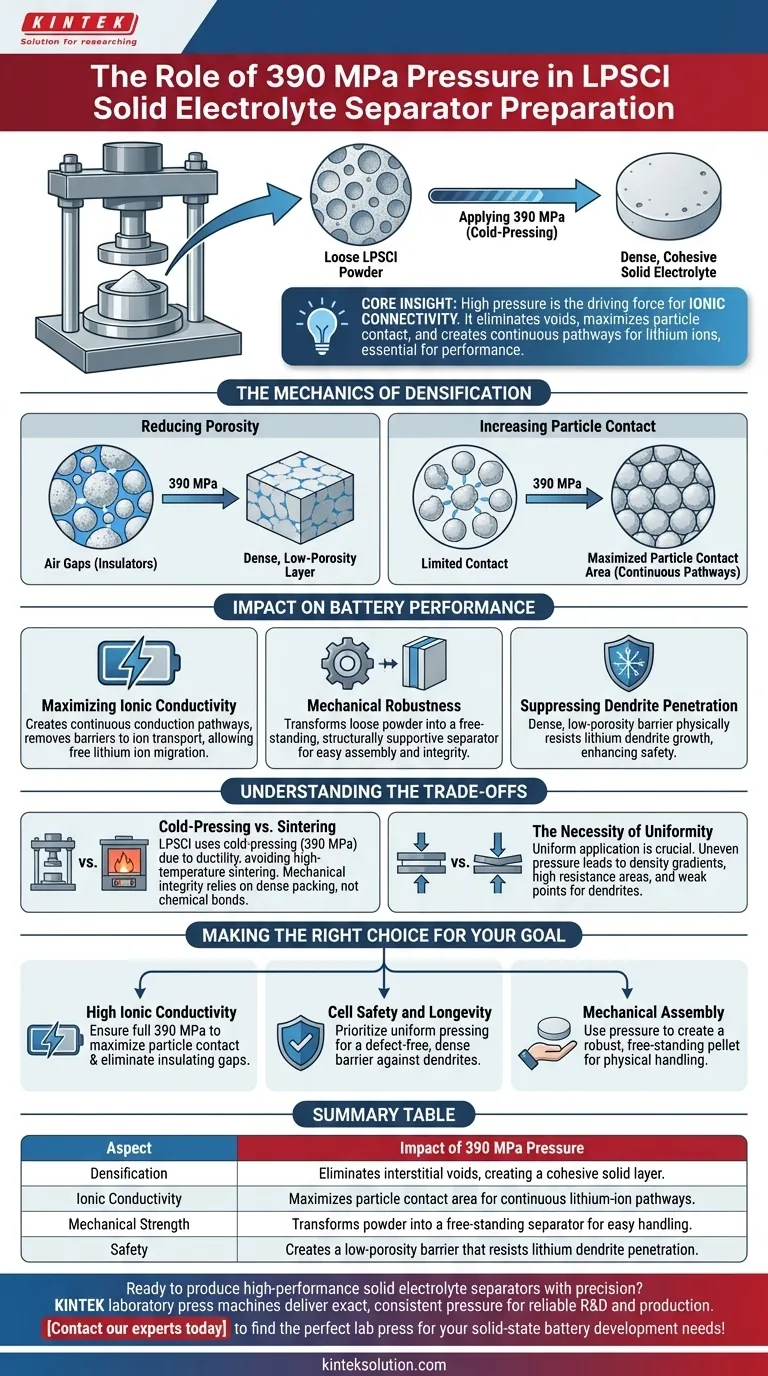
The Core Insight High pressure is not merely for shaping the pellet; it is the driving force for ionic connectivity. By crushing the pores and maximizing the contact area between particles, you create the continuous pathways required for lithium ions to move efficiently, a state that cannot be achieved with loose packing.
The Mechanics of Densification
Reducing Porosity
The primary function of applying 390 MPa is the significant reduction of interstitial voids. In its raw state, LPSCl powder contains air gaps that act as insulators, blocking the flow of ions.
High uniaxial pressure forces the particles together, collapsing these pores. This results in a dense, low-porosity layer that mimics the properties of a continuous solid material.
Increasing Particle Contact
For a solid electrolyte to function, lithium ions must move from one particle to the next. This requires physical contact.
The pressure creates a massive increase in the contact area among particles. This ensures that the electrolyte particles are not just touching, but are tightly packed against one another, minimizing the resistance at grain boundaries.
Impact on Battery Performance
Maximizing Ionic Conductivity
Conductivity is directly linked to the density achieved during pressing. The structural improvements gained at 390 MPa create continuous conduction pathways.
By removing the physical gaps, you remove the barriers to ion transport. This allows the lithium ions to migrate freely through the separator, which is essential for the overall efficiency of the battery.
Mechanical Robustness
A separator must act as a structural support component within the battery cell. The cold-pressing technique transforms loose powder into a free-standing separator.
This mechanical strength is vital for handling the separator during cell assembly. It also ensures the layer maintains its integrity during the operation of the battery.
Suppressing Dendrite Penetration
A critical safety function of the solid electrolyte is preventing short circuits caused by lithium dendrites.
A highly densified, low-porosity electrolyte physically resists the growth of these dendrites. By eliminating the voids that dendrites typically grow through, the separator acts as a physical barrier, enhancing the safety of the cell.
Understanding the Trade-offs
Cold-Pressing vs. Sintering
It is important to recognize that LPSCl relies on cold-pressing due to its material properties. Unlike oxide electrolytes (like LGVO) which may require heat and sintering to form phases, sulfide electrolytes like LPSCl are generally more ductile.
This ductility allows them to densify effectively under high pressure alone (390 MPa) without the need for high-temperature sintering. However, this means the mechanical integrity is entirely dependent on the maintenance of this dense packed structure, rather than chemical bonding formed during heat treatment.
The Necessity of Uniformity
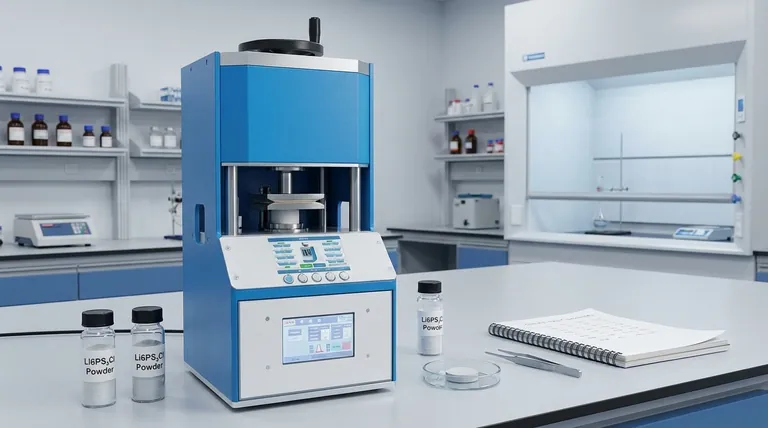
While high pressure is required, the application must be uniform. Reference data indicates that a laboratory hydraulic press is used to apply this pressure uniaxially.
If pressure is applied unevenly, density gradients can occur. This would lead to localized areas of high resistance or weak points where dendrites could easily penetrate, undermining the purpose of the high-pressure step.
Making the Right Choice for Your Goal
To maximize the effectiveness of your LPSCl separator preparation, consider your primary objective:
- If your primary focus is High Ionic Conductivity: Ensure you reach the full 390 MPa target to maximize particle-to-particle contact and eliminate insulating air gaps.
- If your primary focus is Cell Safety and Longevity: Prioritize the uniformity of the pressing to create a defect-free, dense barrier that resists lithium dendrite penetration.
- If your primary focus is Mechanical Assembly: Use this pressure to create a robust, free-standing pellet that can withstand the physical handling required during battery construction.
Ultimately, the application of 390 MPa is the defining step that converts LPSCl from a loose powder into a conductive, structural component capable of powering a solid-state battery.
Summary Table:
| Aspect | Impact of 390 MPa Pressure |
|---|---|
| Densification | Eliminates interstitial voids, creating a cohesive solid layer. |
| Ionic Conductivity | Maximizes particle contact area for continuous lithium-ion pathways. |
| Mechanical Strength | Transforms powder into a free-standing separator for easy handling. |
| Safety | Creates a low-porosity barrier that resists lithium dendrite penetration. |
Ready to produce high-performance solid electrolyte separators with precision?
Achieving the critical 390 MPa pressure uniformly is essential for maximizing the ionic conductivity and safety of your Li6PS5Cl-based solid-state batteries. KINTEK specializes in laboratory press machines, including automatic and heated lab presses, designed to deliver the exact, consistent pressure required for reliable R&D and production.
Our robust and easy-to-use presses ensure you can create defect-free, dense separators that are crucial for your battery's performance and longevity.
Contact our experts today to find the perfect lab press for your solid-state battery development needs!
Visual Guide
References
- Jaka Šivavec, Kostiantyn V. Kravchyk. On the Feasibility of Pairing Pyrochlore Iron(III) Hydroxy Fluoride Cathode with Argyrodite Li<sub>6</sub>PS<sub>5</sub>Cl Solid‐State Electrolyte for Low‐Cost All‐Solid‐State Batteries. DOI: 10.1002/batt.202400731
This article is also based on technical information from Kintek Solution Knowledge Base .
Related Products
- Warm Isostatic Press for Solid State Battery Research Warm Isostatic Press
- Laboratory Hydraulic Split Electric Lab Pellet Press
- Lab Cylindrical Press Mold for Laboratory Use
- Manual Laboratory Hydraulic Press Lab Pellet Press
- Lab Round Bidirectional Press Mold
People Also Ask
- Why must composite cathodes be sealed in vacuum lamination bags for WIP? Ensure Battery Stability and Density
- What is the function of elastic molds in warm isostatic pressing? Achieve Uniform Density in Composite Particles
- How do sacrificial volume materials (SVM) maintain microchannels in isostatic pressing? Ensure Structural Integrity
- What is the process involved in warm isostatic pressing? Mastering Uniform Density with WIP Technology
- How does Warm Isostatic Pressing differ from traditional pressing methods? Unlock Uniform Density for Complex Parts



















