
The primary purpose of applying stable pressure in all-solid-state batteries is to overcome the physical rigidity of the components to establish a functional electrochemical interface. Unlike liquid electrolytes which naturally "wet" electrode surfaces, solid-state materials require continuous external force—often ranging from 0.1 MPa to 80 MPa—to maintain intimate physical contact, minimize interfacial resistance, and mechanically sustain the cell structure during the volumetric changes caused by cycling.
Core Takeaway Solid-state batteries face a fundamental mechanical challenge: rigid solids do not naturally maintain continuous contact with one another. Stable pressure acts as a critical binding agent, forcing electrode and electrolyte particles together to ensure ion transport and preventing the battery from physically tearing itself apart during charge and discharge cycles.
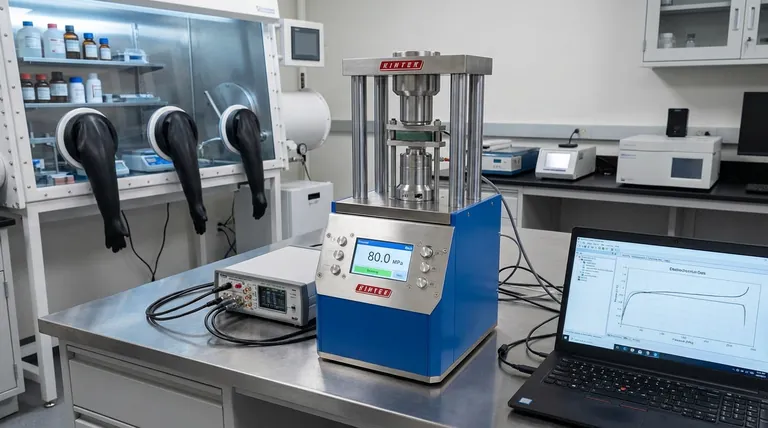
Overcoming Interfacial Resistance
Bridging Rigid Interfaces
The internal environment of an all-solid-state battery consists of rigid solid-solid interfaces. Without external intervention, these rigid particles create gaps and voids.
Applying high external pressure forces the particles of the cathode, solid-state electrolyte, and anode into intimate, continuous physical contact. This is the only way to establish the necessary pathways for ions to move between layers.
Minimizing Impedance
The direct result of improved physical contact is a significant reduction in interfacial resistance.
If the pressure is insufficient, the contact area between particles decreases, hindering the smooth transport of lithium ions. High, stable pressure ensures that the impedance remains low, allowing the battery to function efficiently.
Managing Volumetric Changes and Mechanical Stability
Counteracting Expansion and Contraction
During charge and discharge cycles, electrode materials (such as Nb2O5 or lithium metal) undergo significant volumetric changes. They expand and contract as ions are inserted and extracted.
A controlled stack pressure—often achieved using in-situ compression setups—accommodates these fluctuations. It acts as a mechanical stabilizer, ensuring the stack remains intact despite the "breathing" of the materials.
Preventing Delamination and Cracks
Without maintained pressure, the volume changes described above would lead to interface delamination. The layers would physically separate, breaking the ionic circuit.
Precise pressure helps suppress this separation and minimizes the formation of cracks and voids within the material, which are primary causes of capacity fading and battery failure.
Inducing Lithium Creep
In systems using lithium metal anodes, pressure serves a unique, active role. Appropriate pressure induces creep in the lithium metal.
This allows the lithium to mechanically flow and actively fill interfacial voids. This reduces the risk of dendrite penetration and ensures a more uniform current distribution, which is vital for improving critical current density and cycle life.
Ensuring Data Reliability and Reproducibility
Eliminating Variable Contact
For researchers, the consistency of the applied pressure is just as important as the magnitude. Variations in pressure lead to variations in interfacial contact quality.
By maintaining a consistent forming pressure (e.g., using a hydraulic press), researchers ensure that the contact area is identical from one cell to the next.
Obtaining Authentic Data
Variable pressure results in erratic electrochemical data. To evaluate material properties accurately—such as impedance spectra and cycling performance—the pressure must be constant.
This consistency eliminates mechanical variables, allowing researchers to obtain reproducible and authentic data regarding the chemistry of the battery materials themselves.
Understanding the Trade-offs
The Requirement for Specialized Hardware
Maintaining these high pressures (up to 80 MPa) introduces significant engineering constraints. It requires specialized cell holders and plungers that can withstand high stress without deforming or reacting chemically.
For example, titanium rods are often required as pressure plungers because they possess the necessary hardness and chemical stability, particularly against corrosive sulfide-based electrolytes. Standard materials may corrode or bend, leading to pressure loss and test failure.
The Complexity of Simulation
While high pressure is beneficial in a lab setting to achieve perfect contact, it can be difficult to replicate in commercial packaging.
Researchers must use equipment with precise pressure control to simulate realistic battery packaging conditions. Relying solely on massive hydraulic pressures may yield performance data that is unattainable in a practical, mass-market device.
Making the Right Choice for Your Goal
Whether you are designing a commercial cell or characterizing a new material, the application of pressure must be deliberate.
- If your primary focus is Fundamental Material Characterization: Maintain a highly consistent, reproducible pressure across all samples to ensure that any variation in performance is due to chemistry, not mechanical inconsistencies.
- If your primary focus is Cycle Life and Longevity: Utilize a pressure system capable of dynamic accommodation (active load) to suppress dendrites and prevent delamination during repeated volumetric expansion and contraction.
- If your primary focus is Anode-Free Architectures: Apply sufficient pressure to ensure the newly formed lithium layer maintains contact with the electrolyte, preventing void formation during stripping.
Ultimately, pressure in solid-state batteries is not just a variable; it is a structural component that dictates the efficiency, stability, and lifespan of the interface.
Summary Table:
| Purpose of Stable Pressure | Key Benefit |
|---|---|
| Overcoming Interfacial Resistance | Establishes ion transport pathways, reduces impedance |
| Managing Volumetric Changes | Prevents delamination and cracks during cycling |
| Ensuring Data Reproducibility | Provides consistent contact for reliable electrochemical testing |
| Inducing Lithium Creep (Li-metal anodes) | Improves critical current density and cycle life |
Achieve precise, stable pressure for your solid-state battery R&D with KINTEK's lab press machines.
Whether you are characterizing new materials, testing cycle life, or developing anode-free architectures, our automatic lab presses, isostatic presses, and heated lab presses deliver the consistent, high-pressure control (up to 80 MPa) required to:
- Minimize interfacial resistance and ensure reliable ion transport
- Accommodate volumetric changes and prevent mechanical failure
- Obtain reproducible data for accurate material analysis
Don’t let mechanical inconsistencies compromise your research. Contact us today to discuss how our specialized lab press solutions can support your laboratory’s specific needs.
Get in touch with our experts now!
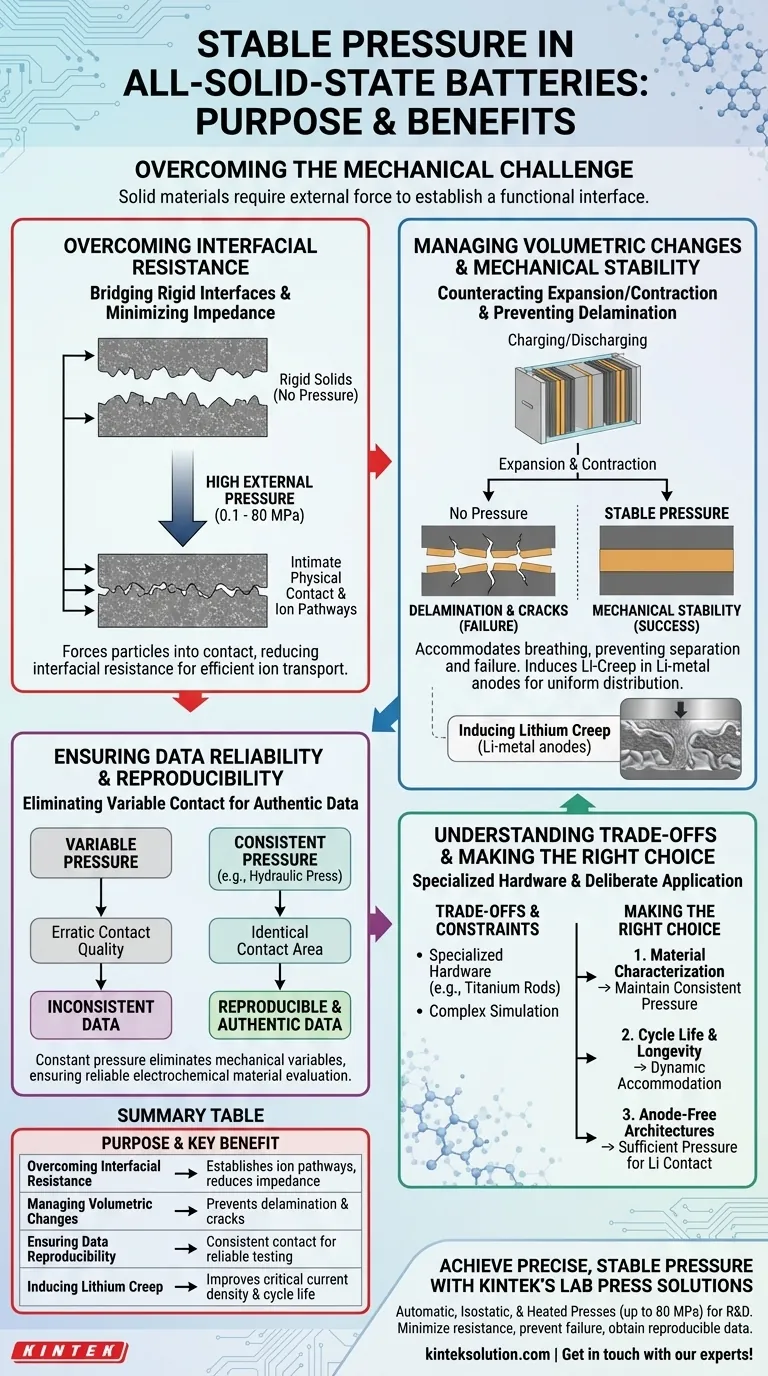
Visual Guide
Related Products
- Warm Isostatic Press for Solid State Battery Research Warm Isostatic Press
- Lab Button Battery Tablet Press Sealing Mold
- Button Battery Sealing Press Machine for Lab
- Laboratory Hydraulic Press Lab Pellet Press Button Battery Press
- Carbide Lab Press Mold for Laboratory Sample Preparation
People Also Ask
- Why must composite cathodes be sealed in vacuum lamination bags for WIP? Ensure Battery Stability and Density
- How do sacrificial volume materials (SVM) maintain microchannels in isostatic pressing? Ensure Structural Integrity
- What is the function of elastic molds in warm isostatic pressing? Achieve Uniform Density in Composite Particles
- What is the process involved in warm isostatic pressing? Mastering Uniform Density with WIP Technology
- What is the function of hydraulic pressure in warm isostatic pressing? Achieve Uniform Material Density








