Knowledge What is the purpose of applying high mechanical pressure, such as 100 MPa, during the sintering of ceramic powders in an SPS system? Achieve Rapid, High-Density Sintering
Author avatar

Tech Team · Kintek Press

Updated 3 days ago

What is the purpose of applying high mechanical pressure, such as 100 MPa, during the sintering of ceramic powders in an SPS system? Achieve Rapid, High-Density Sintering


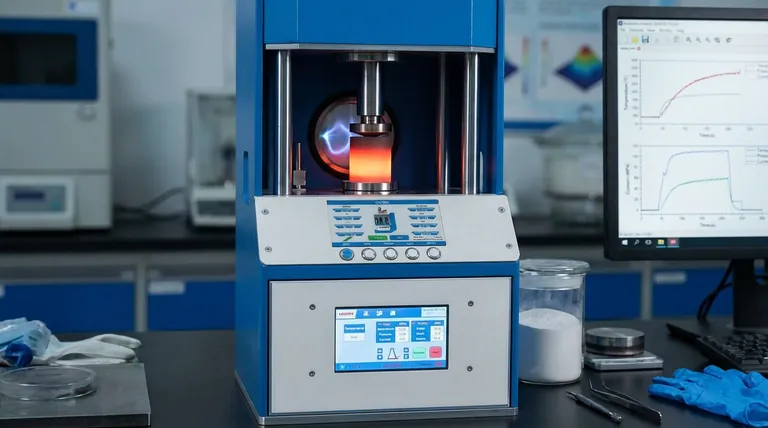
Applying high mechanical pressure serves as a primary driving force for the rapid densification of ceramic powders in Spark Plasma Sintering (SPS). When you apply pressures such as 100 MPa, you mechanically force precursor particles into intimate contact, accelerating solid-state reactions and physically expelling voids. This mechanical energy works in synergy with thermal energy, allowing you to achieve fully dense materials at lower temperatures and in significantly shorter timeframes.

Core Takeaway Pressure in SPS is not merely for containment; it is an active processing parameter that lowers the thermal energy required for densification. By mechanically overcoming sintering resistance, high pressure enables the creation of high-density nanoceramics while minimizing the grain growth associated with prolonged high-heat exposure.
What is the purpose of applying high mechanical pressure, such as 100 MPa, during the sintering of ceramic powders in an SPS system? Achieve Rapid, High-Density Sintering

The Mechanisms of Pressure-Driven Densification

To understand why 100 MPa changes the outcome of your sintering process, you must look at how it alters the behavior of the powder at the microscopic level.

Enhancing Particle Contact

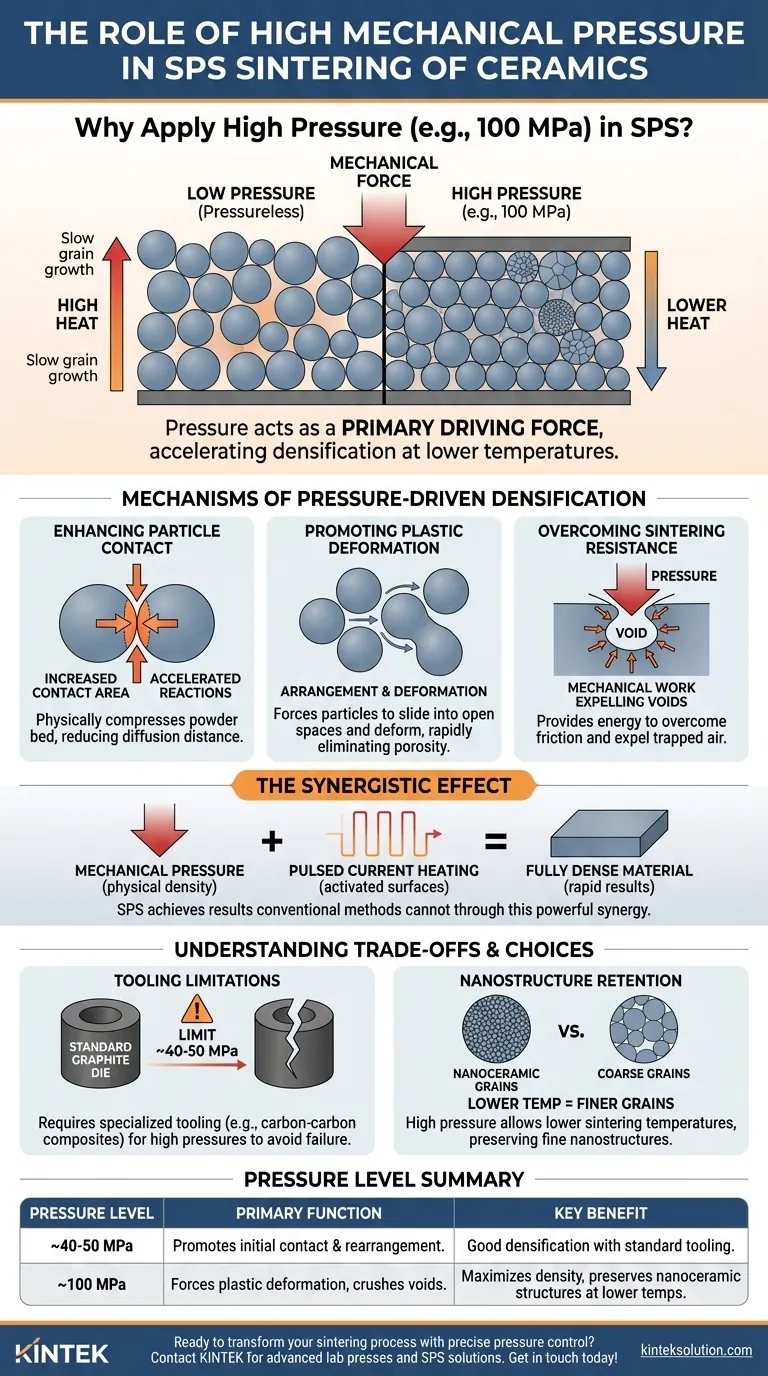
High pressure physically compresses the powder bed, significantly increasing the contact area between individual particles.

This intimate contact is essential for solid-state reactions. By reducing the distance atoms must diffuse, you effectively accelerate the reaction rate.

Promoting Plastic Deformation

Under high pressure (such as 37.5–50 MPa or higher), powder particles undergo plastic deformation and rearrangement during the heating phase.

Rather than waiting for slow diffusion processes to move material, the pressure forces particles to slide into open spaces and deform to fit against their neighbors. This mechanical action rapidly eliminates porosity.

Overcoming Sintering Resistance

Ceramic powders naturally resist densification due to friction and inter-particle forces.

Applying 100 MPa provides the mechanical work needed to overcome this sintering resistance. It actively expels voids (air pockets) that would otherwise remain trapped in the material.

The Synergistic Effect

The true power of SPS lies in the synergy between this mechanical pressure and the pulsed current heating.

The pressure creates the physical density, while the rapid heating activates the particle surfaces. This combination is the fundamental reason SPS achieves results that conventional pressureless sintering cannot.

Understanding the Trade-offs

While high pressure is beneficial, it introduces specific engineering constraints that you must manage.

Tooling Limitations

Standard high-density graphite dies typically tolerate pressures up to roughly 40-50 MPa.

To utilize 100 MPa, you generally require specialized tooling, such as carbon-carbon composites or silicon carbide dies. Exceeding the mechanical limit of your tooling will result in catastrophic die failure.

Nanostructure Retention vs. Stress

The advantage of high pressure is that it allows for lower sintering temperatures.

By relying on pressure rather than excessive heat to achieve density, you avoid rapid grain growth. This is critical for fabricating nanoceramics, where maintaining a fine grain structure is the priority.

Making the Right Choice for Your Goal

The level of pressure you apply should be dictated by the specific material properties you are trying to engineer.

  • If your primary focus is Maximum Density: Apply the highest pressure your tooling can safely withstand (e.g., 100 MPa) to mechanically crush voids and maximize particle packing.
  • If your primary focus is Nanostructure Preservation: Use high pressure to offset the need for high thermal energy, allowing you to sinter at lower temperatures and prevent grain coarsening.

Leveraging high pressure transforms the sintering process from a thermal challenge into a controlled, mechanical shaping of material properties.

Summary Table:

Pressure Level Primary Function Key Benefit
~40-50 MPa Standard graphite die limit; promotes initial particle contact and rearrangement. Good densification with standard tooling.
~100 MPa Forces plastic deformation, crushes voids, and overcomes sintering resistance. Maximizes density and enables lower-temperature sintering to preserve nanoceramic structures.

Ready to transform your ceramic sintering process with precise pressure control? KINTEK specializes in advanced lab press machines, including automatic and heated lab presses ideal for SPS research. Our equipment delivers the reliable, high-pressure performance you need to achieve full densification and nanostructure preservation. Contact us today to discuss how our solutions can enhance your laboratory's capabilities and accelerate your material development. Get in touch via our contact form!

Visual Guide
What is the purpose of applying high mechanical pressure, such as 100 MPa, during the sintering of ceramic powders in an SPS system? Achieve Rapid, High-Density Sintering Visual Guide

Related Products

People Also Ask

Related Products

Automatic High Temperature Heated Hydraulic Press Machine with Heated Plates for Lab

Automatic High Temperature Heated Hydraulic Press Machine with Heated Plates for Lab

KINTEK High Temperature Hot Press: Precision sintering & material processing for labs. Achieve extreme temperatures & consistent results. Custom solutions available.

Automatic Heated Hydraulic Press Machine with Hot Plates for Laboratory

Automatic Heated Hydraulic Press Machine with Hot Plates for Laboratory

KINTEK Automatic Lab Heat Press: Precision heating, programmable control, and rapid cooling for efficient sample preparation. Enhance lab productivity today!

24T 30T 60T Heated Hydraulic Lab Press Machine with Hot Plates for Laboratory

24T 30T 60T Heated Hydraulic Lab Press Machine with Hot Plates for Laboratory

High-quality hydraulic lab presses for precise sample preparation. Choose automatic or heated models for material research, pharmacy, and more. Get a quote now!

Heated Hydraulic Press Machine with Heated Plates for Vacuum Box Laboratory Hot Press

Heated Hydraulic Press Machine with Heated Plates for Vacuum Box Laboratory Hot Press

KINTEK Heated Hydraulic Lab Press with Vacuum Box ensures precise sample preparation. Compact, durable, and featuring digital pressure control for superior results.

Laboratory Split Manual Heated Hydraulic Press Machine with Hot Plates

Laboratory Split Manual Heated Hydraulic Press Machine with Hot Plates

Boost lab efficiency with KINTEK's heated lab presses—precise temperature control, durable design, and rapid cooling for consistent results. Explore now!

Automatic Heated Hydraulic Press Machine with Heated Plates for Laboratory

Automatic Heated Hydraulic Press Machine with Heated Plates for Laboratory

KINTEK Automatic Heated Hydraulic Lab Press: Precision heating, uniform pressure, and automated control for superior sample processing. Ideal for labs and research. Contact us today!

Manual Heated Hydraulic Lab Press with Integrated Hot Plates Hydraulic Press Machine

Manual Heated Hydraulic Lab Press with Integrated Hot Plates Hydraulic Press Machine

KINTEK's precision lab presses offer efficient, high-temperature sample prep for material research, pharmacy, and ceramics. Explore models now!

Split Automatic Heated Hydraulic Press Machine with Heated Plates

Split Automatic Heated Hydraulic Press Machine with Heated Plates

KINTEK Split Automatic Heated Lab Press: Precision hydraulic press with 300°C heating for efficient sample preparation. Ideal for research labs.

Heated Hydraulic Press Machine With Heated Plates For Vacuum Box Laboratory Hot Press

Heated Hydraulic Press Machine With Heated Plates For Vacuum Box Laboratory Hot Press

Enhance lab precision with KINTEK's Heated Vacuum Lab Press for uniform, oxidation-free samples. Ideal for sensitive materials. Get expert advice now!

Laboratory Manual Heated Hydraulic Press Machine with Hot Plates

Laboratory Manual Heated Hydraulic Press Machine with Hot Plates

KINTEK's Manual Hot Press delivers precise material processing with controlled heat and pressure. Ideal for labs needing reliable bonds and high-quality samples. Contact us today!

Lab Heat Press Special Mold

Lab Heat Press Special Mold

Precision KINTEK lab press molds for reliable sample prep. Durable, customizable, and ideal for diverse research needs. Enhance your lab's efficiency today!

Cylindrical Lab Electric Heating Press Mold for Laboratory Use

Cylindrical Lab Electric Heating Press Mold for Laboratory Use

KINTEK's Cylindrical Electric Heating Press Mold offers rapid heating (up to 500°C), precise control, and customizable sizes for lab sample preparation. Ideal for battery, ceramic, and material research.

Laboratory Hydraulic Press Lab Pellet Press Button Battery Press

Laboratory Hydraulic Press Lab Pellet Press Button Battery Press

KINTEK Lab Press Machines: Precision hydraulic presses for material research, pharmacy, and electronics. Compact, durable, and low maintenance. Get expert advice today!

Automatic Laboratory Hydraulic Press for XRF and KBR Pellet Pressing

Automatic Laboratory Hydraulic Press for XRF and KBR Pellet Pressing

KinTek XRF Pellet Press: Automated sample prep for precise XRF/IR analysis. High-quality pellets, programmable pressure, durable design. Boost lab efficiency today!

Laboratory Hydraulic Split Electric Lab Pellet Press

Laboratory Hydraulic Split Electric Lab Pellet Press

KINTEK Split Electric Lab Press: Precision sample preparation for research. Compact, versatile, with advanced pressure control. Ideal for material studies.

Laboratory Hydraulic Press 2T Lab Pellet Press for KBR FTIR

Laboratory Hydraulic Press 2T Lab Pellet Press for KBR FTIR

KINTEK 2T Lab Hydraulic Press for precise FTIR sample prep, durable KBr pellet creation, and versatile material testing. Ideal for research labs.

Laboratory Hydraulic Press Lab Pellet Press Machine for Glove Box

Laboratory Hydraulic Press Lab Pellet Press Machine for Glove Box

Precision lab press for glove boxes: Compact, leak-proof design with digital pressure control. Ideal for inert atmosphere material processing. Explore now!

Manual Laboratory Hydraulic Press Lab Pellet Press

Manual Laboratory Hydraulic Press Lab Pellet Press

KINTEK's Protective Manual Lab Hydraulic Press ensures safe, precise sample preparation with durable construction, versatile applications, and advanced safety features. Ideal for labs.

Manual Laboratory Hydraulic Pellet Press Lab Hydraulic Press

Manual Laboratory Hydraulic Pellet Press Lab Hydraulic Press

Boost lab efficiency with KINTEK's precision hydraulic presses—compact, leak-proof, and ideal for spectroscopy. Custom solutions available.

Assemble Lab Cylindrical Press Mold for Laboratory Use

Assemble Lab Cylindrical Press Mold for Laboratory Use

Premium lab cylindrical press mold for flawless sample prep. Prevents delamination, ultra-durable Japanese steel. Custom sizes available. Get yours now!


Leave Your Message













