
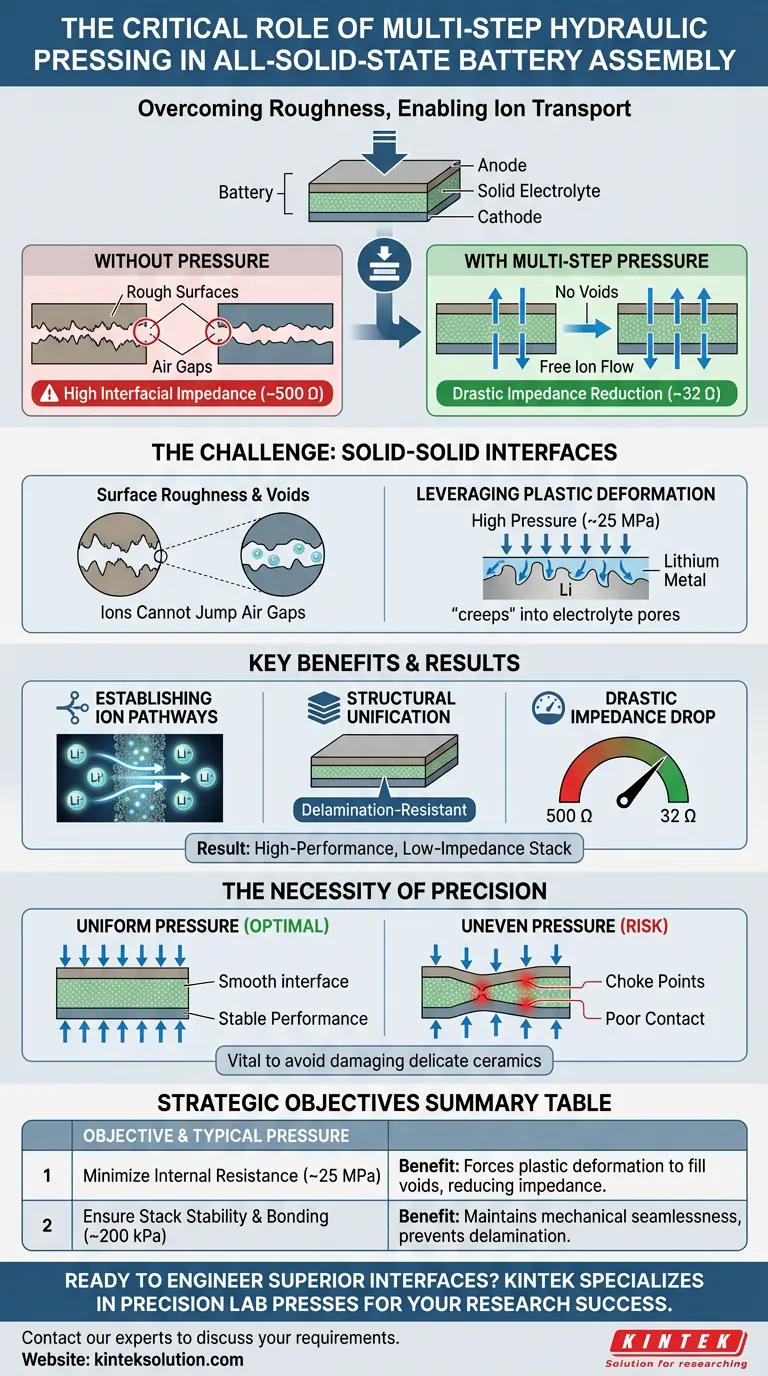
The primary purpose of applying multi-step, precisely controlled pressure is to force the solid electrolyte, cathode, and anode layers into intimate, void-free contact. This mechanical compaction is essential to overcome the inherent roughness of solid materials, minimizing interfacial impedance and creating a continuous pathway for efficient ion transport.
Solid-state batteries lack the liquid electrolytes that naturally "wet" surfaces to create connections; therefore, external mechanical pressure is the critical substitute. By leveraging material plasticity to eliminate microscopic voids, this process can reduce interfacial resistance by an order of magnitude, transforming a non-functional stack into a high-performance battery.
The Challenge of Solid-Solid Interfaces
Overcoming Surface Roughness
Unlike liquid batteries, where the electrolyte flows into every pore, solid-state components have microscopic surface irregularities.
Without pressure, these rough surfaces touch only at high points, leaving significant gaps.
A hydraulic press applies the force necessary to compact these layers, densifying the material and maximizing the active contact area.
Leveraging Plastic Deformation
To achieve a true bond, the materials must physically deform to fill the voids.
For example, applying high pressure (such as 25 MPa) leverages the plastic nature of materials like lithium metal.
This causes the lithium to "creep," flowing into the microscopic pores of the solid electrolyte to create a dense, physically seamless interface.
Drastic Reduction in Impedance
The direct result of this physical deformation is a massive drop in electrical resistance.
Data indicates that proper pressurization can reduce interfacial impedance from over 500 Ω down to approximately 32 Ω.
This reduction is a fundamental prerequisite for the battery to function efficiently.
Mechanical Integrity and Ion Transport
Establishing Ion Pathways
Ions cannot jump across air gaps; they require a continuous solid medium to travel between the anode and cathode.
The multi-step pressing process eliminates these gaps, ensuring a low-impedance solid-solid interface.
This allows for the rapid and stable transport of ions required for charging and discharging.
Structural Unification
Beyond electrical performance, the press ensures the mechanical integrity of the stack.
By compacting the composite cathode, electrolyte, and anode into a single unit, the layers are bonded together.
Uniform pressure (e.g., 200 kPa) helps maintain this bond, preventing delamination during handling or operation.
Understanding the Necessity of Precision
The Risk of Inadequate Contact
If the applied pressure is insufficient or uneven, the interface will remain porous.
This leads to "choke points" where ion current is concentrated, causing high resistance and poor performance.
The Importance of Uniformity
Using a hydraulic press with a mold ensures the pressure is applied uniformly across the entire surface area.
Uneven pressure can create localized hotspots or areas of poor contact, compromising the overall stability of the battery.
Precision control is vital to apply enough force to induce plasticity without damaging the structural integrity of delicate ceramic electrolytes.
Making the Right Choice for Your Goal
To optimize your solid-state battery assembly, align your pressing strategy with your specific objective:
- If your primary focus is minimizing internal resistance: Utilize higher pressures (e.g., 25 MPa) initially to force plastic deformation of the lithium metal, filling surface voids completely.
- If your primary focus is stack stability and bonding: Apply a consistent, uniform pressure (e.g., 200 kPa) to maintain the mechanical seamlessness of the layers without over-compressing the assembly.
Ultimately, the hydraulic press is not just an assembly tool, but an active instrument for engineering the microscopic landscape of the battery interface.
Summary Table:
| Pressing Objective | Key Benefit | Typical Pressure Range |
|---|---|---|
| Minimize Internal Resistance | Forces plastic deformation (e.g., of Li metal) to fill voids, drastically reducing impedance. | ~25 MPa |
| Ensure Stack Stability & Bonding | Creates a mechanically unified, delamination-resistant stack by maintaining uniform contact. | ~200 kPa |
Ready to Engineer Superior Solid-State Battery Interfaces?
The precise mechanical compaction described is critical for your research success. KINTEK specializes in the laboratory hydraulic presses needed to achieve this level of control. Our automatic lab presses, isostatic presses, and heated lab presses are engineered to deliver the multi-step, uniform pressure essential for creating high-performance, low-impedance battery stacks.
Let us help you transform your battery assembly process. Contact our experts today to discuss your specific requirements and discover the perfect press for your laboratory's needs.
Visual Guide
Related Products
- Warm Isostatic Press for Solid State Battery Research Warm Isostatic Press
- Laboratory Hydraulic Press Lab Pellet Press Button Battery Press
- 24T 30T 60T Heated Hydraulic Lab Press Machine with Hot Plates for Laboratory
- Laboratory Hydraulic Press 2T Lab Pellet Press for KBR FTIR
- Automatic Laboratory Hydraulic Press for XRF and KBR Pellet Pressing
People Also Ask
- Why must composite cathodes be sealed in vacuum lamination bags for WIP? Ensure Battery Stability and Density
- What is the function of elastic molds in warm isostatic pressing? Achieve Uniform Density in Composite Particles
- How do sacrificial volume materials (SVM) maintain microchannels in isostatic pressing? Ensure Structural Integrity
- What is the mechanism of a Warm Isostatic Press (WIP) on cheese? Master Cold Pasteurization for Superior Safety
- What is the role of the flexible material in warm isostatic pressing? Key to Uniform Density & Precision



















