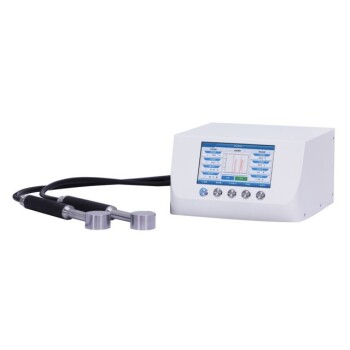
Heating stage equipment serves as a critical mechanism for thermal management after the laser surface texturing of solid-state electrolytes. Its primary function during post-processing is to provide a controlled heat treatment that promotes the physical repair of microstructures damaged by the laser and facilitates the infiltration of subsequent slurry materials.
By applying precise thermal regulation, this equipment ensures the laser-processed surface is structurally sound and receptive to bonding. The ultimate goal is to maximize the physical contact area between the electrolyte and the electrodes, which is essential for efficient battery performance.
The Role of Heat in Post-Process Recovery
The laser texturing process is physically intensive and can alter the microscopic integrity of solid-state electrolytes. Heating stage equipment addresses these changes through two primary mechanisms.
Physical Repair of Microstructures
Laser drilling or etching involves high-energy ablation, which can leave behind local defects or irregularities in the material.
Applying controlled heat immediately following this process acts as an annealing step.
This thermal application promotes the physical repair of local microstructures, smoothing out irregularities and restoring the structural consistency of the electrolyte surface.
Facilitating Slurry Infiltration
After texturing, the electrolyte often requires the application of a slurry to form the final electrode interface.
The heating stage prepares the textured surface to receive this material more effectively.
By maintaining a specific temperature, the equipment promotes subsequent slurry infiltration, ensuring the liquid flows deeply into the laser-created textures before solidifying.
Improving the Physical Contact Area
The combined effect of microstructural repair and improved infiltration leads to a single, critical outcome.
It significantly improves the physical contact area between the solid-state electrolyte and the electrodes.
This maximized contact is vital for reducing interfacial resistance and ensuring efficient ion transport within the battery.
Thermal Management Context
While your question focuses on post-processing, it is important to understand that this equipment often functions throughout the entire manufacturing cycle.
Regulating Light Absorption
During the actual texturing phase, the heating stage provides a stable substrate preheating environment.
This preheating helps regulate the light absorption of the material, ensuring consistent interaction between the laser and the electrolyte.
Alleviating Thermal Stress
Laser processing generates significant, localized heat shocks.
The heating stage maintains a baseline temperature that helps alleviate thermal stress.
This reduces the risk of the electrolyte cracking or warping during and immediately after the high-energy laser impact.
Understanding the Trade-offs
While heating stage equipment is essential for high-quality electrolyte processing, it introduces variables that must be carefully managed.
Precision vs. Thermal Damage
The line between repair and damage is thin. If the controlled heat treatment is too aggressive, it can degrade the electrolyte material rather than repair it. Conversely, insufficient heat will fail to promote the necessary slurry infiltration or microstructural healing.
Process Complexity
Adding a heating stage increases the complexity of the manufacturing setup. It requires precise calibration to synchronize with the laser parameters, adding another layer of variables that must be monitored to prevent batch inconsistencies.
Making the Right Choice for Your Goal
The specific application of heat should be dictated by the primary defect you are trying to resolve in your electrolyte manufacturing process.
- If your primary focus is Structural Integrity: Utilize the heating stage to perform a post-process annealing cycle to heal micro-defects and alleviate stress caused by laser ablation.
- If your primary focus is Interfacial Bonding: Prioritize thermal settings that lower the viscosity of your specific slurry effectively to maximize infiltration into the textured surface.
Ultimately, the heating stage transforms a rough, laser-cut surface into a chemically and mechanically optimized interface ready for high-performance battery integration.
Summary Table:
| Function | Key Benefit | Impact on Battery Performance |
|---|---|---|
| Physical Repair | Heals micro-defects & annealing | Restores structural integrity of the electrolyte |
| Slurry Infiltration | Ensures deep texture penetration | Lowers interfacial resistance between layers |
| Thermal Management | Alleviates laser-induced stress | Prevents material cracking and warping |
| Absorption Control | Regulates light-material interaction | Ensures consistent laser texturing results |
Elevate Your Battery Research with KINTEK
Maximize the performance of your solid-state electrolytes with precision thermal management. KINTEK specializes in comprehensive laboratory pressing and heating solutions, offering a range of manual, automatic, heated, and multifunctional models, as well as specialized cold and warm isostatic presses designed for advanced battery material research.
Whether you are aiming to enhance interfacial bonding or ensure structural integrity after laser texturing, our equipment provides the stability and control your lab requires. Contact KINTEK today to find the perfect solution for your electrolyte processing needs!
References
- Dongfang Yang. Applications of Laser Material Processing for Solid-State Lithium Batteries. DOI: 10.3390/batteries11040128
This article is also based on technical information from Kintek Solution Knowledge Base .
Related Products
- Automatic High Temperature Heated Hydraulic Press Machine with Heated Plates for Lab
- Infrared Heating Quantitative Flat Plate Mold for Precise Temperature Control
- 24T 30T 60T Heated Hydraulic Lab Press Machine with Hot Plates for Laboratory
- Heated Hydraulic Press Machine with Heated Plates for Vacuum Box Laboratory Hot Press
- Lab Double Plate Heating Mold for Laboratory Use
People Also Ask
- Function of a Laboratory Hydraulic Press with Heated Platens in SSE? Enhance Battery Density & Conductivity
- What are the requirements for electrode pressing with high-viscosity ionic liquids like EMIM TFSI? Optimize Performance
- How does a laboratory heated hydraulic press facilitate PBN sample prep for WAXS? Achieve Precise X-Ray Scattering
- What are the industrial applications of heated hydraulic presses? Master Heat & Force for Precision Manufacturing
- Why is a laboratory hydraulic press with heating plates required for PLA/TEC films? Achieve Precise Sample Integrity