
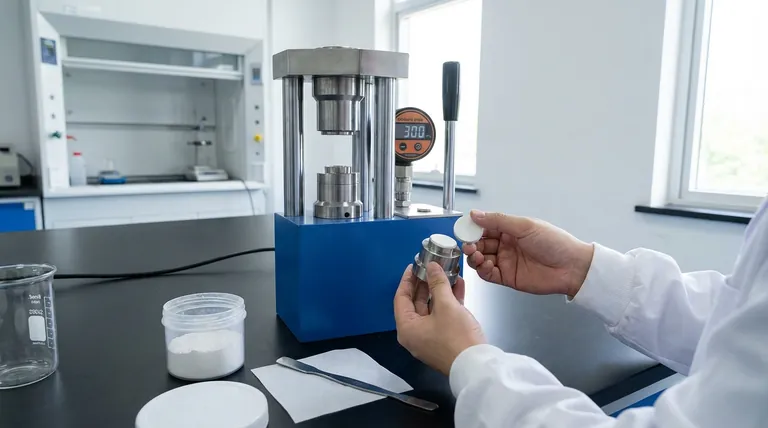
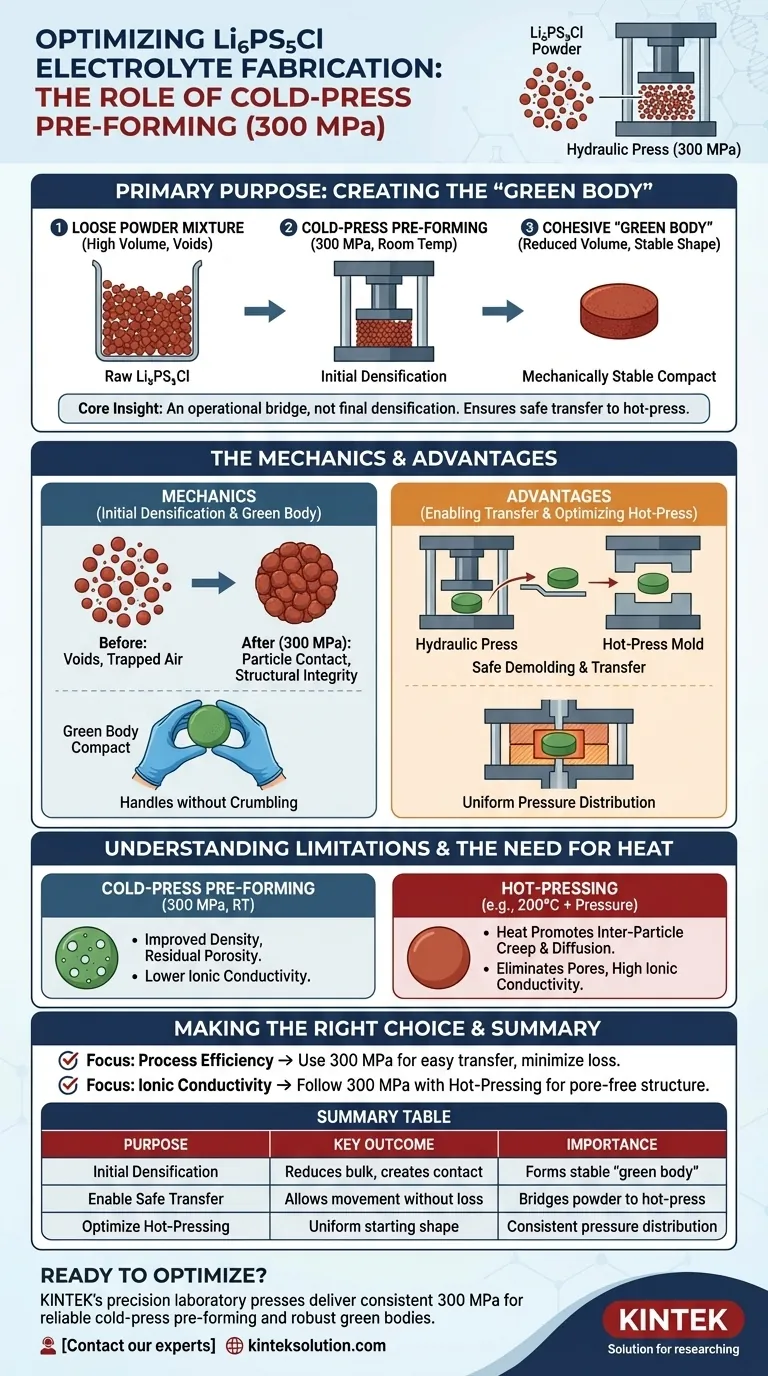
The primary purpose of performing cold-press pre-forming at 300 MPa is to transform the loose, mixed powder of Li6PS5Cl-based electrolytes into a cohesive, manageable shape known as a "green body." This preparatory step densifies the powder and significantly reduces its bulk volume at room temperature. By creating a mechanically stable compact, you enable the safe demolding and transfer of the material into a subsequent hot-press mold without structural disintegration.
Core Insight: Cold-press pre-forming is an operational bridge, not the final densification stage. Its goal is not to achieve maximum ionic conductivity immediately, but to create a robust intermediate structure that ensures the efficiency and success of the subsequent hot-pressing process.
The Mechanics of Pre-Forming
Volume Reduction and Initial Densification
Raw Li6PS5Cl powder mixtures contain a significant amount of void space and trapped air.
Applying 300 MPa of pressure compresses the particles, drastically reducing the bulk volume. This initial densification establishes a baseline particle-to-particle contact necessary for structural integrity.
Creation of the "Green Body"
The result of this process is a green body—a shaped compact that holds its form under its own weight.
While this compact is not yet fully dense, it possesses enough mechanical stability to be handled. This prevents the sample from crumbling or returning to a powder state during processing steps.
Operational Advantages
Enabling Material Transfer
Handling loose powders is imprecise and prone to material loss.
A pre-formed pellet allows for easy demolding and transfer. You can physically move the electrolyte from the initial hydraulic press to the hot-press setup without disturbing the homogeneity of the mixture.
Optimizing the Hot-Press Stage
The pre-forming step ensures a smooth transition to the final sintering or hot-pressing stage.
By entering the hot press as a shaped solid rather than loose powder, the material ensures uniform pressure distribution during the final heating cycle. This contributes to the final membrane's consistency.
Understanding the Limitations
Pre-Forming vs. Final Densification
It is critical to distinguish between the green body created at 300 MPa and the final electrolyte membrane.
While 300 MPa improves density, it does not achieve the pore-free structure required for high ionic conductivity. Cold pressing alone leaves residual porosity that hinders performance.
The Necessity of Heat
Mechanical pressure at room temperature cannot replicate the plasticity induced by heat.
As noted in comparative studies, combining pressure with heat (e.g., 200°C) promotes inter-particle creep and diffusion. This is required to eliminate the pores that remain after the cold-press pre-forming stage.
Making the Right Choice for Your Goal
To maximize the quality of your solid-state electrolyte, you must treat pre-forming as part of a two-step system.
- If your primary focus is Process Efficiency: Utilize the 300 MPa cold-press step to minimize material loss and simplify the transfer of samples between different equipment.
- If your primary focus is Ionic Conductivity: Do not rely on the 300 MPa cold-pressed green body as your final product; you must follow it with hot pressing to eliminate voids and inhibit lithium dendrite growth.
Mastering the pre-forming stage ensures your starting material is mechanically sound enough to withstand the rigors of high-performance fabrication.
Summary Table:
| Purpose | Key Outcome | Importance for Process |
|---|---|---|
| Initial Densification | Reduces bulk volume and creates particle contact. | Forms a mechanically stable compact (green body). |
| Enable Safe Transfer | Allows demolding and movement without material loss. | Bridges the gap between powder mixing and hot-pressing. |
| Optimize Hot-Pressing | Provides a uniform starting shape for final sintering. | Ensures consistent pressure distribution during heating. |
Ready to optimize your solid-state electrolyte fabrication process?
KINTEK's precision laboratory presses, including automatic and heated models, are engineered to deliver the consistent 300 MPa pressure required for reliable cold-press pre-forming. Our equipment ensures you create robust green bodies, streamlining your workflow from powder to final, high-performance membrane.
Contact our experts today to discuss how our lab press solutions can enhance your research efficiency and reproducibility.
Visual Guide
Related Products
- Laboratory Hydraulic Split Electric Lab Pellet Press
- Laboratory Hydraulic Press 2T Lab Pellet Press for KBR FTIR
- Laboratory Hydraulic Pellet Press for XRF KBR FTIR Lab Press
- Laboratory Hydraulic Press Lab Pellet Press Button Battery Press
- Laboratory Hydraulic Press Lab Pellet Press Machine for Glove Box
People Also Ask
- What are the emerging trends in the design and materials of lab pellet presses? Modernize Your Lab Efficiency
- What are common lab pellet press issues? Expert Troubleshooting Guide for Reliable Material Research
- How do lab pellet presses support customization and flexibility? Optimize Your Sample Prep for Any Material
- What are the common operational types of lab pellet presses? Choosing the Right Manual, Automatic, or Hydraulic System
- Why use a laboratory pellet press for solid-state battery evaluation? Ensure Accuracy in Interface Stability Testing



















