
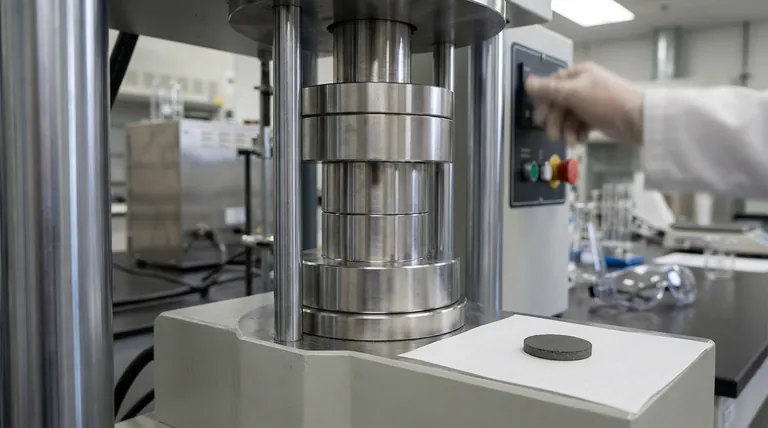
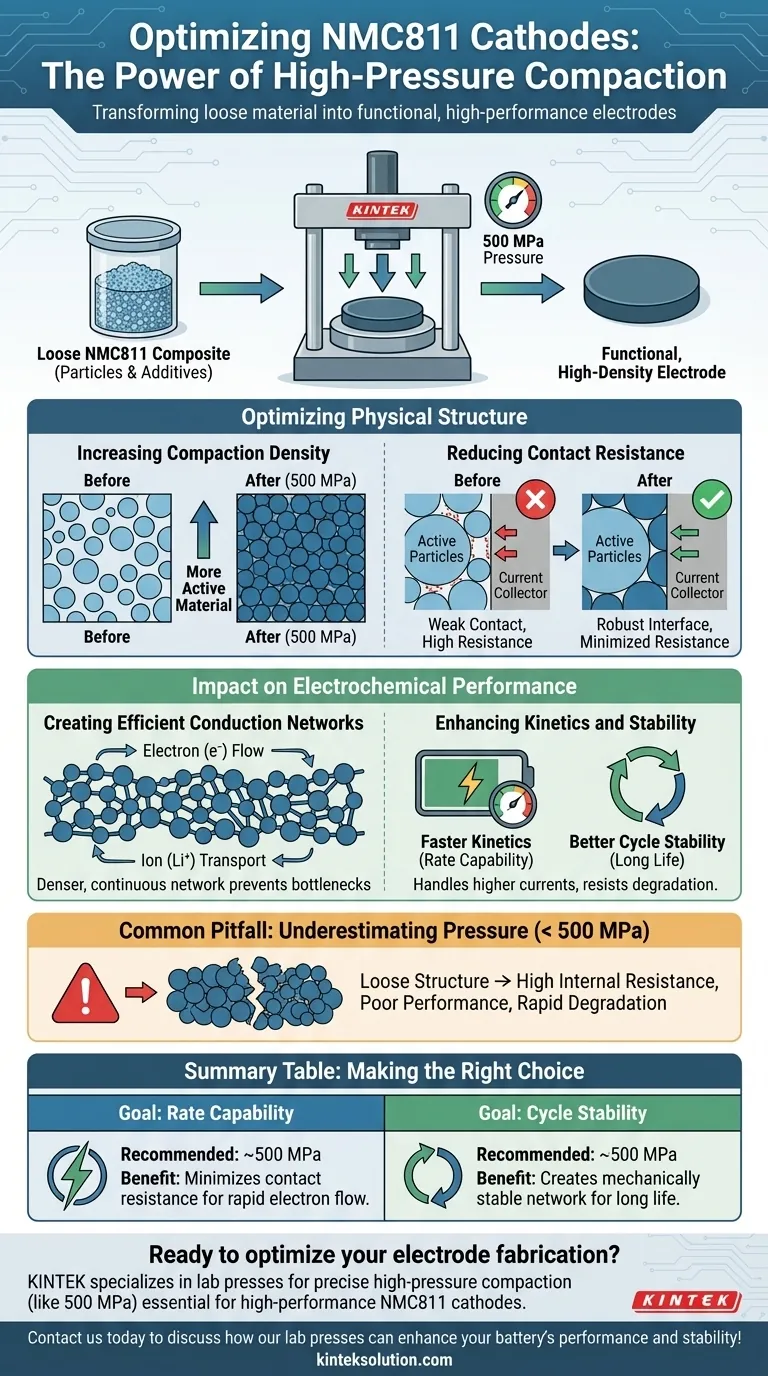
High-pressure compaction is the critical processing step used to transform a loose assembly of materials into a functional, high-performance electrode. By subjecting punched NMC811 composite discs to pressures around 500 MPa, you physically force the active materials and additives into a cohesive, high-density structure.
This process moves beyond simple shaping; it is a fundamental optimization of the electrode's internal architecture. By minimizing empty space and maximizing particle contact, compaction unlocks the material's ability to conduct energy efficiently.
Optimizing the Physical Structure
Increasing Compaction Density
The immediate result of applying 500 MPa of pressure is a significant rise in electrode compaction density.
The lab press eliminates unnecessary void volume within the composite. This packs more active material into the same geometric footprint, which is the baseline requirement for energy-dense cells.
Reducing Contact Resistance
High-pressure treatment addresses the electrical disconnects inherent in loose powders.
It minimizes the contact resistance between the active NMC811 particles and the conductive agents. Furthermore, it ensures a robust interface between the composite mix and the current collector, which is vital for drawing current out of the cell.
Impact on Electrochemical Performance
Creating Efficient Conduction Networks
For a battery to function, electrons and ions must move freely through the cathode.
Compaction creates a denser, more continuous network that supports both electron and ion conduction. This optimized internal contact ensures that the electrochemical reactions are not bottled-necked by poor transport pathways.
Enhancing Kinetics and Stability
The structural improvements gained from compaction directly translate to operational metrics.
The improved network boosts the electrode's kinetic performance and rate capability, allowing it to handle higher currents. Additionally, the mechanical integrity provided by this process contributes to better overall cycle stability over the battery's lifespan.
Common Pitfalls to Avoid
Underestimating the Pressure Requirement
A common error in electrode fabrication is applying insufficient pressure, resulting in a "loose" electrode structure.
If the pressure falls significantly below benchmarks like 500 MPa, the internal contact network remains weak. This leads to high internal resistance, which manifests as poor voltage performance and rapid degradation during cycling.
Making the Right Choice for Your Goal
To maximize the potential of your NMC811 cathodes, align your processing parameters with your performance objectives:
- If your primary focus is Rate Capability: Ensure your compaction pressure is sufficient (around 500 MPa) to minimize contact resistance and allow for rapid electron flow.
- If your primary focus is Cycle Stability: Prioritize uniform compaction to create a mechanically stable network that resists degradation during repeated charge/discharge cycles.
High-pressure compaction is not merely a forming step; it is the bridge between raw material potential and actual battery performance.
Summary Table:
| Goal | Recommended Compaction Pressure | Key Benefit |
|---|---|---|
| Rate Capability | ~500 MPa | Minimizes contact resistance for rapid electron flow. |
| Cycle Stability | ~500 MPa | Creates a mechanically stable network for long life. |
Ready to optimize your electrode fabrication? KINTEK specializes in lab press machines, including automatic and heated lab presses, designed to deliver the precise high-pressure compaction (like 500 MPa) essential for creating high-performance NMC811 cathodes. Our equipment ensures the uniform density and robust internal networks your R&D and production demand. Contact us today to discuss how our lab presses can enhance your battery's performance and stability!
Visual Guide
Related Products
- 24T 30T 60T Heated Hydraulic Lab Press Machine with Hot Plates for Laboratory
- Manual Heated Hydraulic Lab Press with Integrated Hot Plates Hydraulic Press Machine
- Laboratory Hydraulic Pellet Press for XRF KBR FTIR Lab Press
- Lab Infrared Press Mold for Laboratory Applications
- Laboratory Hydraulic Press Lab Pellet Press Machine for Glove Box
People Also Ask
- Function of a Laboratory Hydraulic Press with Heated Platens in SSE? Enhance Battery Density & Conductivity
- Why is a laboratory hydraulic press with heating plates required for PLA/TEC films? Achieve Precise Sample Integrity
- What role does a laboratory heated hydraulic press play in LTCC? Essential for High-Density Ceramic Lamination
- What is the primary function of a laboratory heated hydraulic press? Mastering Thermoplastic Carbon Fiber Composites
- What is the critical role of a laboratory heated hydraulic press? Mastering PVC Sample Prep for Testing



















