
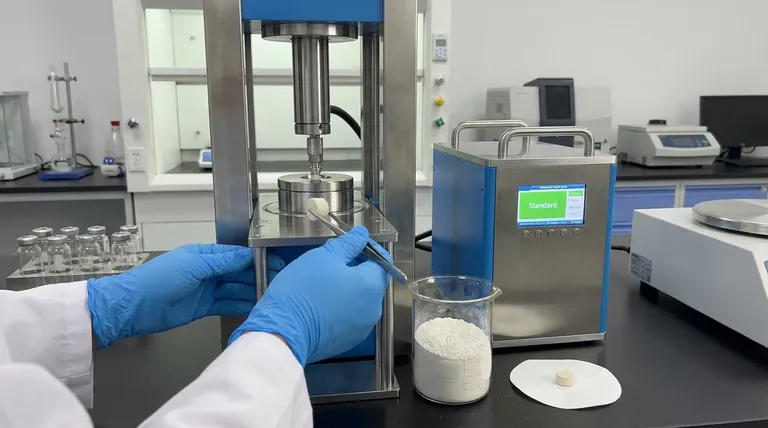
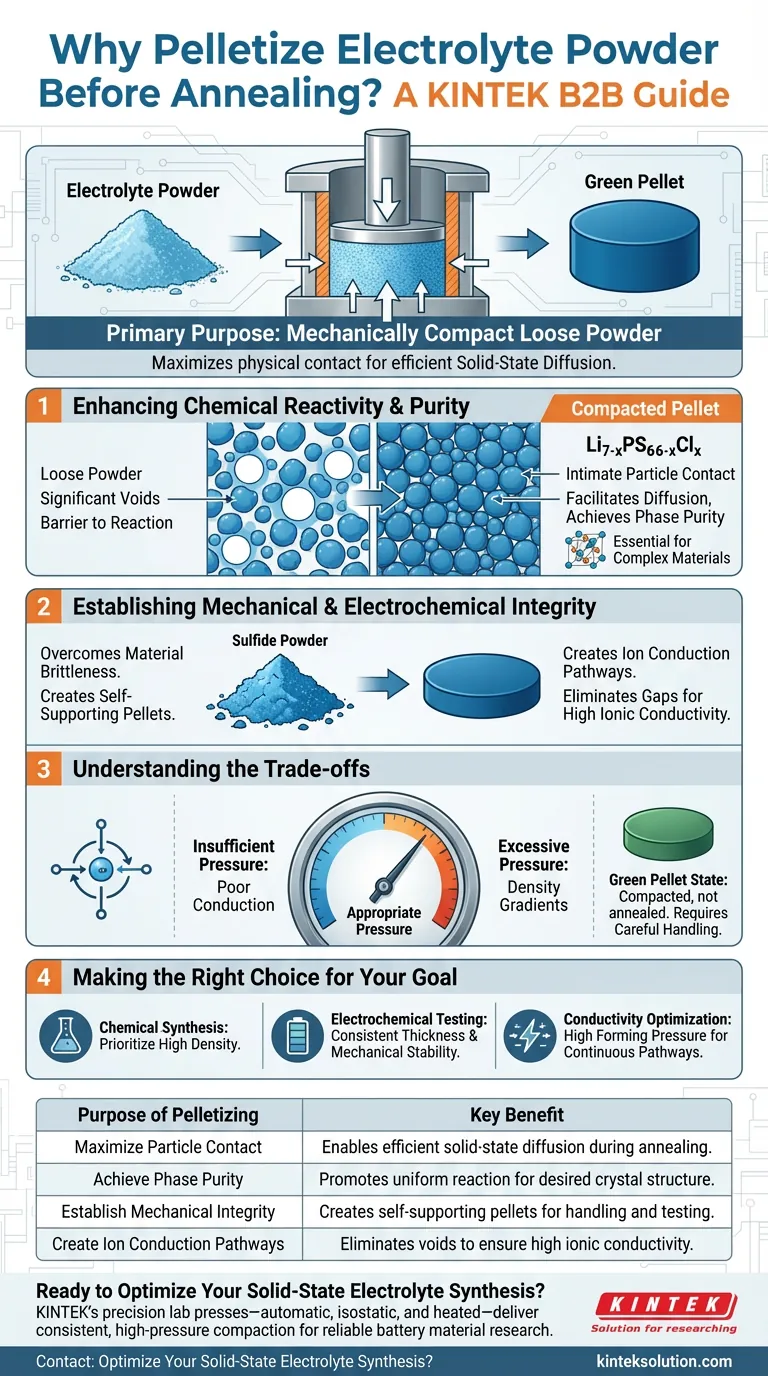
The primary purpose of using a lab press machine in this context is to mechanically compact loose electrolyte powder into a dense, cohesive "green pellet" to maximize physical contact between reactant particles. By eliminating voids and forcing particles into close proximity, the press creates the mandatory conditions for efficient solid-state diffusion during the subsequent high-temperature annealing process.
Pelletizing is not merely a shaping step; it is a critical thermodynamic enabler. Without the high-pressure compaction provided by a lab press, the lack of intimate particle contact prevents the uniform chemical reactions and structural densification required to create a high-performance solid-state electrolyte.
Enhancing Chemical Reactivity and Purity
The most critical function of the lab press is to prepare the material for the chemical changes it will undergo during annealing.
Maximizing Particle Contact
Loose powders naturally contain significant void space, which acts as a barrier to reaction.
Using a lab press ensures intimate physical contact between the reactant particles. This proximity is the fundamental requirement for any solid-state reaction to initiate and propagate effectively.
Facilitating Solid-State Diffusion
Unlike liquid reactions, solid-state synthesis relies on atoms moving physically from one particle to another.
Compaction significantly promotes this solid-state diffusion. By increasing the contact area, you reduce the diffusion distance, allowing the reaction to proceed faster and more completely during heat treatment.
Achieving Phase Purity
A well-compacted pellet leads to a more homogeneous final product.
For complex materials like Li7−xPS6−xClx (argyrodite-type electrolytes), this uniformity is essential for obtaining a phase-pure structure. Proper pelletization minimizes unreacted pockets, ensuring the entire sample converts to the desired crystal structure.
Establishing Mechanical and Electrochemical Integrity
Beyond chemistry, the lab press serves vital mechanical and functional roles in battery fabrication.
Overcoming Material Brittleness
Sulfide solid-state electrolytes are inherently brittle and difficult to handle.
Cold pressing allows for the fabrication of self-supporting pellets with sufficient mechanical strength to withstand handling. This is crucial for creating samples with specific thicknesses (e.g., greater than 600μm) required for consistent testing.
Creating Ion Conduction Pathways
For a battery to function, lithium ions must move freely through the electrolyte material.
Applying appropriate forming pressure eliminates gaps that would otherwise break the ionic circuit. This ensures the establishment of effective ion conduction pathways, which are a prerequisite for high ionic conductivity in the final cell.
Understanding the Trade-offs
While pelletizing is essential, the process involves variables that must be carefully managed to avoid diminishing the sample's quality.
The Necessity of "Appropriate" Pressure
Pressure is not a "more is better" variable; it must be optimized.
References highlight the need for appropriate forming pressure. Insufficient pressure fails to create the necessary contact for conduction pathways, while excessive pressure (though less detailed in the text) can lead to density gradients or mechanical stress issues depending on the specific tooling used.
The "Green Pellet" State
The pellet created by the press is a "green" body, meaning it is compacted but not yet sintered/annealed.
While it has improved mechanical strength compared to loose powder, it relies on physical interlocking rather than chemical bonding. It remains sensitive to handling until the annealing process creates the final, robust ceramic structure.
Making the Right Choice for Your Goal
To maximize the effectiveness of your lab press, align your parameters with your specific research objectives.
- If your primary focus is Chemical Synthesis: Prioritize high density to maximize particle-to-particle contact, ensuring efficient diffusion and a high reaction conversion rate.
- If your primary focus is Electrochemical Testing: Focus on achieving a consistent specific thickness (e.g., >600μm) and mechanical stability to ensure the pellet survives assembly and cycling.
- If your primary focus is Conductivity Optimization: Ensure the forming pressure is high enough to eliminate all internal voids, creating continuous pathways for ion transport.
The lab press is the bridge between raw precursors and a functional material, transforming unstable powder into a high-density medium capable of supporting ion transport.
Summary Table:
| Purpose of Pelletizing | Key Benefit |
|---|---|
| Maximize Particle Contact | Enables efficient solid-state diffusion during annealing |
| Achieve Phase Purity | Promotes uniform reaction for desired crystal structure |
| Establish Mechanical Integrity | Creates self-supporting pellets for handling and testing |
| Create Ion Conduction Pathways | Eliminates voids to ensure high ionic conductivity |
Ready to optimize your solid-state electrolyte synthesis?
KINTEK's precision lab presses—including automatic, isostatic, and heated models—are engineered to deliver the consistent, high-pressure compaction required for reliable battery material research. Whether your goal is achieving phase purity for Li7−xPS6−xClx argyrodite electrolytes or fabricating robust pellets for electrochemical testing, our machines provide the control and repeatability you need.
Let us help you bridge the gap from raw powder to functional material. Contact our experts today to discuss your specific application and find the perfect press for your laboratory.
Visual Guide
Related Products
- XRF KBR Plastic Ring Lab Powder Pellet Pressing Mold for FTIR
- XRF KBR Steel Ring Lab Powder Pellet Pressing Mold for FTIR
- Automatic Laboratory Hydraulic Press for XRF and KBR Pellet Pressing
- Lab XRF Boric Acid Powder Pellet Pressing Mold for Laboratory Use
- Lab Ring Press Mold for Sample Preparation
People Also Ask
- What is the purpose of making KBr pellets for FTIR? Achieve Precise Molecular Analysis with Solid Samples
- What factors should be considered when choosing a lab press for XRF pellet preparation? Ensure Accurate and Consistent Results
- Why are pellets used in XRF analysis, and what is their limitation? Boost Accuracy and Speed in Your Lab
- How are pellets prepared for XRF analysis and what is a potential drawback? Master XRF Sample Prep and Accuracy
- What are the different types of XRF pellet preparation methods available? Manual, Hydraulic, and Automated Presses Explained



















