
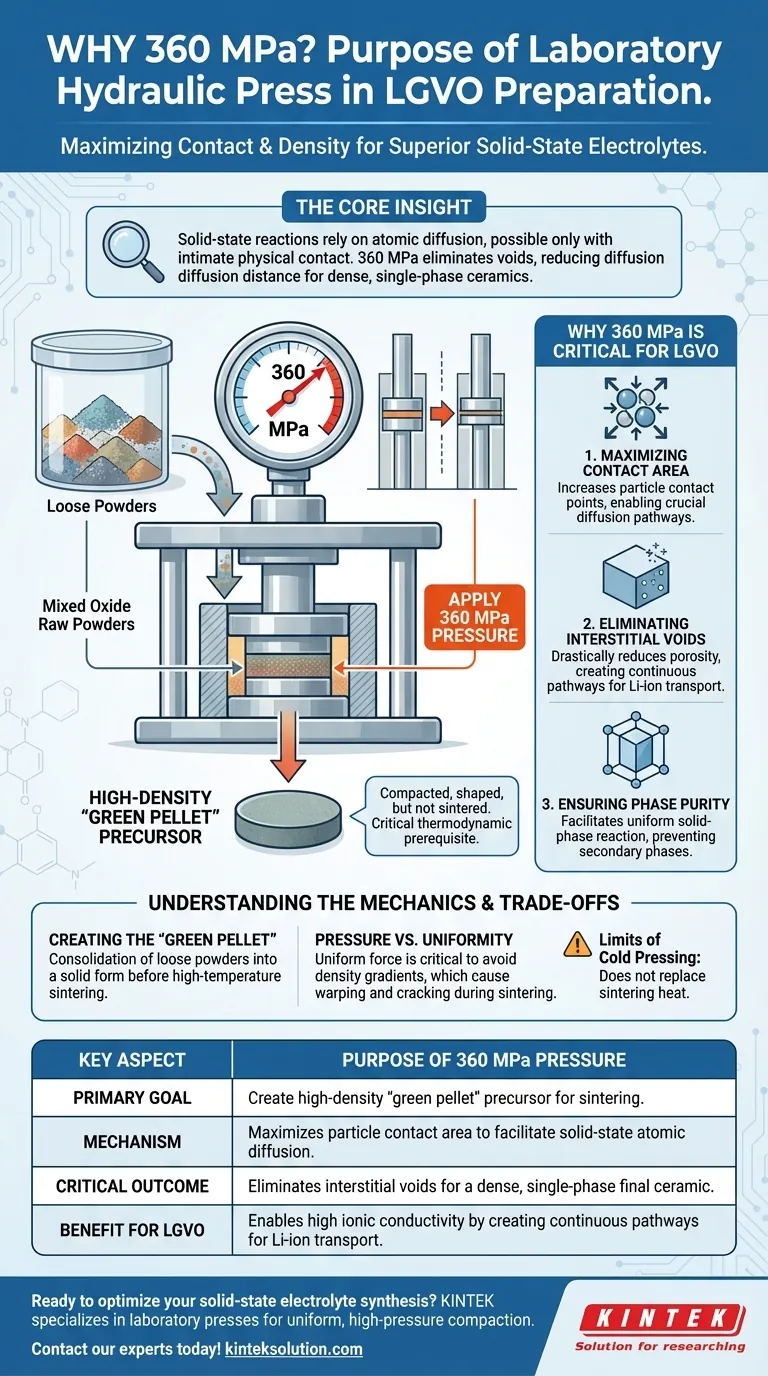
The primary purpose of applying 360 MPa of pressure is to mechanically compact mixed oxide raw powders into a high-density "green pellet" prior to sintering. This step is not merely about shaping the material; it is a critical thermodynamic prerequisite that maximizes the contact area between particles to enable the chemical reactions necessary for forming LGVO ceramics.
The Core Insight Solid-state reactions rely heavily on atomic diffusion, which can only occur effectively when reactant particles are in intimate physical contact. Applying 360 MPa eliminates interstitial voids and reduces the diffusion distance between particles, ensuring the final ceramic achieves a dense, single-phase structure with high ionic conductivity.
The Mechanics of Pre-Sintering Compaction
Creating the "Green Pellet"
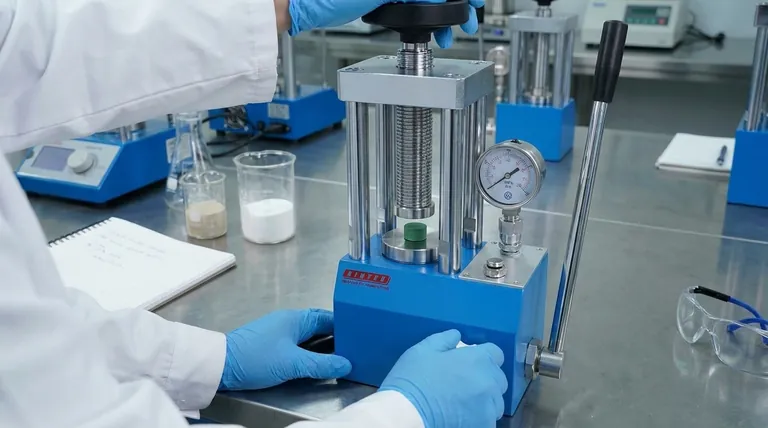
Before the high-temperature heating (sintering) phase can begin, the loose mixed oxide powders must be consolidated into a solid form. The laboratory hydraulic press transforms these loose particles into a green pellet.
This state is referred to as "green" because it has been shaped and compacted but has not yet undergone the thermal processing required to fuse the particles into a final ceramic.
Facilitating Solid-State Diffusion
The defining challenge of solid-state synthesis is that the reactants are solids, meaning atoms do not move as freely as they do in liquids or gases.
By applying 360 MPa, you force particles so close together that you create ideal physical conditions for ion diffusion. This proximity allows atoms to migrate across particle boundaries during the heating phase, which is essential for the chemical reaction to proceed.
Why 360 MPa is Critical for LGVO
Maximizing Contact Area
The specific application of high pressure significantly increases the contact area among the powder particles.
Without this intense compaction, the contact points between particles would be minimal. This would limit the pathways available for diffusion, leading to an incomplete reaction or a structure filled with defects.
Eliminating Interstitial Voids
One of the main enemies of conductivity in solid-state electrolytes is porosity. The 360 MPa load drastically reduces interstitial voids (the empty spaces between particles).
Reducing these voids is fundamental to creating continuous pathways for lithium-ion transport. If voids remain during the precursor stage, they often persist after sintering, hindering the performance of the final battery.
Ensuring Phase Purity
For LGVO electrolytes, the goal is to achieve a single-phase ceramic.
The high-density environment created by the hydraulic press ensures that the solid-phase reaction occurs uniformly throughout the material. This prevents the formation of secondary phases that could degrade the electrolyte's properties.
Understanding the Trade-offs
Pressure Magnitude vs. Uniformity
While applying 360 MPa is necessary for densification, the uniformity of that pressure is equally critical.
If the pressure is applied unevenly, it can create density gradients within the pellet. Upon sintering, these gradients often result in differential shrinkage, leading to warping or cracking in the final ceramic. A crack-free result depends on controlled, uniform force.
The Limits of Cold Pressing
It is important to recognize that the 360 MPa step creates a dense precursor, not the final densified ceramic.
This process is a cold-pressing technique. While it establishes the necessary particle contact, it does not replace the need for high-temperature sintering to chemically bond the material. The press sets the stage; the heat finishes the job.
Making the Right Choice for Your Goal
To optimize your LGVO synthesis process, consider your specific objectives when applying pressure:
- If your primary focus is Chemical Synthesis: Ensure you achieve the full 360 MPa to maximize particle contact, as this acts as the driving force for the solid-state reaction and single-phase formation.
- If your primary focus is Structural Integrity: Monitor the pressure ramp rate to ensure uniformity; a high-quality green pellet is the only way to obtain a crack-free ceramic after sintering.
Ultimate Success: The application of 360 MPa is the bridge between a loose mixture of raw ingredients and a high-performance, conductive solid-state electrolyte.
Summary Table:
| Key Aspect | Purpose of 360 MPa Pressure |
|---|---|
| Primary Goal | Create a high-density "green pellet" precursor for sintering. |
| Mechanism | Maximizes particle contact area to facilitate solid-state atomic diffusion. |
| Critical Outcome | Eliminates interstitial voids to ensure a dense, single-phase final ceramic. |
| Benefit for LGVO | Enables high ionic conductivity by creating continuous pathways for lithium-ion transport. |
Ready to optimize your solid-state electrolyte synthesis?
The precise application of pressure is a critical step in developing high-performance materials like LGVO. KINTEK specializes in laboratory press machines, including automatic, isostatic, and heated lab presses, designed to deliver the uniform, high-pressure compaction your research demands.
Ensure your precursors achieve the perfect density for superior ionic conductivity. Contact our experts today to find the ideal lab press for your specific synthesis goals!
Visual Guide
Related Products
- Laboratory Hydraulic Press Lab Pellet Press Machine for Glove Box
- Laboratory Hydraulic Press 2T Lab Pellet Press for KBR FTIR
- 24T 30T 60T Heated Hydraulic Lab Press Machine with Hot Plates for Laboratory
- Laboratory Hydraulic Press Lab Pellet Press Button Battery Press
- Laboratory Hydraulic Pellet Press for XRF KBR FTIR Lab Press
People Also Ask
- How does a laboratory hydraulic press contribute to the preparation of Li3-3xScxSb samples? Optimize Ionic Conductivity
- What is the function of a laboratory hydraulic press in FT-IR of curcumin-coated MWCNTs? Achieve Optical Clarity.
- Why is a laboratory hydraulic press required for compression molding boron-siloxane? Solve High-Loading Density Challenges
- What role does a laboratory hydraulic press play in the preparation of piezoelectric ceramic discs for DC-PG? | KINTEK
- What role does a laboratory hydraulic press play in reaction pellets? Optimizing Lunar Soil and Metal Fuel Density



















