
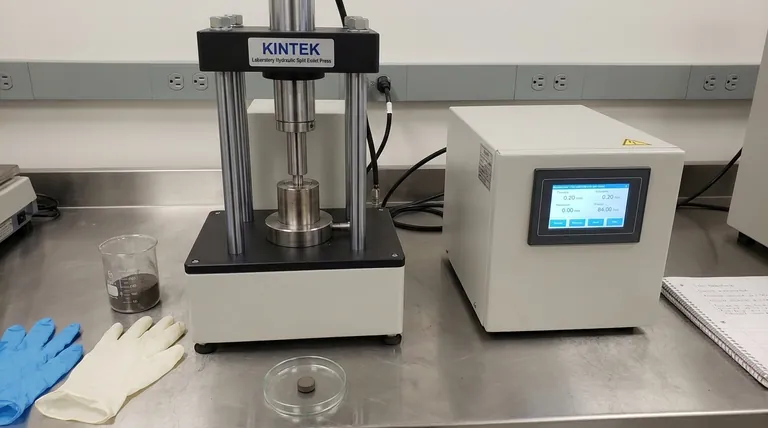
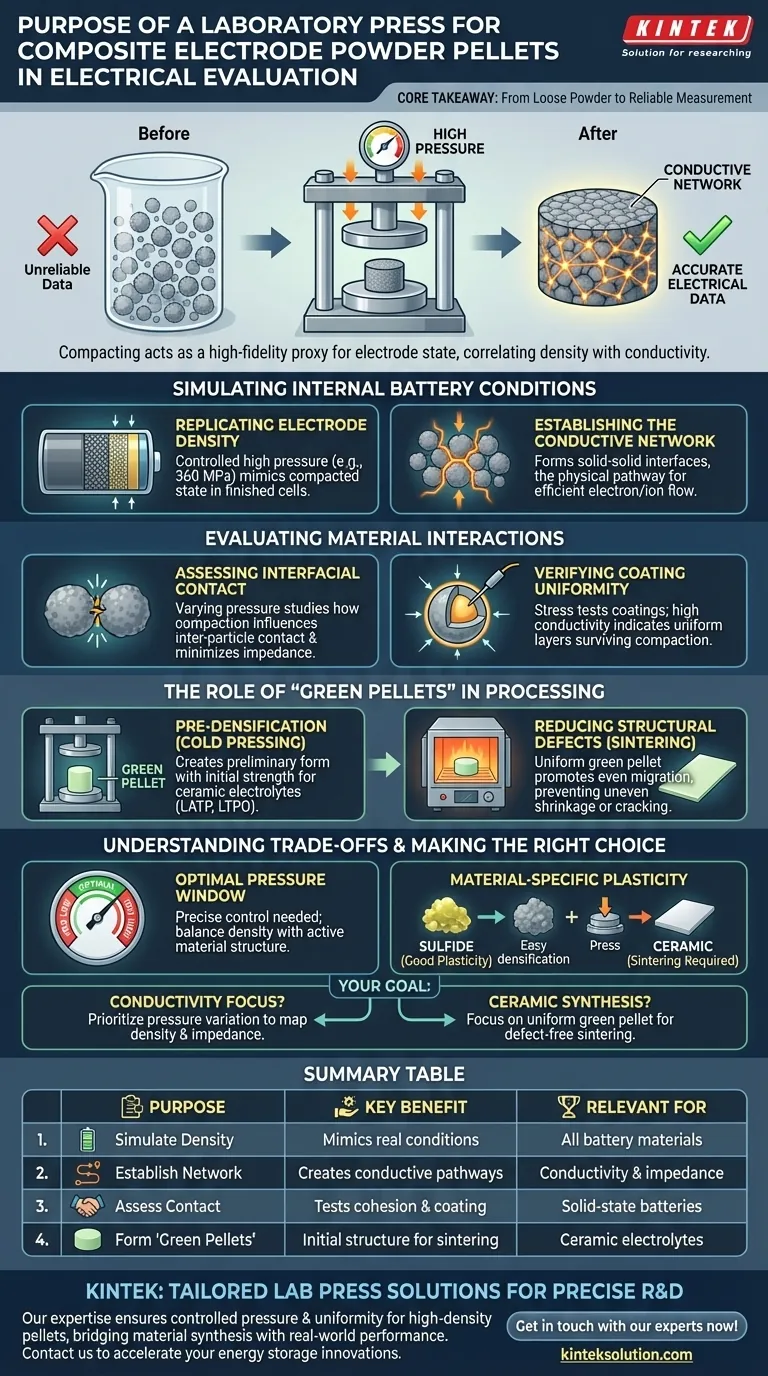
The primary purpose of using a laboratory press machine in this context is to transform loose composite powder into a consolidated geometric form—a pellet—that accurately simulates the physical density of an active battery electrode. This mechanical consolidation is necessary to establish the solid-solid interfaces required for meaningful electrical property evaluation, effectively bridging the gap between raw material synthesis and actual device performance.
Core Takeaway Loose powders contain significant void space that disrupts electrical continuity, making direct measurement unreliable. Compacting the material into a pellet acts as a high-fidelity proxy for the manufactured electrode state, enabling researchers to correlate specific densification levels with conductivity, interfacial quality, and overall electrochemical potential.
Simulating Internal Battery Conditions
Replicating Electrode Density
In an actual battery, electrode layers are highly compacted to maximize energy density. A laboratory press applies controlled, high pressure (e.g., 360 MPa) to composite particles to mimic this state. This simulation ensures that the electrical data gathered in the lab is relevant to how the material will behave inside a finished cell.
Establishing the Conductive Network
Loose particles generally lack the connectivity required for electrons or ions to flow efficiently. By forcing particles into close proximity, the press creates a solid-solid interfacial network. This network is the physical pathway for conduction, allowing researchers to measure the material's true electrical capabilities without the interference of air gaps.
Evaluating Material Interactions
Assessing Interfacial Contact
The conductivity of a pellet is a direct reflection of how well the particles touch one another. By varying the pressure, researchers can study how the degree of compaction influences inter-particle contact. This analysis is critical for minimizing interfacial impedance, particularly in all-solid-state batteries where contact resistance is a major bottleneck.
Verifying Coating Uniformity
For coated particles, the pressing process serves as a stress test for the coating layer. Conductivity measurements performed on the resulting pellet reveal the quality of the interfacial contact between host and guest particles. A highly conductive pellet typically indicates a uniform coating that has survived the compaction process and established effective pathways.
The Role of "Green Pellets" in Processing
Pre-densification for Sintering
When working with ceramic electrolytes (like LATP or LTPO), the press is used to form a "green pellet" via cold pressing. This creates a preliminary form with sufficient mechanical strength and initial density. This step is a prerequisite for high-temperature sintering, as loose powder cannot be effectively sintered into a dense sheet.
Reducing Structural Defects
A uniform green pellet promotes even material migration during the subsequent heating phase. This is essential for preventing uneven shrinkage, cracking, or deformation. By securing high initial density through pressing, the final ceramic product achieves lower porosity and superior mechanical strength.
Understanding the Trade-offs
Pressure Sensitivity and Optimization
While higher pressure generally improves density, the process requires precise control rather than brute force. The goal is to identify the optimal pressure window where the conductive network is formed without damaging the active material structure. Results are highly sensitive to the specific pressure applied, meaning data is only comparable when process parameters are strictly standardized.
Material-Specific Plasticity
Not all materials respond to compression equally. Sulfide electrolytes, for instance, possess good plasticity, allowing them to densify easily at room temperature. Conversely, ceramic materials often require the two-step process of cold pressing followed by sintering to achieve the same dense ionic transport pathways.
Making the Right Choice for Your Goal
To maximize the utility of your laboratory press, you must align your specific pressure parameters with your material objectives.
- If your primary focus is Electrical Conductivity: Prioritize applying varying high pressures to map the relationship between density and interfacial impedance, ensuring the formation of a robust conductive network.
- If your primary focus is Ceramic Electrolyte Synthesis: Focus on producing a defect-free "green pellet" with uniform density to ensure the material survives high-temperature sintering without cracking or deformation.
The laboratory press is not just a shaping tool; it is a critical instrument for defining the microstructure that dictates the ultimate performance of your energy storage material.
Summary Table:
| Purpose | Key Benefit | Relevant For |
|---|---|---|
| Simulate Electrode Density | Mimics real battery conditions for relevant data | All battery material research |
| Establish Conductive Network | Creates pathways for electron/ion flow by removing air gaps | Conductivity & impedance studies |
| Assess Interfacial Contact | Tests particle cohesion and coating quality under stress | Solid-state battery development |
| Form 'Green Pellets' for Sintering | Provides initial structure for high-temperature processing | Ceramic electrolyte synthesis |
Ready to achieve precise and reliable results in your battery material research?
KINTEK's expertise in laboratory press machines—including automatic, isostatic, and heated lab presses—is tailored to meet the specific demands of laboratory research and development. Our equipment ensures the controlled pressure and uniformity required to create high-density pellets for accurate electrical property evaluation, helping you bridge the gap between material synthesis and real-world battery performance.
Contact us today to discuss how our lab press solutions can enhance your R&D workflow and accelerate your energy storage innovations.
Get in touch with our experts now!
Visual Guide
Related Products
- XRF KBR Steel Ring Lab Powder Pellet Pressing Mold for FTIR
- XRF KBR Plastic Ring Lab Powder Pellet Pressing Mold for FTIR
- Automatic Laboratory Hydraulic Press for XRF and KBR Pellet Pressing
- Lab XRF Boric Acid Powder Pellet Pressing Mold for Laboratory Use
- Laboratory Hydraulic Split Electric Lab Pellet Press
People Also Ask
- What considerations are important regarding the die size of an XRF pellet press? Optimize for Your XRF Spectrometer and Sample
- Why are pellets used in XRF analysis, and what is their limitation? Boost Accuracy and Speed in Your Lab
- What is the general process for preparing a sample pellet for XRF? Master Consistency for Accurate Analysis
- What are the differences between manual and automatic XRF pellet presses? Choose the Right Press for Your Lab's Needs
- What are the different types of XRF pellet preparation methods available? Manual, Hydraulic, and Automated Presses Explained



















