
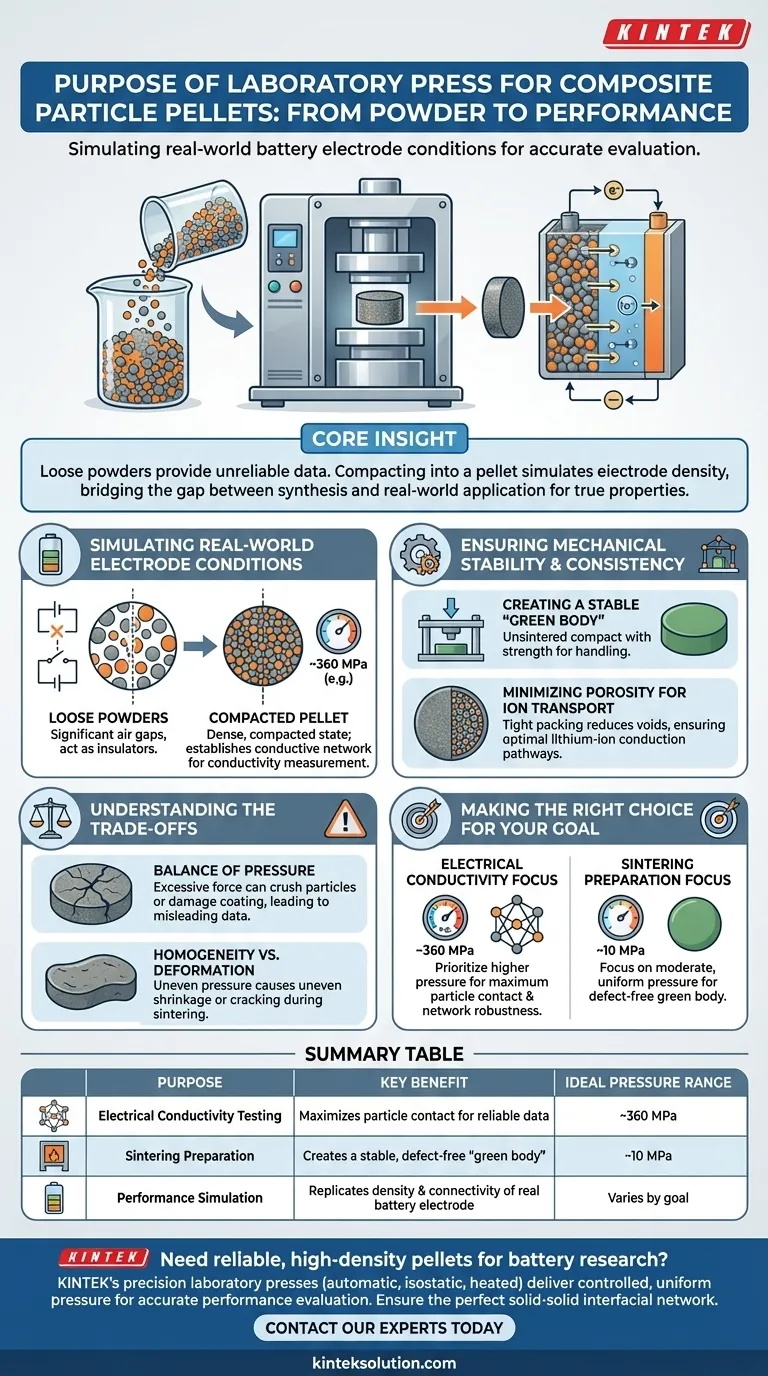
The primary purpose of using a laboratory press in this context is to transform loose, dry-coated composite particles into a dense, solid mass that accurately mimics the physical state of a functional battery electrode. By applying high, controlled pressure, the press forces particles into intimate contact, establishing the continuous solid-solid interfacial network necessary to measure electrical conductivity and evaluate the uniformity of the coating layer.
Core Insight: Loose powders cannot provide reliable data on electrode performance. Compacting them into a pellet simulates the density of an actual battery component, bridging the gap between raw material synthesis and real-world application to reveal true interfacial properties.
Simulating Real-World Electrode Conditions
Replicating High Density
Loose composite powders contain significant air gaps that act as insulators, making direct performance evaluation impossible.
A laboratory press applies substantial pressure (e.g., 360 MPa) to compact these powders. This simulates the dense, compacted state found in a manufactured composite electrode, ensuring that measurements reflect the material's potential in a working battery.
Establishing the Conductive Network
For electrons and ions to flow, particles must touch.
The compaction process forces host and guest particles into close proximity, creating a solid-solid interfacial network. This contact allows researchers to accurately measure conductivity, which serves as a direct proxy for the quality and uniformity of the particle coating.
Ensuring Mechanical Stability and Consistency
Creating a Stable "Green Body"
Before materials like solid-state electrolytes (e.g., LLZO or LATP) undergo high-temperature sintering, they must be formed into a shape that can hold together.
The press utilizes cold pressing to create a "green pellet"—an unsintered compact with sufficient mechanical strength for handling. This step ensures the material maintains its structural integrity prior to thermal processing.
Minimizing Porosity for Ion Transport
Internal voids and porosity disrupt the pathways needed for efficient energy transfer.
Precise pressure control ensures particles are tightly packed, significantly reducing internal porosity. This densification provides an optimal, uninterrupted pathway for lithium-ion conduction, which is critical for high-performance electrolytes.
Understanding the Trade-offs
The Balance of Pressure
While high pressure is necessary to form a pellet, excessive force can be detrimental. Over-compaction may crush the underlying host particles or damage the delicate dry coating, leading to misleading conductivity data that does not accurately represent the material's chemistry.
Homogeneity vs. Deformation
Achieving a uniform density gradient is challenging but essential.
If the pressure is applied unevenly, the resulting pellet may suffer from uneven shrinkage or cracking during subsequent sintering steps. A laboratory press allows for controlled application of force to minimize these deformations and ensure the final ceramic sheet is flat and dense.
Making the Right Choice for Your Goal
To maximize the value of your pelletizing process, align your pressure strategy with your specific analytical objective:
- If your primary focus is Electrical Conductivity: Prioritize higher pressures (e.g., 360 MPa) to maximize particle-to-particle contact and test the robustness of the conductive network.
- If your primary focus is Sintering Preparation: Focus on moderate, uniform pressures (e.g., 10 MPa) to create a defect-free green body that will not crack or warp during heating.
Ultimately, the validity of your performance data relies entirely on creating a pellet that physically represents the density and connectivity of the final application environment.
Summary Table:
| Purpose | Key Benefit | Ideal Pressure Range |
|---|---|---|
| Electrical Conductivity Testing | Maximizes particle contact for reliable conductivity data. | ~360 MPa |
| Sintering Preparation | Creates a stable, defect-free "green body" for thermal processing. | ~10 MPa |
| Performance Simulation | Replicates the density and connectivity of a real battery electrode. | Varies by goal |
Need to create reliable, high-density pellets for your battery material research? KINTEK's precision laboratory presses—including automatic, isostatic, and heated models—are engineered to deliver the controlled, uniform pressure essential for accurate performance evaluation. Ensure your composite particles form the perfect solid-solid interfacial network for trustworthy data. Contact our experts today to find the ideal lab press for your specific application and elevate your R&D outcomes.
Visual Guide
Related Products
- Laboratory Hydraulic Press Lab Pellet Press Button Battery Press
- Laboratory Hydraulic Press 2T Lab Pellet Press for KBR FTIR
- Laboratory Hydraulic Press Lab Pellet Press Machine for Glove Box
- Laboratory Split Manual Heated Hydraulic Press Machine with Hot Plates
- Laboratory Hydraulic Pellet Press for XRF KBR FTIR Lab Press
People Also Ask
- How is a laboratory hydraulic press used for HAP composite gels? Master Mineral Substrate Standardization
- What role does a laboratory hydraulic press play in reaction pellets? Optimizing Lunar Soil and Metal Fuel Density
- What role does a laboratory hydraulic press play in the preparation of piezoelectric ceramic discs for DC-PG? | KINTEK
- Why is a laboratory hydraulic press required for PBAT and PLA sample preparation? Achieve Flawless Characterization
- What role does a laboratory hydraulic press play in the assembly of all-solid-state battery test cells? Expert Guide



















