
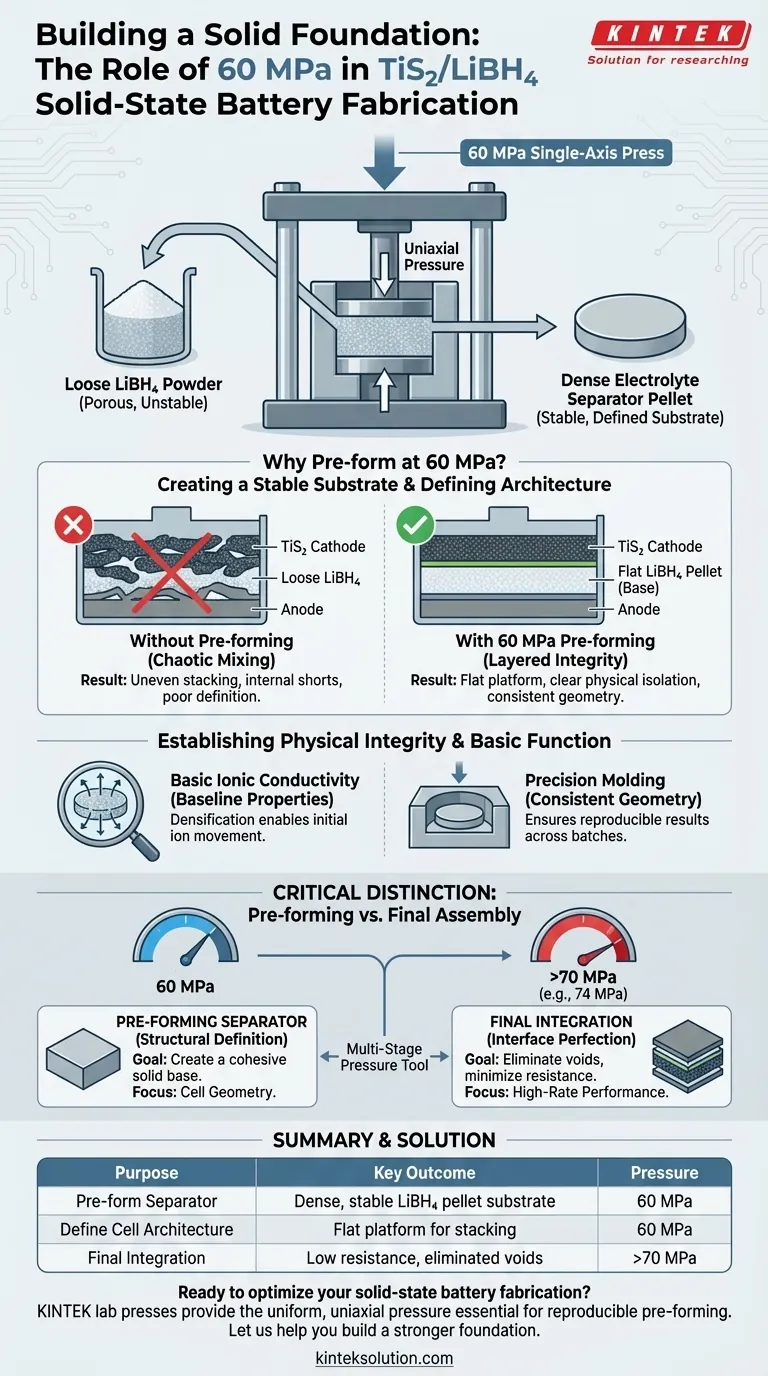
The primary purpose of applying 60 MPa via a single-axis press is to pre-form pure LiBH₄ powder into a dense, independent electrolyte separator pellet. This mechanical compaction transforms loose powder into a flat, stable substrate that serves as the necessary foundation for the subsequent stacking of the TiS₂ composite cathode layer.
Core Takeaway This 60 MPa step is a preparatory measure designed to create a structural "base" with specific density and basic ionic conductivity. It is distinct from the final assembly pressures, serving primarily to define the cell's layered architecture before the anode and cathode are fully integrated.
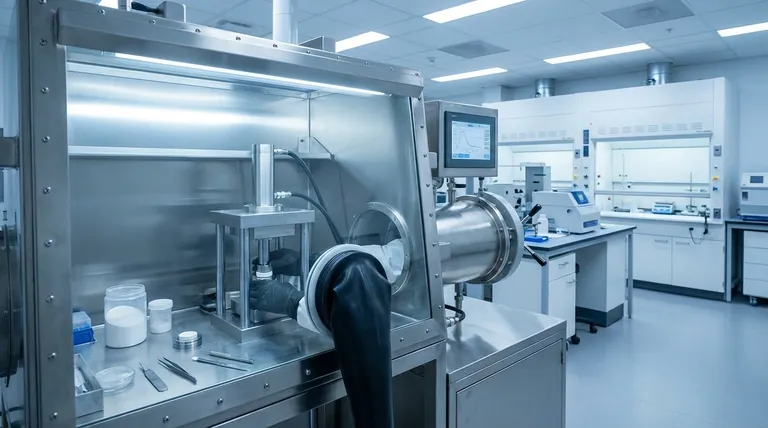
The Role of Pre-forming in Cell Architecture
Creating a Stable Substrate
In the fabrication of all-solid-state batteries, you cannot effectively stack composite layers onto loose powder.
The 60 MPa compaction step consolidates the LiBH₄ material into a rigid, self-supporting pellet. This pellet acts as a physical platform, ensuring that when the cathode layer is added later, the interface remains flat and defined rather than mixing chaotically with the electrolyte.
Defining the Electrolyte Separator
This process turns the LiBH₄ into a clearly defined functional layer.
By compacting the powder to a specific density, you create an independent separator. This layer is critical for physically isolating the anode from the cathode while establishing the medium for ionic transport.
Establishing Physical Integrity
Ensuring Ionic Conductivity
While the final cell performance relies on later steps, this initial compaction establishes the baseline properties of the electrolyte.
The pressure creates a cohesive solid with basic ionic conductivity. Without this densification, the LiBH₄ would remain porous and unable to facilitate the movement of ions effectively.
Precision Molding
The single-axis press works in conjunction with a pellet die, which functions as a precision molding container.
The press uniformly concentrates uniaxial pressure onto the powder. This ensures that the resulting pellet creates a consistent cell geometry, which is essential for reproducible results across different fabrication batches.
Understanding the Difference: Pre-forming vs. Final Assembly
The Distinction in Pressure Goals
It is critical to distinguish this 60 MPa step from the final stacking pressure (often around 74 MPa).
The 60 MPa step is for pre-forming the separator. Its goal is structural definition.
The subsequent higher pressure (e.g., 74 MPa) is for final integration. Its goal is to eliminate microscopic voids between the cathode, electrolyte, and anode to minimize interfacial resistance.
The Risk of Skipping Pre-formation
Attempting to apply final pressure without this intermediate pre-forming step can lead to structural failure.
Without a pre-formed separator pellet, the layers may not stack uniformly. This can result in uneven thicknesses or internal short circuits, compromising the "clearly defined layered cell structure" necessary for accurate testing.
Making the Right Choice for Your Fabrication Protocol
To maximize the performance of a TiS₂/LiBH₄ battery, you must view pressure as a multi-stage tool.
- If your primary focus is Cell Geometry: Ensure the 60 MPa step is applied uniformly to create a perfectly flat substrate; this dictates the alignment of all subsequent layers.
- If your primary focus is Minimizing Resistance: Recognize that 60 MPa is only the setup; you must apply higher final stacking pressure (e.g., >70 MPa) to eliminate voids and activate high-rate performance.
Success in solid-state battery fabrication relies on using moderate pressure to build the structure and high pressure to perfect the interface.
Summary Table:
| Purpose | Key Outcome | Pressure Used |
|---|---|---|
| Pre-form Separator | Creates a dense, stable LiBH₄ pellet substrate | 60 MPa |
| Define Cell Architecture | Establishes a flat platform for cathode stacking | 60 MPa |
| Final Integration | Eliminates voids between layers for low resistance | >70 MPa (e.g., 74 MPa) |
Ready to Optimize Your Solid-State Battery Fabrication?
Achieving a perfectly defined layered structure is fundamental to your research success. The precise mechanical compaction described is exactly the kind of process our equipment is designed to master.
KINTEK specializes in laboratory press machines, including automatic lab presses and isostatic presses, which provide the uniform, uniaxial pressure essential for reproducible pre-forming of electrolyte pellets.
Let us help you build a stronger foundation for your battery prototypes.
Contact our experts today via our simple form to discuss how our lab presses can enhance the precision and reliability of your solid-state battery fabrication protocol.
Visual Guide
Related Products
- 24T 30T 60T Heated Hydraulic Lab Press Machine with Hot Plates for Laboratory
- Split Automatic Heated Hydraulic Press Machine with Heated Plates
- Laboratory Manual Heated Hydraulic Press Machine with Hot Plates
- Manual Heated Hydraulic Lab Press with Integrated Hot Plates Hydraulic Press Machine
- Automatic Laboratory Hydraulic Press Lab Pellet Press Machine
People Also Ask
- Function of a Laboratory Hydraulic Press with Heated Platens in SSE? Enhance Battery Density & Conductivity
- Why is a laboratory hydraulic press with heating plates required for PLA/TEC films? Achieve Precise Sample Integrity
- What role does a laboratory heated hydraulic press play in LTCC? Essential for High-Density Ceramic Lamination
- What is the primary function of a laboratory heated hydraulic press? Mastering Thermoplastic Carbon Fiber Composites
- What is the critical role of a laboratory heated hydraulic press? Mastering PVC Sample Prep for Testing


















