
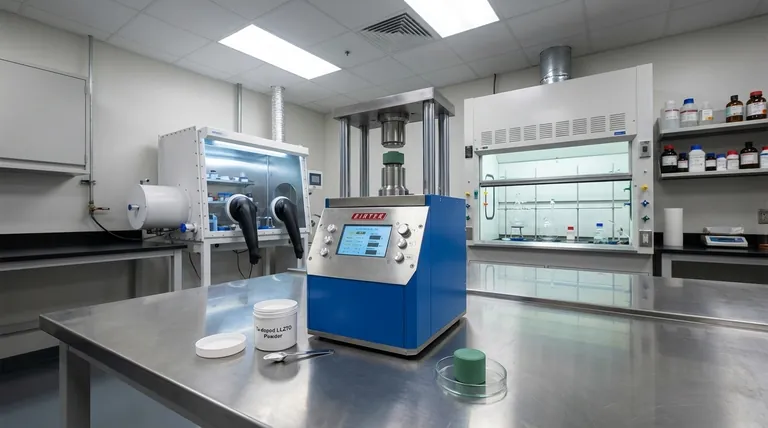
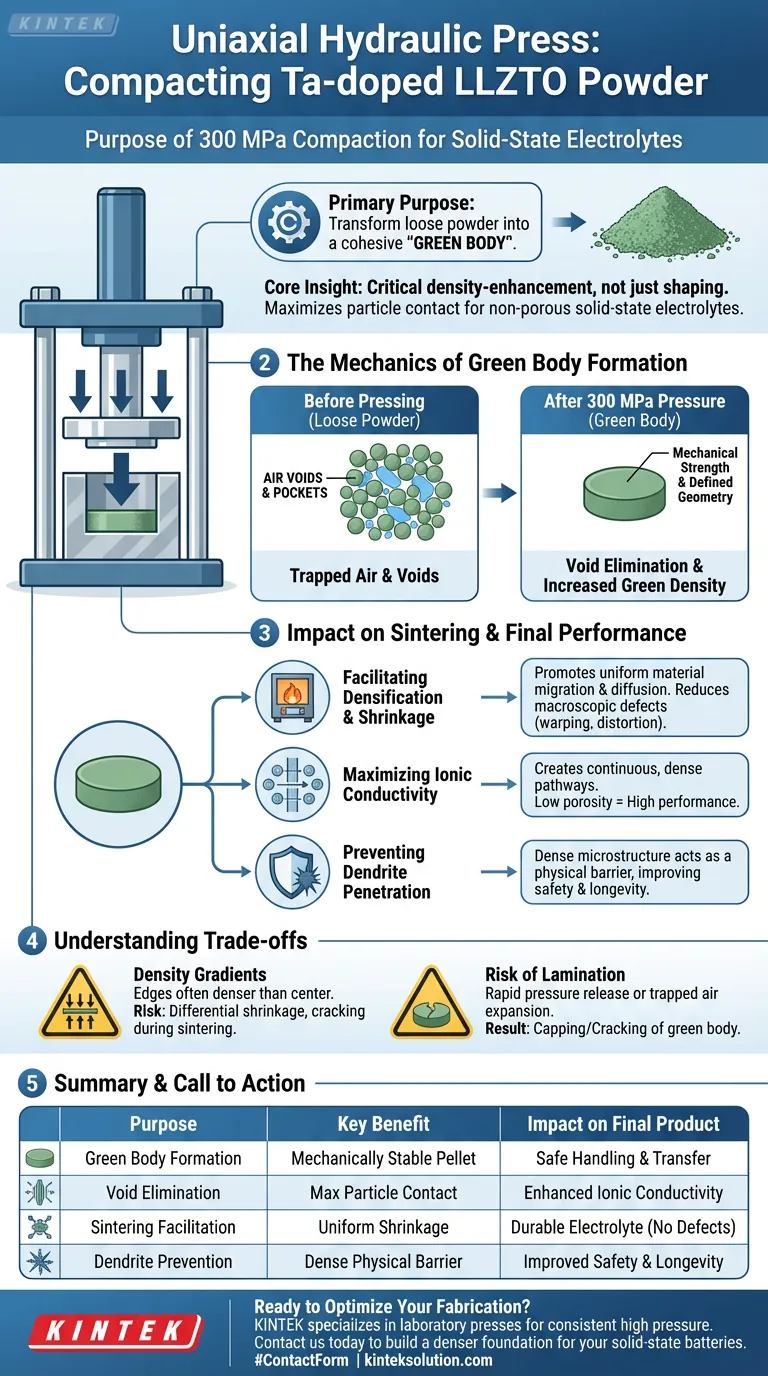
The primary purpose of using a uniaxial hydraulic press is to transform loose Ta-doped LLZTO powder into a cohesive "green body" with sufficient initial density. Applying approximately 300 MPa of pressure forces individual particles into intimate contact, effectively eliminating air voids to create a mechanically stable pellet ready for high-temperature processing.
Core Insight: Compaction is not merely about shaping the material; it is a critical density-enhancement step. By maximizing particle-to-particle contact upfront, you establish the physical foundation required to achieve a non-porous solid-state electrolyte with high ionic conductivity during sintering.
The Mechanics of Green Body Formation
Eliminating Voids and Air Pockets
The immediate physical effect of applying 300 MPa is the expulsion of air trapped within the loose powder. This drastic reduction in volume minimizes porosity at the earliest stage of fabrication.
By mechanically forcing particles together, you increase the "green density" of the material. This creates a tightly packed structure that serves as the baseline for the final ceramic density.
Establishing Mechanical Strength
Before sintering, the powder must be formed into a shape that can be handled without crumbling. The hydraulic press compacts the powder into a solid pellet, often called a green body.
This green body possesses enough mechanical integrity to maintain its defined geometry during transfer to the furnace. Without this high-pressure compaction, the powder would remain too loose to process effectively.
The Impact on Sintering and Final Performance
Facilitating Densification and Shrinkage
High-pressure compaction acts as a prerequisite for successful sintering. The tight particle arrangement promotes efficient material migration and diffusion when heat is applied.
A denser green body shrinks more uniformly during sintering. This reduces the risk of macroscopic defects, such as warping or uneven deformation, in the final ceramic sheet.
Maximizing Ionic Conductivity
The ultimate goal of the LLZTO electrolyte is to conduct lithium ions efficiently. Ionic conductivity is heavily dependent on the density of the final ceramic; porosity acts as a barrier to ion flow.
By starting with a highly compacted pellet, you ensure the final product has low porosity. This creates a continuous, dense pathway for lithium ions, significantly enhancing the electrolyte's performance.
Preventing Dendrite Penetration
A dense microstructure is essential for battery safety and longevity. High relative density creates a physical barrier that resists the penetration of lithium dendrites.
If the initial compaction is insufficient, the final ceramic may retain voids that allow dendrites to grow, potentially causing short circuits.
Understanding the Trade-offs
The Challenge of Density Gradients
While uniaxial pressing is effective, it applies pressure in a single direction. This can sometimes lead to density gradients, where the edges of the pellet are denser than the center.
If not managed correctly, these gradients can cause differential shrinkage during sintering. This may result in cracking or distortion of the final electrolyte layer.
The Risk of Lamination
Applying pressure as high as 300 MPa requires precision. If air is not allowed to escape slowly or if the pressure is released too quickly, the compressed air can expand and crack the green body.
This phenomenon, often called lamination or capping, ruins the structural integrity of the pellet before sintering even begins.
Making the Right Choice for Your Goal
To maximize the effectiveness of your Ta-doped LLZTO fabrication, align your pressing parameters with your specific performance targets:
- If your primary focus is Ionic Conductivity: Prioritize achieving the highest possible green density to minimize porosity and create unobstructed ion pathways.
- If your primary focus is Mechanical Integrity: Focus on pressure uniformity to ensure the pellet shrinks evenly, preventing cracks that weaken the solid-state electrolyte.
Success in solid-state battery fabrication relies on the understanding that the quality of the final sintered ceramic is determined by the quality of the initial green body compaction.
Summary Table:
| Purpose | Key Benefit | Impact on Final Product |
|---|---|---|
| Green Body Formation | Creates a mechanically stable pellet from loose powder | Enables safe handling and transfer to the furnace |
| Void Elimination | Maximizes particle-to-particle contact, reducing porosity | Enhances ionic conductivity by creating unobstructed ion pathways |
| Sintering Facilitation | Promotes uniform shrinkage and densification during heat treatment | Prevents defects like warping and cracking, ensuring a durable electrolyte |
| Dendrite Prevention | Establishes a dense microstructure as a physical barrier | Improves battery safety and longevity by resisting short circuits |
Ready to Optimize Your Solid-State Electrolyte Fabrication?
The precise compaction step is foundational to your research success. KINTEK specializes in laboratory press machines, including automatic and heated lab presses, designed to deliver the uniform high pressure required for materials like Ta-doped LLZTO.
Our expertise helps researchers like you achieve the consistent green density necessary for high-performance ceramics. Contact us today to discuss how our presses can enhance your process and help you build a denser foundation for your solid-state batteries.
Visual Guide
Related Products
- Automatic Laboratory Hydraulic Press for XRF and KBR Pellet Pressing
- Laboratory Hydraulic Press 2T Lab Pellet Press for KBR FTIR
- Split Automatic Heated Hydraulic Press Machine with Heated Plates
- Automatic Laboratory Hydraulic Press Lab Pellet Press Machine
- Automatic Heated Hydraulic Press Machine with Heated Plates for Laboratory
People Also Ask
- Why is pressing powder into a pellet critical before sintering? Ensure Dense, Conductive Solid-State Electrolytes
- What is the role of a laboratory pressure machine and KBr in FTIR? Master Sample Preparation for Flame Retardants
- What are the advantages of using a laboratory automatic hydraulic press for HEA green compact forming?
- What are the advantages of using a lab automatic hydraulic press for HEA green body molding? Ensure Material Integrity
- How does an automatic laboratory hydraulic press improve KBr pellet preparation? Achieve Precision IR Spectroscopy



















