
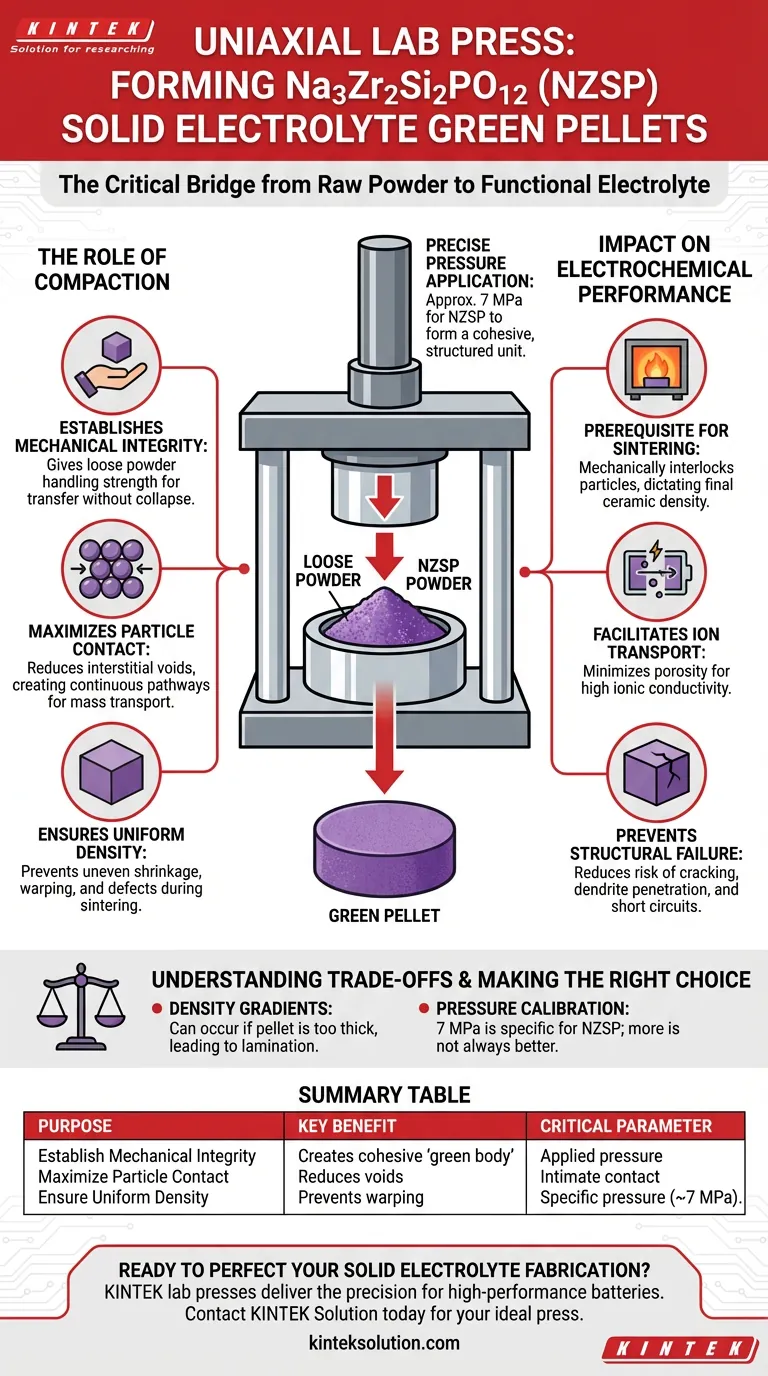
The primary purpose of a uniaxial lab press in this context is to transform loose Na3Zr2Si2PO12 (NZSP) powder into a cohesive, structured unit known as a "green pellet." By applying precise pressure—specifically cited as approximately 7 MPa for this material—the press compacts the powder to establish the necessary shape and mechanical integrity required for subsequent processing.
Core Takeaway: The uniaxial press acts as the critical bridge between raw chemical powder and a functional solid electrolyte. It creates a "green body" with uniform density and minimal voids, which is a non-negotiable prerequisite for achieving a crack-free, highly conductive ceramic during the final sintering stage.

The Role of Compaction in Electrolyte Fabrication
Establishing Mechanical Integrity
The immediate goal of using the press is to give the loose powder handling strength. Without this compression, the NZSP powder would remain a loose aggregate that cannot be moved or processed.
The press consolidates the material into a defined shape, ensuring the sample remains intact during transfer to a furnace. This prevents the collapse of the structure before the chemical bonding of sintering can occur.
Maximizing Particle Contact
Uniaxial pressure significantly reduces the interstitial voids (air gaps) between individual powder particles.
By forcing particles into intimate contact, you create continuous physical pathways. This tight packing is essential for facilitating the mass transport that occurs during high-temperature treatment.
Ensuring Uniform Density
A high-quality green pellet must possess uniform density throughout its volume to prevent macroscopic defects.
If the density is inconsistent, the pellet will shrink unevenly during heating. This uniformity is the primary defense against warping and deformation in the final ceramic product.
The Impact on Electrochemical Performance
Prerequisite for Sintering
The "green pellet" formed by the press is the foundation for the high-temperature sintering stage.
You cannot obtain a dense ceramic electrolyte from loose powder; the particles must be mechanically interlocked first. The quality of the pressed pellet directly dictates the final density of the sintered ceramic.
Facilitating Ion Transport
The ultimate goal of an NZSP electrolyte is high ionic conductivity.
By reducing porosity at the pressing stage, you minimize resistive barriers in the final product. A denser pellet ensures that lithium ions have a direct, unimpeded path through the material structure.
Preventing Structural Failure
A well-formed green pellet significantly reduces the risk of cracking during sintering.
Cracks in the final electrolyte act as points of failure, potentially allowing dendrite penetration or short circuits. The press ensures the internal structure is robust enough to withstand thermal stress.
Understanding the Trade-offs
The Risk of Density Gradients
While uniaxial pressing is effective, it can sometimes lead to uneven density distribution if the pellet is too thick.
Friction against the die walls may cause the edges to be less dense than the center. This can lead to "capping" or lamination, where the top of the pellet separates from the body.
Pressure Calibration
Applying the correct amount of pressure is vital; more is not always better.
References indicate a specific pressure of 7 MPa for NZSP, whereas other electrolytes may require up to 360 MPa. Deviating from the material-specific protocol can result in pellets that are either too fragile to handle or so stressed that they fracture upon ejection from the mold.
Making the Right Choice for Your Goal
To ensure the success of your NZSP electrolyte fabrication, align your pressing parameters with your specific objectives:
- If your primary focus is Structural Integrity: Ensure you apply the specific reference pressure (approx. 7 MPa) to avoid introducing internal stresses that lead to lamination.
- If your primary focus is Ionic Conductivity: Prioritize achieving the highest possible uniform density in the green state to minimize porosity after sintering.
The uniaxial lab press does not merely shape the powder; it defines the potential performance ceiling of the final solid-state battery component.
Summary Table:
| Purpose | Key Benefit | Critical Parameter |
|---|---|---|
| Establish Mechanical Integrity | Creates a cohesive "green body" for handling and transfer. | Applied pressure consolidates loose powder. |
| Maximize Particle Contact | Reduces voids to facilitate mass transport during sintering. | Ensures intimate particle contact for uniform density. |
| Ensure Uniform Density | Prevents warping and cracking for a defect-free final ceramic. | Specific pressure (e.g., ~7 MPa for NZSP) is critical. |
| Impact on Performance | High green density is a prerequisite for high ionic conductivity. | Directly influences the final electrolyte's performance ceiling. |
Ready to perfect your solid electrolyte fabrication process?
The precise compaction achieved with a KINTEK lab press is the critical first step in developing high-performance solid-state batteries. Our automatic lab presses, isostatic presses, and heated lab presses are engineered to deliver the uniform pressure and control required to form flawless NZSP green pellets, setting the foundation for superior ionic conductivity and structural integrity in your final product.
Let KINTEK's expertise support your laboratory's success. Contact our team today to discuss your specific application needs and discover the ideal press for your research.
Visual Guide
Related Products
- Manual Laboratory Hydraulic Pellet Press Lab Hydraulic Press
- Laboratory Hydraulic Split Electric Lab Pellet Press
- Automatic Laboratory Hydraulic Press Lab Pellet Press Machine
- Manual Laboratory Hydraulic Press Lab Pellet Press
- Laboratory Hydraulic Press Lab Pellet Press Machine for Glove Box
People Also Ask
- What is the primary purpose of a manual lab hydraulic pellet press? Ensure Accurate Sample Prep for XRF and FTIR
- What is the primary purpose of manual lab hydraulic pellet presses? Achieve High-Precision Sample Preparation for Spectroscopy
- What is the purpose of initial axial molding using a lab hydraulic press? Optimizing Electrolyte Green Bodies
- What is the primary function of a laboratory hydraulic press in evaluating the ionic conductivity of Li6PS5X (LMSX)?
- What role does a lab hydraulic press play in researching squishy granular matter? Expert Insights into Material Physics



















