
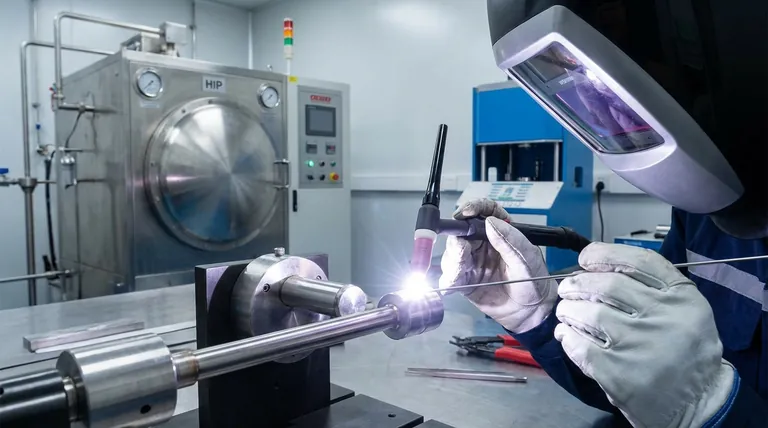
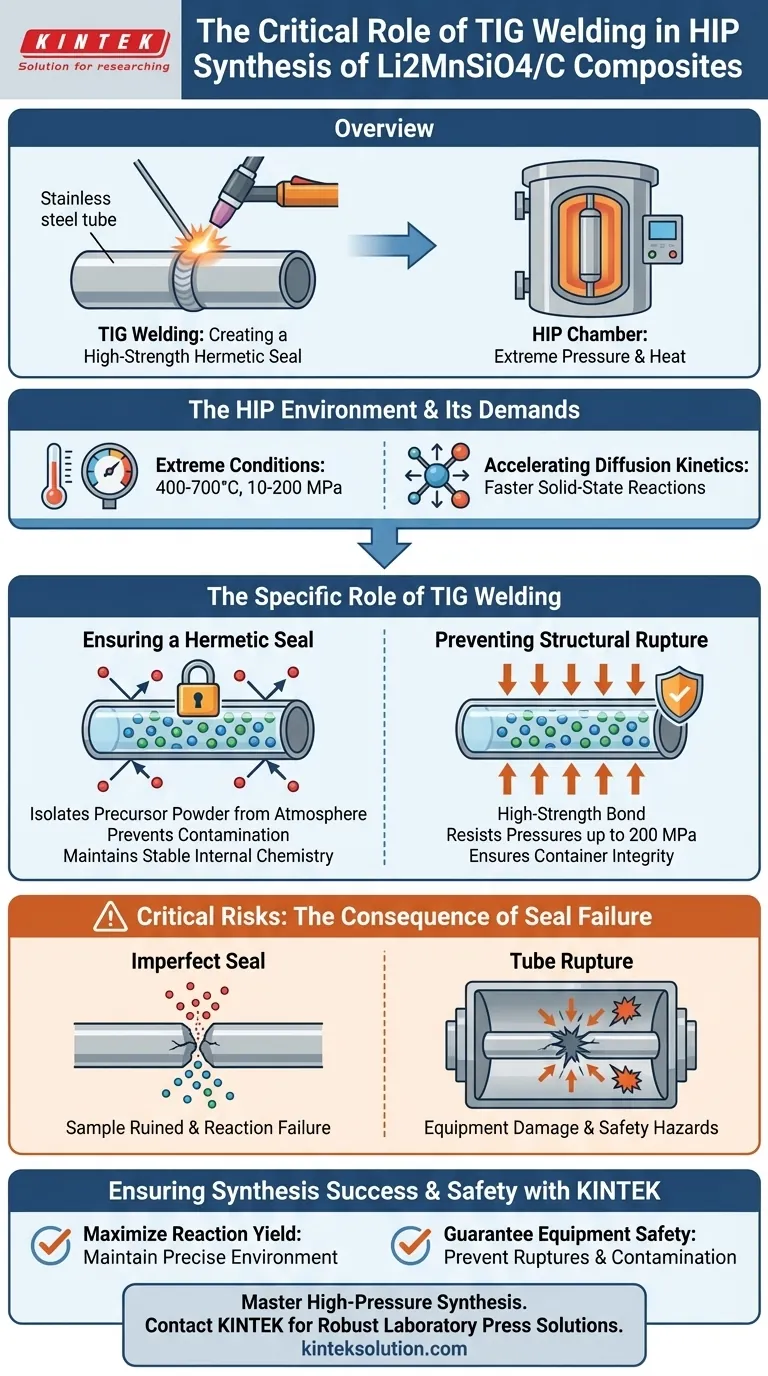
Tungsten Inert Gas (TIG) welding serves as the critical containment step during the preparation of Li2MnSiO4/C composites. Its primary purpose is to apply a high-strength, hermetically sealed closure to the stainless steel tube holding the precursor powder.
The success of Hot Isostatic Pressing (HIP) relies on maintaining a closed environment under extreme stress. TIG welding ensures the sample container remains intact, preventing leaks that would ruin the synthesis reaction or damage the pressurization equipment.
The Demands of the HIP Environment
Withstanding Extreme Pressure and Heat
The Hot Isostatic Pressing (HIP) system subjects the sample to severe environmental conditions to force the reaction.
Temperatures typically range from 400 to 700 °C, combined with isotropic pressures between 10 and 200 MPa.
Accelerating Diffusion Kinetics
These aggressive conditions are necessary to create a synergistic effect on the material.
The combination of heat and pressure significantly accelerates diffusion kinetics, enabling the solid-state reaction to occur more efficiently than in conventional methods.
The Specific Role of TIG Welding
Ensuring a Hermetic Seal
To synthesize Li2MnSiO4/C successfully, the precursor powder must be completely isolated from the HIP equipment's atmosphere.
TIG welding provides a hermetic closure on the stainless steel tube. This prevents the external pressurization medium from contaminating the sample and ensures the internal chemistry remains stable.
Preventing Structural Rupture
The physical integrity of the container is paramount when subjected to pressures up to 200 MPa.
A standard seal is insufficient; TIG welding creates a high-strength bond capable of resisting these forces without rupturing. This ensures the tube maintains its shape and containment throughout the synthesis cycle.
Critical Considerations and Risks
The Consequence of Seal Failure
The reliance on TIG welding introduces a binary risk factor: the seal must be perfect.
If the weld contains even microscopic imperfections, the tube will leak or rupture under HIP conditions. This leads to immediate failure of the synthesis reaction.
Operational Safety Hazards
Beyond the loss of the sample, a ruptured tube poses a significant safety risk to the HIP machinery.
A leak can release precursor materials into the high-pressure chamber, potentially damaging the press and creating unsafe operating conditions. Therefore, the quality of the TIG weld is a non-negotiable prerequisite for safe operation.
Ensuring Synthesis Success
The choice of sealing method is not just about closing a tube; it is about guaranteeing the sample survives the process required to control particle size and morphology.
- If your primary focus is Reaction Yield: Ensure the TIG weld is hermetic to maintain the precise chemical environment needed for high-yield synthesis at lower temperatures.
- If your primary focus is Equipment Safety: Prioritize high-strength welding protocols to prevent tube rupture and protect the HIP system from contamination.
By verifying the integrity of your TIG weld, you secure the foundation for a successful and safe high-pressure synthesis.
Summary Table:
| Aspect | Role of TIG Welding in HIP Synthesis |
|---|---|
| Primary Purpose | Creates a high-strength, hermetically sealed closure on the stainless steel sample container. |
| Key Benefit | Prevents contamination of the precursor powder and maintains a stable internal chemical environment. |
| Critical for Safety | Withstands extreme HIP conditions (up to 200 MPa pressure) to prevent tube rupture and equipment damage. |
| Risk of Failure | Imperfect welds can lead to leaks, ruining the synthesis reaction and posing safety hazards. |
Master High-Pressure Material Synthesis with KINTEK
Precision sealing is the foundation of successful Hot Isostatic Pressing. KINTEK specializes in providing robust laboratory press solutions, including isostatic presses, designed for demanding synthesis applications like creating Li2MnSiO4/C composites.
Our expertise ensures your lab equipment can handle the extreme conditions required for advanced material development safely and efficiently.
Ensure your next HIP synthesis is a success. Contact KINTEK today to discuss your laboratory press needs and how our solutions can enhance your research reliability and safety.
Visual Guide
Related Products
- Warm Isostatic Press for Solid State Battery Research Warm Isostatic Press
- Electric Lab Cold Isostatic Press CIP Machine
- Electric Split Lab Cold Isostatic Pressing CIP Machine
- Lab Isostatic Pressing Molds for Isostatic Molding
- Manual Cold Isostatic Pressing CIP Machine Pellet Press
People Also Ask
- Why must composite cathodes be sealed in vacuum lamination bags for WIP? Ensure Battery Stability and Density
- What is the function of elastic molds in warm isostatic pressing? Achieve Uniform Density in Composite Particles
- How do sacrificial volume materials (SVM) maintain microchannels in isostatic pressing? Ensure Structural Integrity
- What is the process involved in warm isostatic pressing? Mastering Uniform Density with WIP Technology
- How does Warm Isostatic Pressing differ from traditional pressing methods? Unlock Uniform Density for Complex Parts



















