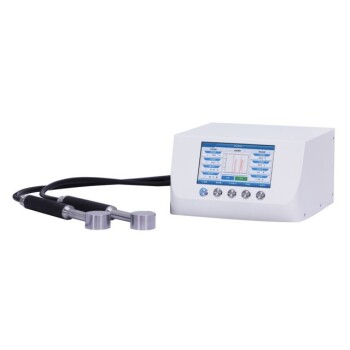
The laboratory high-temperature oven or muffle furnace serves as the critical activation chamber for processing Sugarcane Bagasse Ash (SCBA). Its specific function is to subject the raw ash to a controlled temperature of 500°C for a continuous period of 24 hours.
This thermal treatment is the bridge between raw agricultural waste and a functional construction material. By eliminating impurities and driving off moisture, the furnace activates the ash's pozzolanic properties, enabling it to strengthen the cement matrix in Self-Compacting Concrete.
The Mechanics of Thermal Pretreatment
Precise Temperature Regulation
The furnace must maintain a steady temperature of 500°C.
This specific thermal threshold is required to alter the chemical composition of the ash without vitrifying or degrading its useful properties.
Duration of Exposure
The process requires a continuous 24-hour cycle.
Shortening this duration may result in incomplete processing, leaving the material unsuitable for use as a concrete additive.
Chemical and Physical Transformation
Elimination of Contaminants
Raw sugarcane bagasse contains significant amounts of organic impurities and residual moisture.
The muffle furnace effectively burns off these organic compounds and evaporates the water content. This purification is necessary because organic matter can interfere with the hydration process of cement.
Activation of Pozzolanic Reactivity
The primary goal of the heat treatment is pozzolanic activation.
Once treated, the SCBA functions as a supplementary cementitious material. This means it can chemically react with calcium hydroxide (a byproduct of cement hydration) to form additional binding compounds.
Enhancement of the Microstructure
The treated ash contributes to a denser, more robust cement matrix.
By filling voids and reacting chemically, the SCBA improves the internal structure of the Self-Compacting Concrete, leading to better overall performance.
Understanding the Operational Trade-offs
Strict Process Control
The parameters of 500°C and 24 hours are not arbitrary suggestions; they are strict requirements.
Deviating from these settings—either by reducing the temperature or the time—risks leaving organic material in the ash, which compromises the concrete's strength.
Energy and Time Intensity
This process is resource-intensive regarding both energy consumption and time.
Because the furnace must run continuously for a full day, the production rate of treated ash is limited by the batch size of the laboratory oven.
Applying This to Your Concrete Mix Design
If your primary focus is material purity:
- Ensure the furnace maintains 500°C consistently to fully incinerate organic impurities that could retard setting times.
If your primary focus is structural strength:
- Adhere strictly to the 24-hour duration to guarantee maximum activation of pozzolanic properties for a superior cement matrix.
Proper thermal treatment turns a standard waste byproduct into a high-performance ingredient that significantly enhances the durability of your concrete.
Summary Table:
| Parameter | Specification | Purpose |
|---|---|---|
| Temperature | 500°C | Chemical activation and vitrification prevention |
| Duration | 24 Hours | Complete removal of moisture and organic impurities |
| Material Effect | Pozzolanic Activation | Enables ash to react with calcium hydroxide in cement |
| Final Result | Enhanced Microstructure | Creates a denser, stronger cement matrix in concrete |
Elevate Your Material Research with KINTEK
Precision thermal pretreatment is the key to transforming agricultural waste into high-performance construction materials. At KINTEK, we specialize in comprehensive laboratory pressing and thermal solutions designed for the most demanding research applications.
Whether you are focusing on battery research or sustainable concrete development, our range of manual, automatic, heated, and multifunctional muffle furnaces—along with our advanced cold and warm isostatic presses—ensure the strict temperature control and stability your experiments require.
Ready to achieve superior material activation? Contact us today to find the perfect laboratory solution and see how KINTEK can enhance your lab's efficiency and results.
References
- Monali Wagh, Anshul Nikhade. Experimental investigation of mechanical and durability performances of self-compacting concrete blended with bagasse ash, metakaolin, and glass fiber. DOI: 10.3389/fmats.2024.1351554
This article is also based on technical information from Kintek Solution Knowledge Base .
Related Products
- Lab Double Plate Heating Mold for Laboratory Use
- Infrared Heating Quantitative Flat Plate Mold for Precise Temperature Control
- Lab Infrared Press Mold for No Demolding
- Lab Cylindrical Press Mold for Laboratory Use
- XRF KBR Plastic Ring Lab Powder Pellet Pressing Mold for FTIR
People Also Ask
- How does the geometry of laboratory molds influence mycelium-based composites? Optimize Density and Strength
- Why are precision laboratory molds essential for forming basalt-reinforced lightweight concrete specimens?
- Why are high-precision laboratory molds and specific compaction processes required? Ensure Data Integrity in Soil Research
- What is the purpose of using a laboratory hot plate and weight pressing? Mastering Cellulose Filament Bond Strength
- Why is low-temperature pre-drying on a laboratory hot plate necessary? Stabilize Silver Ink for Better Conductivity