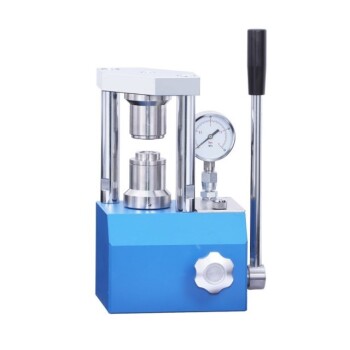
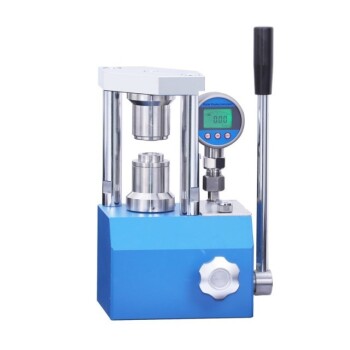
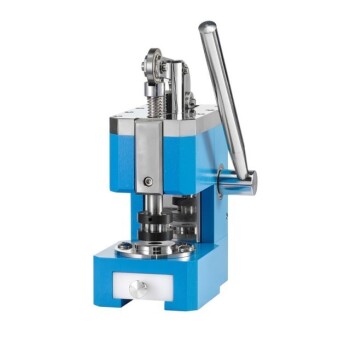
A laboratory hydraulic press or coin cell crimper serves as the critical mechanical stabilizer in the assembly of MIL-91(Al) lithium-selenium batteries. Its primary function is to apply precise, repeatable pressure during the sealing phase to tightly compress the internal stack—comprising the cathode, separator, lithium chip, spacers, and spring sheets—thereby creating the necessary physical conditions for electrochemical operation.
The application of controlled pressure eliminates interfacial voids and minimizes internal ohmic resistance. This physical consistency is strictly required to accurately isolate and measure how MIL-91(Al) additives improve redox kinetics, particularly under high-rate discharge conditions like 20C.
The Physical Foundation of Electrochemical Performance
Eliminating Interfacial Voids
In battery assembly, merely stacking components does not ensure functionality. The hydraulic press applies force to drive the flexible components into tight physical contact with the rigid electrodes.
This compression eliminates microscopic voids at the interfaces between the cathode, separator, and lithium chip. Removing these voids is essential for creating a continuous path for ion transport.
Reducing Internal Ohmic Resistance
The immediate result of this precise compression is a significant reduction in internal ohmic resistance.
If the internal components are loosely packed, the resistance increases, causing voltage drops that mask the true performance of the battery materials. The press ensures that the resistance measured is intrinsic to the chemistry, not a result of poor assembly.
Ensuring Uniform Current Distribution
Proper compression prevents the issue of uneven current distribution.
When contact is inconsistent, current concentrates in specific spots, leading to localized degradation. By ensuring uniform contact across the entire surface area, the press supports stable cycling performance.
Validating MIL-91(Al) Additives
Isolating Chemical Kinetics
The specific goal of using MIL-91(Al) in lithium-selenium batteries is to enhance redox kinetics.
However, you cannot accurately measure these chemical reaction speeds if physical resistance is interfering with the signal. The hydraulic press effectively removes physical contact variables, allowing researchers to attribute performance gains directly to the MIL-91(Al) additive.
Enabling High-Rate Discharge Testing
Testing batteries at high discharge rates, such as 20C, places immense stress on the cell's internal structure.
At these high rates, even minor contact imperfections can lead to immediate failure or drastic voltage sag. The high-precision pressing ensures the cell is robust enough to withstand high-rate demands, providing valid data on the additive's effectiveness under stress.
Understanding the Trade-offs
The Risk of Inconsistent Pressure
While pressure is vital, repeatability is the metric that matters most for data integrity.
If the pressure applied varies between coin cells, the resulting data will be inconsistent. A cell crimped with lower pressure will exhibit artificially high resistance, potentially leading researchers to falsely conclude that the MIL-91(Al) formulation is ineffective.
Balancing Physical Contact vs. Material Integrity
There is a critical balance to be struck regarding the magnitude of pressure applied.
Insufficient pressure fails to reduce solid-solid interfacial impedance, preventing smooth lithium-ion transport. Conversely, while not explicitly detailed in the primary text, excessive pressure in general battery assembly can damage porous separators or crush delicate electrode structures, highlighting the need for the precision mentioned in the primary reference.
Making the Right Choice for Your Goal
When configuring your assembly process for MIL-91(Al) batteries, consider your primary testing objectives:
- If your primary focus is measuring High-Rate Kinetics (20C): Prioritize higher precision and tightness in your crimping to minimize ohmic resistance, ensuring voltage drops are purely chemical in nature.
- If your primary focus is Cycle Life and Stability: Ensure the press delivers uniform, repeatable pressure to prevent uneven current distribution and localized degradation over time.
Ultimately, the hydraulic press transforms a stack of loose components into a unified electrochemical system capable of delivering reliable scientific data.
Summary Table:
| Key Function | Impact on Battery Performance | Importance for MIL-91(Al) Research |
|---|---|---|
| Interfacial Void Removal | Creates continuous ion transport paths | Eliminates physical variables to isolate chemical kinetics |
| Ohmic Resistance Reduction | Minimizes voltage drops during operation | Ensures performance gains are attributed to additives, not assembly |
| Current Distribution | Prevents localized degradation and hotspots | Supports stable cycling and accurate high-rate (20C) data |
| Mechanical Sealing | Ensures airtight, repeatable cell closure | Guarantees data integrity across multiple test batches |
Elevate Your Battery Research Precision with KINTEK
Don't let inconsistent assembly compromise your MIL-91(Al) research data. KINTEK specializes in comprehensive laboratory pressing solutions designed for the rigorous demands of next-generation battery development. From manual and automatic crimpers to heated, multifunctional, and glovebox-compatible models, our equipment provides the repeatable, high-precision pressure required to minimize ohmic resistance and maximize electrochemical performance.
Whether you are conducting high-rate discharge testing or long-term cycle life studies, KINTEK offers the cold and warm isostatic presses needed for superior results.
Contact us today to find the perfect pressing solution for your lab!
References
- Tutku Mutlu, Rezan Demir‐Cakan. <scp>MIL</scp>‐91(Al) to Boost Solid–Solid Conversion Reactions in Li‐Se Batteries. DOI: 10.1002/eem2.70038
This article is also based on technical information from Kintek Solution Knowledge Base .
Related Products
- Lab Button Battery Disassembly and Sealing Mold
- Manual Button Battery Sealing Machine for Battery Sealing
- Button Battery Sealing Machine for Button Batteries
- Button Battery Sealing Press Machine for Lab
- Lab Button Battery Tablet Press Sealing Mold
People Also Ask
- How does a sealed battery mold facilitate the assembly and testing of asymmetric supercapacitors using VO2?
- What is the function of specialized battery molds and sealing consumables? Optimize Your In-situ XRD Testing Today
- How does the geometry of laboratory molds influence mycelium-based composites? Optimize Density and Strength
- Why are specialized battery test molds used? Ensure Peak Performance for All-Solid-State Sodium Batteries (ASSIBs)
- What role do battery testing molds play in electrolyte performance? Exploring Pressure vs. Viscoelasticity