
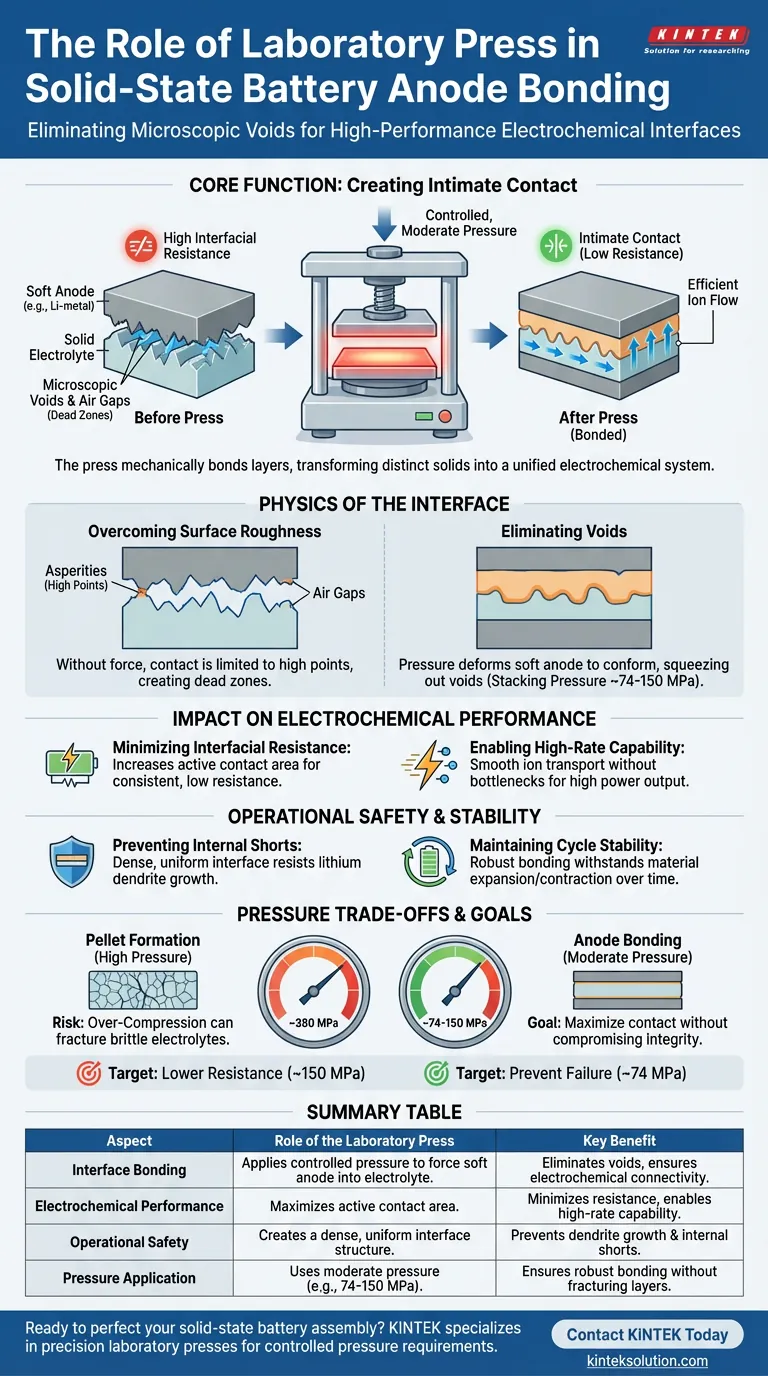
The primary role of a laboratory press in anode bonding is to eliminate microscopic voids between the anode material and the solid electrolyte. By applying a controlled, moderate pressure—typically lower than what is used to form the electrolyte pellet itself—the press forces the soft anode material (such as lithium-indium or lithium metal) into intimate contact with the electrolyte surface. This mechanical bonding is the defining step that establishes the low interfacial resistance necessary for the battery to function effectively.
The laboratory press transforms distinct solid layers into a unified electrochemical system. Its function during anode bonding is not merely structural, but electrochemical: it minimizes the physical distance ions must travel, thereby reducing internal resistance and enabling high-rate performance.
The Physics of the Interface
Overcoming Surface Roughness
Solid-state materials, even those that appear smooth, possess microscopic surface roughness. Without external force, an anode placed on an electrolyte touches only at high points (asperities).
This lack of contact creates "dead zones" where ions cannot flow. The laboratory press applies sufficient force to deform the softer anode material, making it conform to the topography of the harder electrolyte layer.
Eliminating Microscopic Voids
Air gaps or voids at the interface act as insulators for ion transport. The press effectively squeezes these voids out of the stack.
By applying specific stacking pressures (referenced, for example, around 74 MPa to 150 MPa), the press ensures a void-free physical connection. This "wetting" of the solid interface is analogous to how a liquid electrolyte wets a separator in traditional batteries.
Impact on Electrochemical Performance
Minimizing Interfacial Resistance
The single biggest barrier to solid-state battery efficiency is often the resistance at the solid-solid interface.
A laboratory press drastically reduces this resistance by increasing the active contact area. A well-pressed assembly ensures that the resistance remains low and consistent, rather than fluctuating unpredictably.
Enabling High-Rate Capability
For a battery to charge or discharge quickly, ions must move across the interface without bottlenecks.
High interfacial resistance creates heat and voltage drops that severely limit power output. By ensuring intimate contact, the press activates the battery’s ability to handle high-rate cycling without significant performance degradation.
Operational Safety and Stability
Preventing Internal Short Circuits
A dense, well-compacted structure is a critical safety feature. Loose interfaces can lead to uneven current distribution.
Uneven current can promote the growth of lithium dendrites, which may penetrate the electrolyte. The press helps create a uniform density that resists these internal defects.
Maintaining Cycle Stability
The bond created by the press must be stable over time.
As the battery charges and discharges, materials may expand and contract. The initial bonding pressure ensures the anode/electrolyte interface is robust enough to maintain connectivity throughout these physical changes.
Understanding the Pressure Trade-offs
Differentiating Bonding vs. Formation Pressure
It is critical to distinguish between pellet formation and anode bonding.
References indicate that forming the electrolyte pellet requires very high pressure (e.g., 380 MPa) to achieve density. However, bonding the anode generally utilizes lower pressure (e.g., 150 MPa or 74 MPa).
The Risk of Over-Compression
Applying too much pressure during the anode bonding phase can be detrimental.
Excessive force can fracture the brittle solid electrolyte layer or excessively deform soft anode materials. The goal is to maximize contact area without compromising the structural integrity of the underlying electrolyte framework.
Making the Right Choice for Your Goal
When configuring your laboratory press for anode assembly, your specific pressure targets should align with your performance objectives.
- If your primary focus is lowering internal resistance: Target a pressure (e.g., ~150 MPa) sufficient to plastically deform the anode material into the electrolyte's surface texture.
- If your primary focus is preventing mechanical failure: Use the minimum effective "stacking pressure" (e.g., ~74 MPa) that achieves void-free contact to avoid stressing the electrolyte pellet.
The laboratory press is not just a tool for compaction; it is the instrument that dictates the quality of the ionic bridge between your active materials.
Summary Table:
| Aspect | Role of the Laboratory Press | Key Benefit |
|---|---|---|
| Interface Bonding | Applies controlled pressure to force soft anode material into contact with the solid electrolyte. | Eliminates microscopic voids and air gaps. |
| Electrochemical Performance | Maximizes active contact area between anode and electrolyte. | Minimizes interfacial resistance, enabling high-rate capability. |
| Operational Safety | Creates a dense, uniform interface structure. | Prevents lithium dendrite growth and internal short circuits. |
| Pressure Application | Uses moderate pressure (e.g., 74-150 MPa) distinct from higher pellet formation pressures. | Ensures robust bonding without fracturing brittle electrolyte layers. |
Ready to perfect your solid-state battery assembly?
Anode bonding is a critical step that defines your battery's performance and safety. KINTEK specializes in precision laboratory presses—including automatic, isostatic, and heated models—designed specifically for the controlled pressure requirements of battery research and development.
Our presses help you achieve the intimate, void-free interfaces necessary for low resistance and high cycle stability. Let us provide the reliable tool you need to bridge the gap between your materials and your goals.
Contact KINTEK today to discuss your lab's specific needs and discover the right press for your anode bonding process.
Visual Guide
Related Products
- Laboratory Hydraulic Press Lab Pellet Press Button Battery Press
- Laboratory Hydraulic Press 2T Lab Pellet Press for KBR FTIR
- Laboratory Hydraulic Press Lab Pellet Press Machine for Glove Box
- Laboratory Hydraulic Pellet Press for XRF KBR FTIR Lab Press
- Laboratory Split Manual Heated Hydraulic Press Machine with Hot Plates
People Also Ask
- How is a laboratory hydraulic press used for HAP composite gels? Master Mineral Substrate Standardization
- What role does a laboratory hydraulic press play in the preparation of piezoelectric ceramic discs for DC-PG? | KINTEK
- What role does a laboratory hydraulic press play in reaction pellets? Optimizing Lunar Soil and Metal Fuel Density
- Why is a laboratory hydraulic press required for PBAT and PLA sample preparation? Achieve Flawless Characterization
- What role does a laboratory hydraulic press play in the assembly of all-solid-state battery test cells? Expert Guide



















