
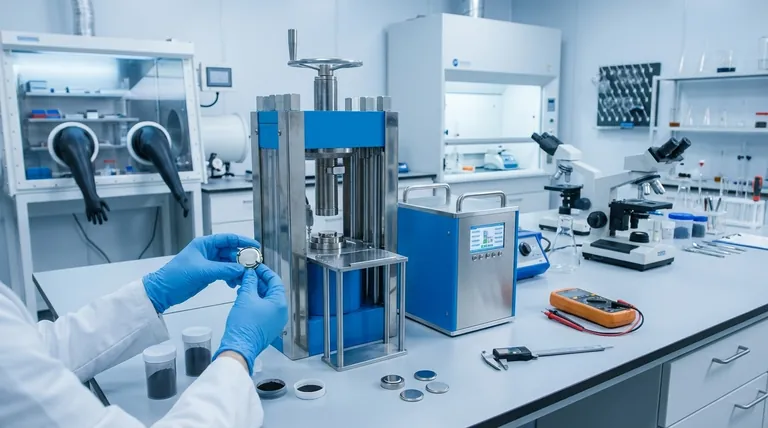
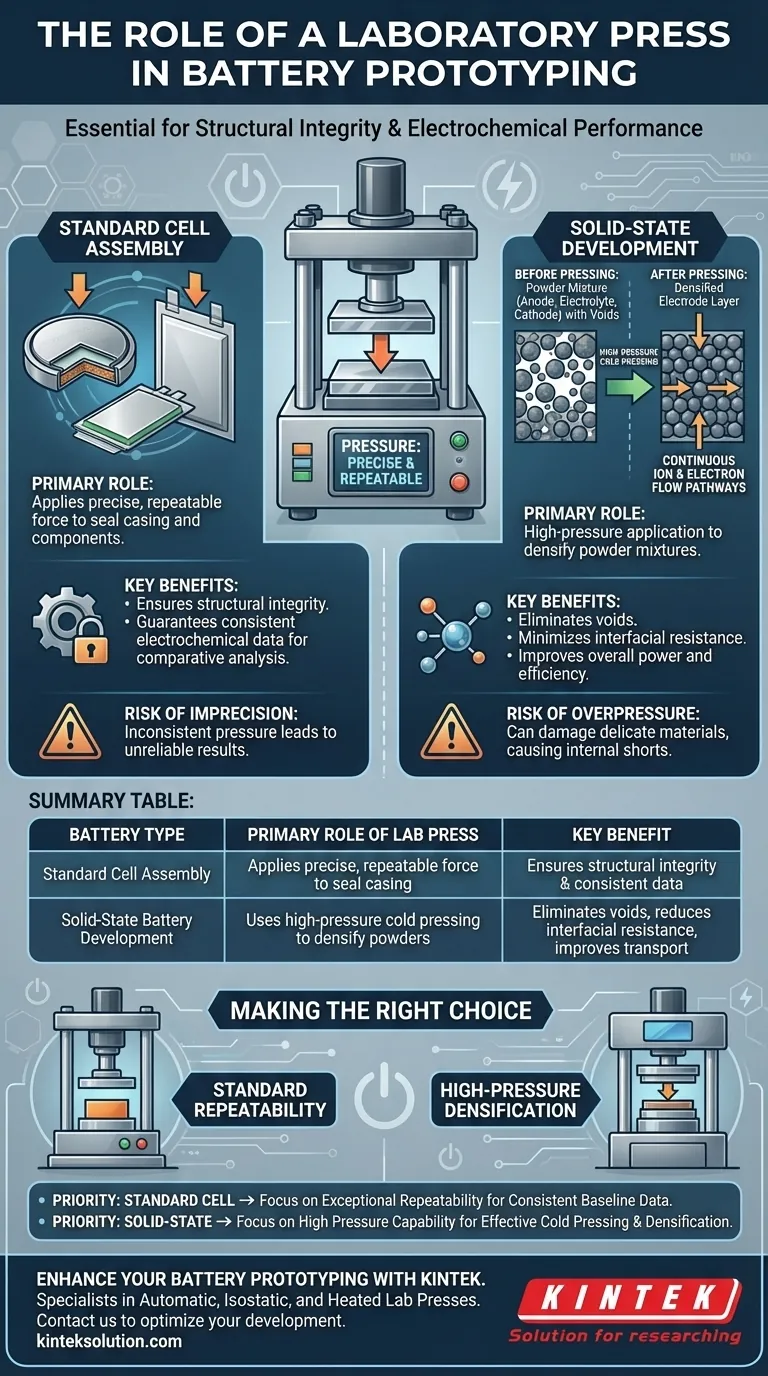
The primary role of a laboratory press in battery prototyping is to apply precise, repeatable mechanical force to assemble cell components. This equipment ensures the anode, cathode, separator, and casing are sealed tightly and uniformly. By guaranteeing structural integrity, the press creates the stable physical environment necessary for accurate electrochemical testing.
The press does more than mechanically bind parts; it is a tool for minimizing interfacial resistance. By forcing materials into intimate contact, it eliminates voids and creates the continuous pathways required for ion and electron flow, directly dictating the cell's performance.
Ensuring Structural Integrity and Consistency
The Importance of Uniform Sealing
In standard battery assembly, the press acts as the final arbiter of build quality. It applies force to seal the cell casing, locking the internal stack (anode, cathode, separator) in place.
This process must be precise and repeatable. If the pressure varies between prototypes, the structural integrity of the cells will differ, rendering comparative data useless.
Impact on Electrochemical Performance
A high-quality physical assembly is the prerequisite for reliable electrical performance. Without the uniform application of force provided by the press, components may shift or lose contact.
This loss of contact leads to inconsistent results during testing. Therefore, the press is critical for ensuring that the electrochemical data you collect reflects the chemistry of the battery, not errors in assembly.
The Critical Role in Solid-State Batteries
Densification via Cold Pressing
For all-solid-state batteries, the laboratory hydraulic press takes on a more complex role, often utilizing a cold pressing process.
This high-pressure application targets the mixture of active material powders, conductive additives, and solid electrolyte powders. The goal is to compress these loose materials into a dense, unified electrode layer.
Eliminating Voids and Resistance
The primary objective of this high-pressure assembly is the elimination of voids between particles.
When the press forces these powders into "intimate contact," it significantly reduces the space where ions cannot travel. This densification is non-negotiable for solid-state technology.
Establishing Transport Pathways
A dense electrode structure creates continuous highways for transport. By maximizing contact, the press ensures there are unbroken paths for both ions and electrons.
This direct contact significantly lowers interfacial resistance. Consequently, the mechanical action of the press directly improves the overall power and efficiency of the solid-state cell.
Understanding the Pitfalls
The Risk of Imprecise Application
While pressure is vital, the key operational term is precision.
Applying force without control can damage delicate separators or crush active materials, leading to internal shorts. Conversely, insufficient pressure fails to eliminate voids, resulting in high internal resistance and poor performance.
The "trade-off" here is not about the tool, but the calibration; the press must be set to the exact specifications of the chemistry being tested to avoid compromising the prototype.
Making the Right Choice for Your Goal
Ideally, your use of a laboratory press should align with the specific chemistry you are developing.
- If your primary focus is Standard Cell Assembly: Prioritize a press that offers exceptional repeatability to ensure every casing is sealed with identical force for consistent baseline data.
- If your primary focus is Solid-State Development: You require a hydraulic press capable of higher pressures to effectively cold-press powders and achieve the necessary densification for ion transport.
The laboratory press is not just an assembly tool; it is a critical instrument for defining the internal architecture and efficiency of your battery prototype.
Summary Table:
| Battery Type | Primary Role of Lab Press | Key Benefit |
|---|---|---|
| Standard Cell Assembly | Applies precise, repeatable force to seal casing and components. | Ensures structural integrity and consistent electrochemical data. |
| Solid-State Battery Development | Uses high-pressure cold pressing to densify electrode powders. | Eliminates voids, reduces interfacial resistance, and improves ion transport. |
Ready to enhance your battery prototyping with precision and reliability? KINTEK specializes in lab press machines—including automatic, isostatic, and heated lab presses—designed to meet the exacting demands of laboratory environments. Whether you're assembling standard cells or developing next-generation solid-state batteries, our equipment ensures the uniform force application and repeatability critical for accurate R&D. Contact us today to discuss how our lab presses can optimize your battery development process and deliver the performance you need.
Visual Guide
Related Products
- Laboratory Hydraulic Press Lab Pellet Press Button Battery Press
- Laboratory Hydraulic Press 2T Lab Pellet Press for KBR FTIR
- Laboratory Hydraulic Press Lab Pellet Press Machine for Glove Box
- Laboratory Split Manual Heated Hydraulic Press Machine with Hot Plates
- Laboratory Hydraulic Pellet Press for XRF KBR FTIR Lab Press
People Also Ask
- How is a laboratory hydraulic press used for HAP composite gels? Master Mineral Substrate Standardization
- What role does a laboratory hydraulic press play in the preparation of piezoelectric ceramic discs for DC-PG? | KINTEK
- What role does a laboratory hydraulic press play in reaction pellets? Optimizing Lunar Soil and Metal Fuel Density
- Why is a laboratory hydraulic press required for PBAT and PLA sample preparation? Achieve Flawless Characterization
- What role does a laboratory hydraulic press play in the assembly of all-solid-state battery test cells? Expert Guide



















