
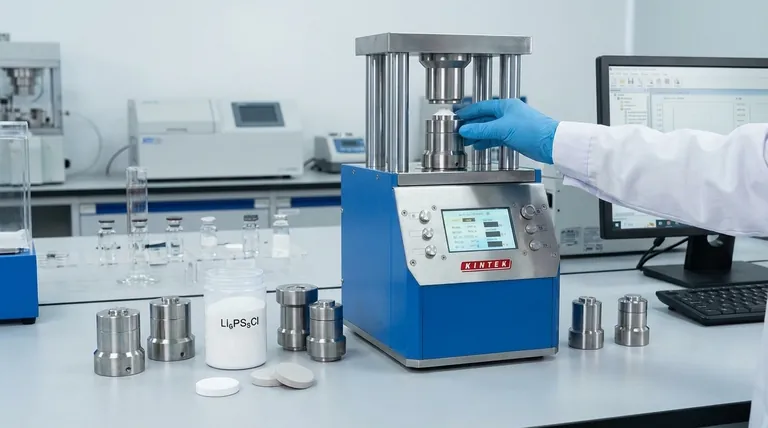
The role of a laboratory press is to transform loose Li6PS5Cl (LPSCI) powder into a dense, functional solid electrolyte separator through high-pressure compaction. By applying uniaxial pressure (typically between 370 and 390 MPa), the press minimizes internal porosity and maximizes particle-to-particle contact, creating a mechanically stable pellet with the high ionic conductivity required for battery operation.
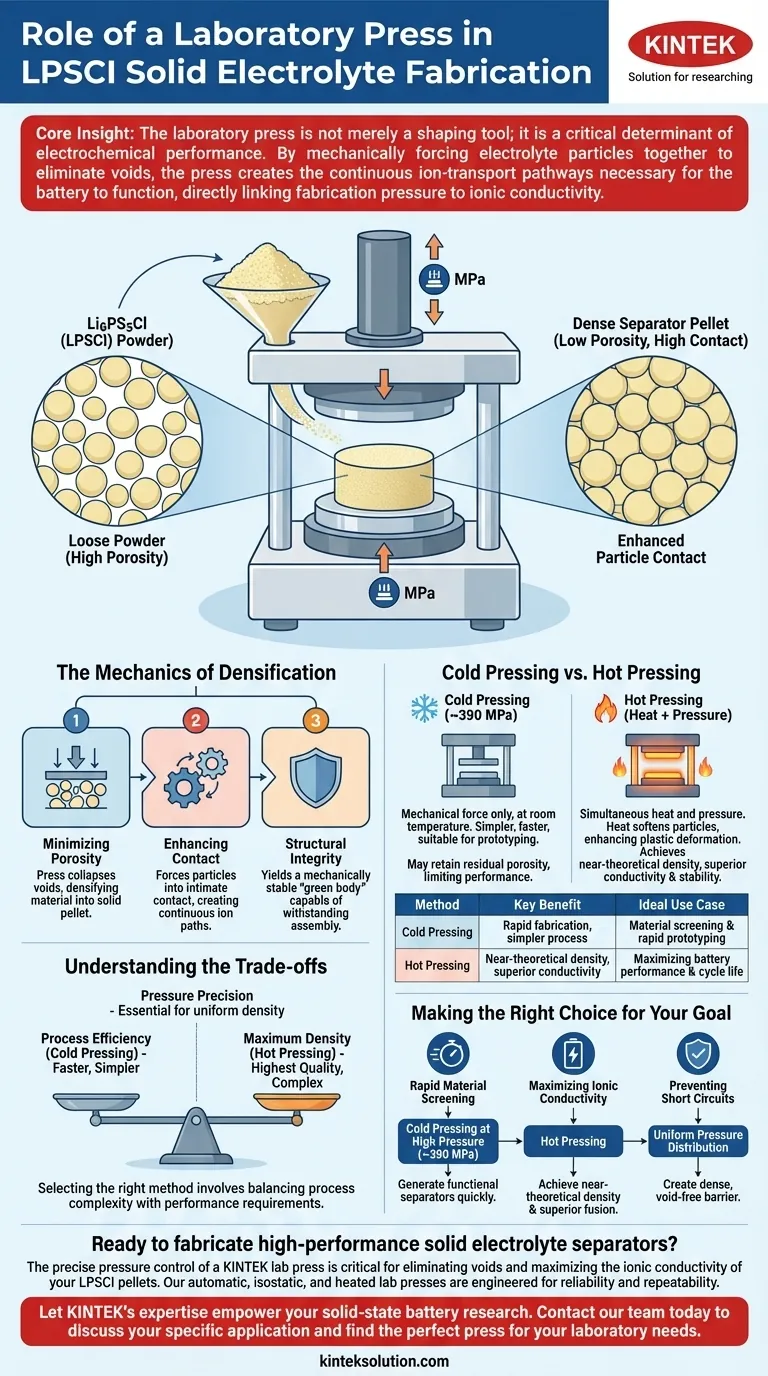
Core Insight: The laboratory press is not merely a shaping tool; it is a critical determinant of electrochemical performance. By mechanically forcing electrolyte particles together to eliminate voids, the press creates the continuous ion-transport pathways necessary for the battery to function, directly linking fabrication pressure to ionic conductivity.
The Mechanics of Densification
The primary function of the laboratory press is to overcome the natural resistance of loose powder to form a cohesive solid. This process is driven by the reduction of void volume.
Minimizing Porosity
Loose LPSCI powder contains significant amounts of empty space (voids) between particles. A hydraulic press applies uniform uniaxial force to collapse these voids, densifying the material into a solid pellet.
Enhancing Particle-to-Particle Contact
For lithium ions to move through the separator, they require a continuous physical path. The press forces individual powder particles into intimate contact, establishing the necessary interfaces for ion transfer.
Ensuring Structural Integrity
Beyond electrochemical needs, the separator must physically separate the anode and cathode. The compaction process yields a mechanically robust "green body" or pellet capable of withstanding assembly without crumbling or allowing internal short circuits.
Cold Pressing vs. Hot Pressing
While standard cold pressing is effective, the references highlight a distinct advantage when heat is introduced during the pressing stage.
The Limits of Cold Pressing
Standard cold pressing relies solely on mechanical force (e.g., 390 MPa) to compact the powder at room temperature. While this creates a functional separator, it may retain residual porosity that limits ultimate performance.
The Synergy of Hot Pressing
Hot pressing involves heating the press platens while applying pressure. This simultaneous application of heat softens the surface of the LPSCI particles, significantly enhancing their ability to plastically deform.
Achieving Theoretical Density
Because the heated particles deform more easily, they flow to fill voids that cold pressing cannot eliminate. This results in pellets that approach their theoretical density, offering superior ionic conductivity and mechanical stability compared to cold-pressed counterparts.
Understanding the Trade-offs
Selecting the right pressing method involves balancing process complexity with performance requirements.
Process Efficiency vs. Performance
Cold pressing is faster and requires simpler equipment, making it suitable for rapid prototyping. However, it may result in lower ionic conductivity due to imperfect particle contact.
Complexity vs. Maximum Density
Hot pressing yields the highest quality separators with the best cycling performance. However, it introduces thermal variables and requires specialized equipment capable of maintaining stable pressure and temperature simultaneously.
Pressure Precision
The application of pressure must be precise and stable (e.g., maintaining exactly 370 MPa). Inconsistent pressure can lead to density gradients within the pellet, causing uneven current distribution and potential failure points in the final battery.
Making the Right Choice for Your Goal
The optimal use of a laboratory press depends on the specific performance metrics required for your solid-state battery project.
- If your primary focus is rapid material screening: Utilize cold pressing at high pressures (approx. 390 MPa) to quickly generate functional separators with sufficient strength for basic testing.
- If your primary focus is maximizing ionic conductivity: Implement hot pressing, as the heat-induced plastic deformation allows the LPSCI to reach near-theoretical density and superior particle fusion.
- If your primary focus is preventing short circuits: Prioritize uniform pressure distribution to ensure the separator creates a dense, void-free barrier that physically isolates electrodes.
By controlling the density of the separator, the laboratory press acts as the gatekeeper for the efficiency and safety of all-solid-state batteries.
Summary Table:
| Pressing Method | Key Benefit | Ideal Use Case |
|---|---|---|
| Cold Pressing (~390 MPa) | Rapid fabrication, simpler process | Material screening and rapid prototyping |
| Hot Pressing (Heat + Pressure) | Near-theoretical density, superior conductivity | Maximizing battery performance and cycle life |
Ready to fabricate high-performance solid electrolyte separators?
The precise pressure control of a KINTEK lab press is critical for eliminating voids and maximizing the ionic conductivity of your LPSCI pellets. Whether you need the speed of cold pressing for R&D or the ultimate density of hot pressing for peak performance, our automatic lab presses, isostatic presses, and heated lab presses are engineered for reliability and repeatability.
Let KINTEK's expertise empower your solid-state battery research. Contact our team today to discuss your specific application and find the perfect press for your laboratory needs.
Visual Guide
References
- Jaka Šivavec, Kostiantyn V. Kravchyk. On the Feasibility of Pairing Pyrochlore Iron(III) Hydroxy Fluoride Cathode with Argyrodite Li<sub>6</sub>PS<sub>5</sub>Cl Solid‐State Electrolyte for Low‐Cost All‐Solid‐State Batteries. DOI: 10.1002/batt.202400731
This article is also based on technical information from Kintek Solution Knowledge Base .
Related Products
- Assemble Lab Cylindrical Press Mold for Laboratory Use
- Lab Cylindrical Press Mold for Laboratory Use
- Warm Isostatic Press for Solid State Battery Research Warm Isostatic Press
- Cylindrical Lab Electric Heating Press Mold for Laboratory Use
- Laboratory Hydraulic Split Electric Lab Pellet Press
People Also Ask
- What is the purpose of incorporating cartridge heaters into a lab press mold for MLCC block compression? Optimize Results
- What is the function of a pressing tool in thermoplastic panels? Master Precision Shaping & Fusion Bonding
- Why is precise cooling management of the lab press mold necessary? Protect Core Integrity in Thermoforming
- Why is a high-performance laboratory molding press critical for in-situ electrolyte formation? Unlock Battery Success
- How does the geometry of laboratory molds influence mycelium-based composites? Optimize Density and Strength



















