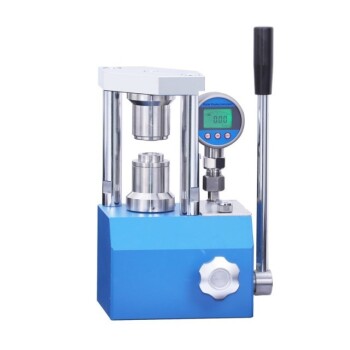
Coin cell assembly equipment acts as the definitive mechanism for integrating component layers into a functional Zinc Hybrid Supercapacitor (Zn-HSC). By using specialized sealing machines and molds, you apply precise mechanical pressure to the battery casing, forcing the zinc foil negative electrode, separator, electrolyte, and thiolated reduced graphene oxide (rGOSH) positive electrode into a unified, active stack.
The core function of this equipment is to create a hermetically sealed, pressurized environment that forces tight interfacial contact between internal components. This mechanical pressure is the prerequisite for minimizing electrical resistance and guaranteeing the validity of long-term stability data.
The Mechanics of Electrochemical Performance
Establishing Critical Interfacial Contact
The primary role of the assembly machinery is to eliminate microscopic gaps between layers.
The equipment applies targeted force to compress the zinc foil negative electrode, the separator, and the rGOSH positive electrode together. This ensures that the electrolyte creates a continuous ionic path between these solid components.
Minimizing Contact Resistance
A loose assembly results in high internal resistance, which degrades performance.
By maintaining a stable, pressurized environment, the assembly process minimizes contact resistance. This allows for efficient electron transfer and optimizes the power output of the Zn-HSC.
Ensuring Environmental Isolation
The sealing process does more than just hold the parts together; it isolates the chemistry.
Proper sealing prevents electrolyte evaporation, which is a common failure mode in open or poorly assembled cells. This retention of electrolyte is vital for maintaining the device's electrochemical capacity over time.
Understanding the Trade-offs of Assembly Quality
The Risk of Inconsistent Pressure
If the mechanical pressure applied by the equipment is uneven or insufficient, the data collected becomes unreliable.
Variations in pressure lead to fluctuations in contact resistance. This makes it impossible to distinguish between the intrinsic properties of the rGOSH material and artifacts caused by poor assembly.
The Impact on Cycling Stability Tests
Reliability in assembly is directly linked to the validity of your testing.
The primary reference notes that a stable environment is crucial for cycling stability tests. Without the precise mechanical seal provided by this equipment, long-term cycling results will be skewed by environmental factors rather than reflecting the true degradation of the battery chemistry.
Making the Right Choice for Your Goal
To maximize the effectiveness of your Zn-HSC fabrication, consider how the assembly process aligns with your specific objectives.
- If your primary focus is electrical efficiency: Prioritize the precision of the mechanical pressure to ensure maximum interfacial contact and minimum resistance.
- If your primary focus is long-term data validation: Ensure the sealing integrity is flawless to prevent electrolyte loss and guarantee that cycling stability results are reproducible.
Precision in assembly is not merely a manufacturing step; it is a fundamental variable in the electrochemical equation.
Summary Table:
| Component/Process | Role in Zn-HSC Assembly | Impact on Performance |
|---|---|---|
| Sealing Machine | Hermetic isolation & mechanical pressure | Prevents electrolyte loss & ensures airtight seal |
| Precision Molds | Uniform compression of electrode stack | Minimizes contact resistance & gaps |
| Interfacial Contact | Bonding zinc foil, separator, & rGOSH | Creates a continuous ionic path for electron transfer |
| Cycling Stability | Maintaining a pressurized environment | Guarantees reproducible data and long-term durability |
Elevate Your Battery Research with KINTEK Precision
Maximize the electrochemical performance and data reliability of your Zinc Hybrid Supercapacitors with KINTEK’s industry-leading assembly solutions. We specialize in comprehensive laboratory pressing equipment, including manual, automatic, heated, and multifunctional models, as well as specialized isostatic presses designed for the most demanding battery research applications.
Don't let inconsistent pressure or poor sealing compromise your cycling stability tests. Our equipment ensures the precise mechanical integrity needed to minimize resistance and optimize power output. Contact us today to find the perfect pressing solution for your lab!
References
- Cataldo Valentini, Paolo Samorı́. Boosting Zinc Hybrid Supercapacitor Performance via Thiol Functionalization of Graphene‐Based Cathodes. DOI: 10.1002/advs.202309041
This article is also based on technical information from Kintek Solution Knowledge Base .
Related Products
- Lab Button Battery Tablet Press Sealing Mold
- Button Battery Sealing Press Machine for Lab
- Assemble Lab Cylindrical Press Mold for Laboratory Use
- Lab Button Battery Disassembly and Sealing Mold
- Button Battery Sealing Machine for Button Batteries
People Also Ask
- How does a sealed battery mold facilitate the assembly and testing of asymmetric supercapacitors using VO2?
- Why use standardized CR2032 components & high-precision presses? Ensure reliability in lithium metal battery research.
- Why is a laboratory battery sealing press essential for desolvation energy testing? Ensure Reliable Kinetic Data
- What is the function of specialized battery molds and sealing consumables? Optimize Your In-situ XRD Testing Today
- What role does a laboratory sealing press play in thermal analysis of solid dispersion films? Ensure Data Integrity