
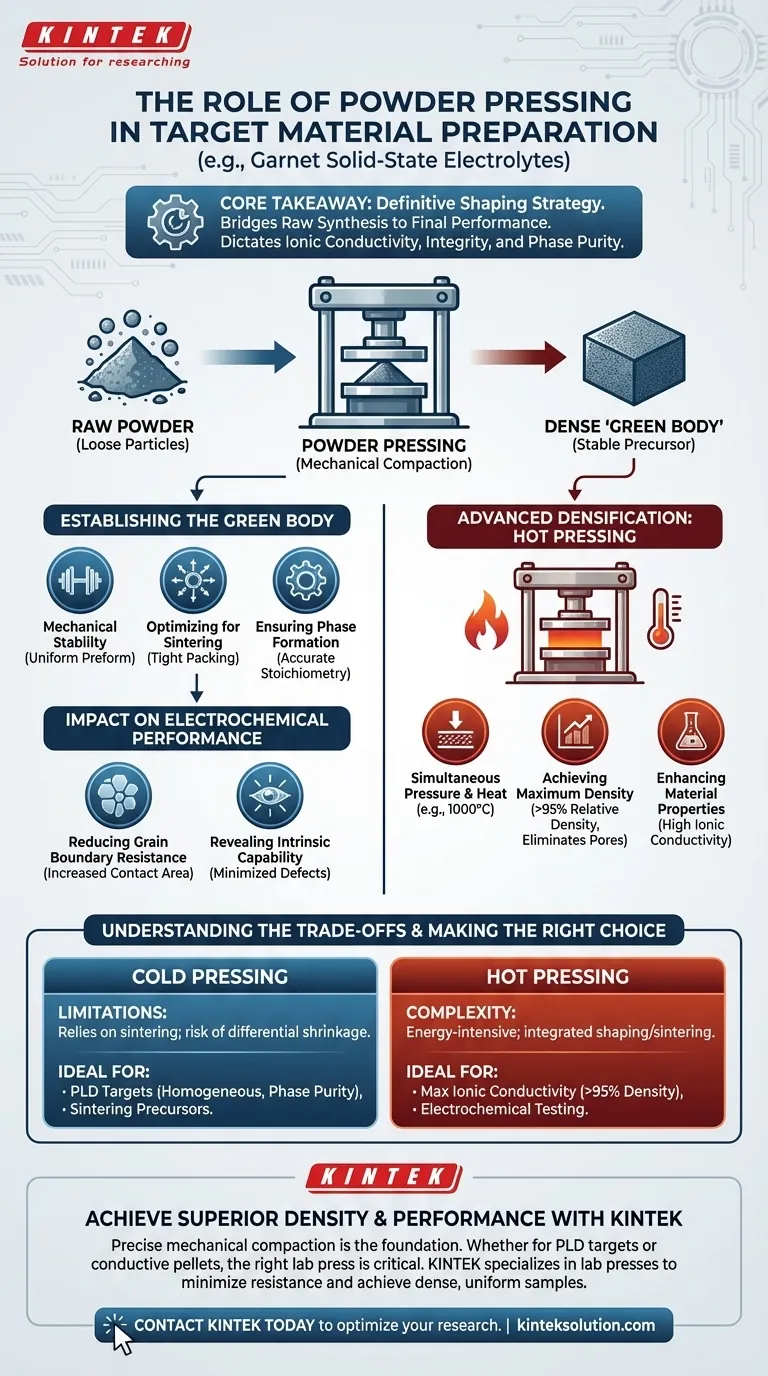
Powder pressing acts as the definitive shaping strategy in the fabrication of ceramic targets, serving as the bridge between raw synthesis and final material performance. It transforms loose powder into a dense, mechanically stable "green body," establishing the particle packing necessary for uniform densification and accurate stoichiometry in applications like garnet solid-state electrolytes.
Core Takeaway The primary function of powder pressing is to minimize void space and maximize particle-to-particle contact early in the fabrication process. This mechanical compaction is not merely about shaping; it directly dictates the final ionic conductivity, structural integrity, and phase purity of the material by reducing grain boundary resistance and enabling high-density sintering.
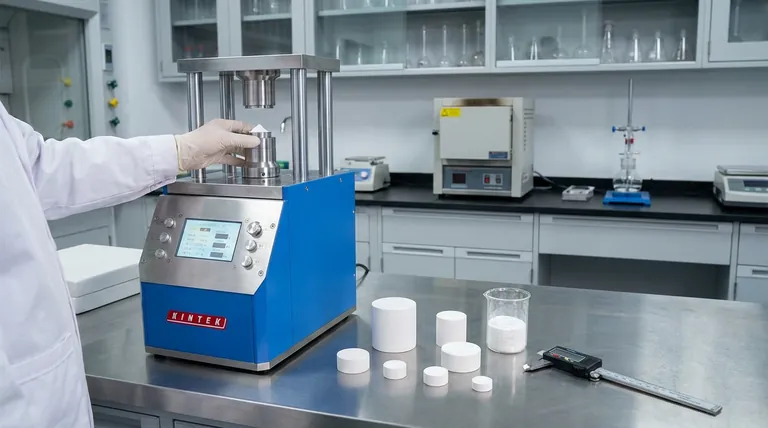
Establishing the "Green Body" Precursor
Before a material can be used as a target for Pulsed Laser Deposition (PLD) or tested in a battery, it must possess structural integrity. Powder pressing creates this foundation.
Mechanical Stability and Uniformity
Using a lab press machine, raw synthesized powder is compacted into a dense preform known as a "green body" or "powder compact." This process ensures the material is mechanically stable enough to be handled and processed further without crumbling.
Optimizing for Sintering
A precisely pressed compact is a prerequisite for successful high-temperature sintering (e.g., at 1050°C). By creating a homogeneous precursor with tight particle packing, you ensure that the material densifies uniformly during heat treatment, preventing warping or cracking.
Ensuring Phase Formation
The pressure applied during this stage is critical for the formation of the desired crystal phase structure. Proper compaction allows for the atomic diffusion required to achieve accurate stoichiometry, which is essential for the functionality of complex materials like garnet electrolytes.
The Impact on Electrochemical Performance
For solid-state electrolytes, the physical arrangement of particles directly correlates to electrical efficiency.
Reducing Grain Boundary Resistance
The application of high pressure minimizes voids and significantly increases the contact area between powder particles. In electrochemical impedance spectroscopy (EIS), this is vital because it reduces the resistance found at grain boundaries.
Revealing Intrinsic Capability
By minimizing structural defects through pressing, the data collected during testing reflects the material's intrinsic ionic transport capability rather than artifacts caused by poor contact or porosity.
Advanced Densification: The Role of Hot Pressing
While cold pressing prepares a precursor, hot pressing combines thermal and mechanical energy for superior results.
Simultaneous Pressure and Heat
In the fabrication of Perovskite or Garnet-type ceramics, hot pressing applies uniaxial pressure while simultaneously heating the material (e.g., to 1000°C). This technique is distinct from cold pressing followed by sintering.
Achieving Maximum Density
This process actively promotes the sintering of powder particles, effectively eliminating internal pores. The result is a highly dense pellet with a relative density exceeding 95%, which is difficult to achieve through cold pressing alone.
Enhancing Material Properties
The near-total elimination of porosity via hot pressing is essential for realizing high ionic conductivity and superior mechanical strength, both of which are non-negotiable for high-performance solid-state batteries.
Understanding the Trade-offs
While pressing is fundamental, choosing the right method requires understanding the limitations of each approach.
Cold Pressing Limitations
Cold pressing is excellent for creating precursors, but it relies heavily on the subsequent sintering step to achieve final density. If the initial packing is non-uniform, the final product may suffer from differential shrinkage, leading to voids or structural weakness that post-sintering cannot fix.
Hot Pressing Complexity
Hot pressing yields superior density (>95%) and conductivity, but it is a more complex, energy-intensive process. It integrates the shaping and sintering steps, which offers less flexibility if you need to modify the shape or chemistry of the "green body" prior to final heating.
Making the Right Choice for Your Goal
To select the correct pressing strategy, you must align the process with your specific end-application.
- If your primary focus is Pulsed Laser Deposition (PLD) targets: Prioritize cold pressing to create a homogeneous, accurate stoichiometric "green body" that can withstand long-duration sintering at 1050°C without losing phase purity.
- If your primary focus is maximum Ionic Conductivity: Utilize hot pressing to drive relative density above 95%, ensuring that internal pores do not impede ion transport.
- If your primary focus is Electrochemical Testing (EIS): Ensure sufficient pressure is applied during pellet preparation to minimize grain boundary resistance, guaranteeing your data measures the material's chemistry rather than its porosity.
Ultimate target performance is not determined by the chemistry alone, but by how rigorously you control the physical compaction of that chemistry.
Summary Table:
| Pressing Method | Key Function | Impact on Final Material | Ideal For |
|---|---|---|---|
| Cold Pressing | Creates a mechanically stable "green body" precursor | Enables uniform sintering; ensures phase purity and accurate stoichiometry | Preparing PLD targets; creating precursors for sintering |
| Hot Pressing | Applies heat and pressure simultaneously for densification | Achieves >95% relative density; minimizes pores for maximum ionic conductivity | Maximizing ionic conductivity for electrochemical testing |
Achieve superior density and performance in your solid-state electrolyte research.
The precise mechanical compaction provided by powder pressing is not just a shaping step—it's the foundation for high ionic conductivity and reliable electrochemical data. Whether your goal is creating a perfect PLD target or a highly conductive pellet for testing, the right lab press is critical.
KINTEK specializes in lab press machines, including automatic and heated lab presses, designed to meet the rigorous demands of ceramic and electrolyte fabrication. Our equipment helps researchers like you minimize grain boundary resistance and achieve the dense, uniform samples necessary for accurate, high-performance results.
Ready to optimize your target material preparation? Contact KINTEK today to discuss how our lab press solutions can enhance your solid-state battery research.
Visual Guide
Related Products
- Lab Polygon Press Mold
- XRF KBR Plastic Ring Lab Powder Pellet Pressing Mold for FTIR
- Lab XRF Boric Acid Powder Pellet Pressing Mold for Laboratory Use
- Lab Round Bidirectional Press Mold
- Square Bidirectional Pressure Mold for Lab
People Also Ask
- What is the purpose of incorporating cartridge heaters into a lab press mold for MLCC block compression? Optimize Results
- How do the design and geometric precision of pressing molds and mandrels affect the quality of PTFE composite samples?
- What role do precision positioning and pressure molds play in single-lap joints? Ensure 100% Data Integrity
- What are the requirements for pressing molds when using SSCG? Key Materials for Complex Single Crystal Production
- How do industrial-grade pressure molds affect zinc metal pouch cells? Maximize Energy Density & Performance



















