
Sequential pressing is a layer-by-layer fabrication technique used to construct high-density all-solid-state battery components using a laboratory hydraulic press.
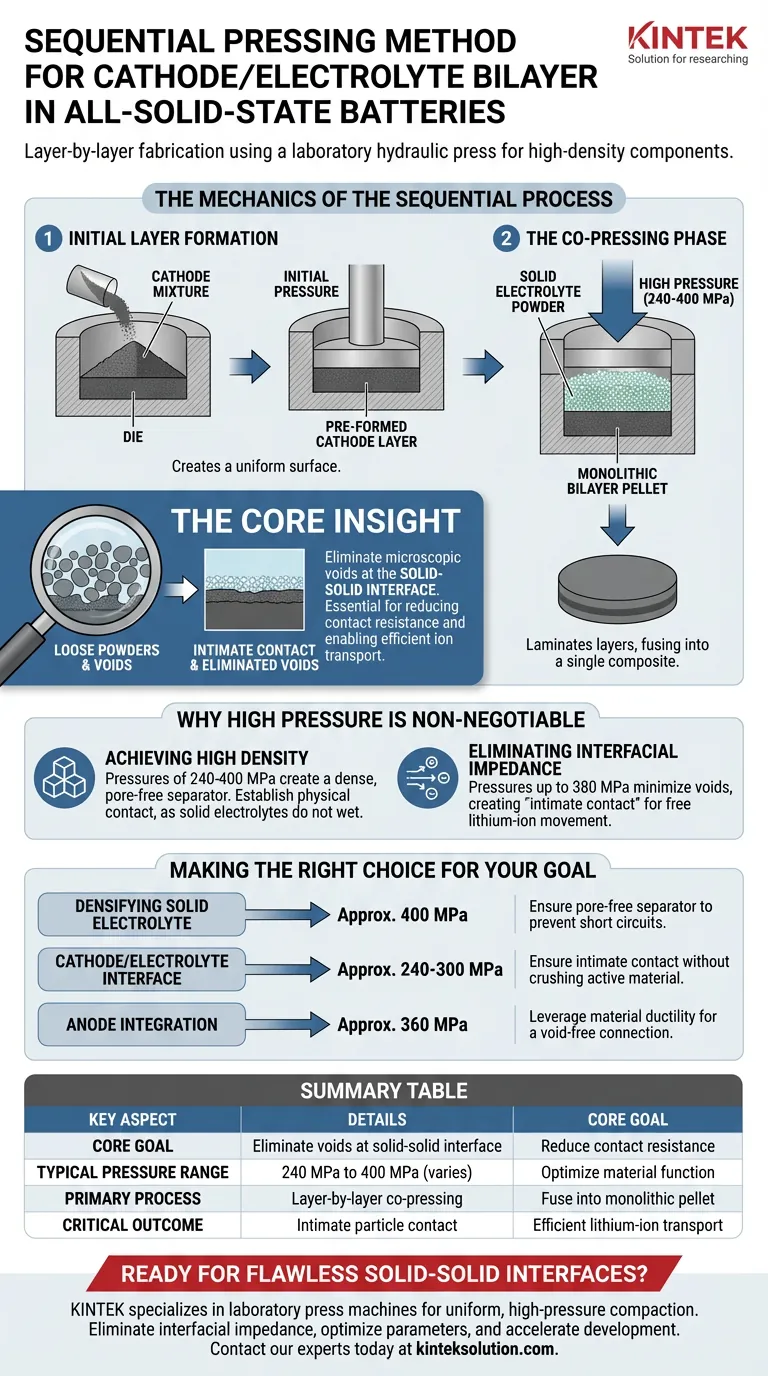
To create a cathode/electrolyte bilayer specifically, the process involves first loading the cathode mixture into a die and applying initial pressure to form a base layer. Subsequently, the solid electrolyte powder is distributed evenly on top of this pre-formed cathode layer, and the entire stack is co-pressed at high pressure to fuse the two materials into a single, integrated composite pellet.
The Core Insight: The primary function of sequential pressing is not merely to shape the battery cell, but to eliminate microscopic voids at the solid-solid interface. Without sufficient mechanical pressure, the contact resistance between the cathode and electrolyte remains too high for efficient ion transport, rendering the battery ineffective.
The Mechanics of the Sequential Process
Initial Layer Formation
The process begins by creating a stable foundation. The cathode composite powder is loaded into the press mold.
Pressure is applied to this layer to flatten and lightly compact it. This creates a uniform surface ready to receive the subsequent electrolyte layer without mixing the powders chaotically.
The Co-Pressing Phase
Once the electrolyte powder is added on top of the cathode layer, the critical bonding step occurs.
The hydraulic press applies a massive, uniform load to the entire stack. This action laminates the layers together, transforming loose powders into a monolithic bilayer pellet where the materials are mechanically locked together.
Why High Pressure is Non-Negotiable
Achieving High Density
Solid-state electrolytes do not wet the cathode like liquid electrolytes; they require physical force to establish contact.
References indicate that pressures ranging from 240 MPa to 400 MPa are necessary. This extreme compaction creates a dense, pore-free separator layer that is mechanically robust.
Eliminating Interfacial Impedance
The greatest barrier to all-solid-state battery performance is the resistance at the particle boundaries.
By applying pressures up to 380 MPa, you minimize the voids and porosity between particles. This creates "intimate contact" between the cathode active material and the solid electrolyte, which is the fundamental requirement for lowering interfacial impedance and enabling lithium ions to move freely.
Understanding the Trade-offs
The Necessity of Uniformity
While high pressure is required, it must be applied uniformly. A laboratory press is essential here because it delivers precise force distribution.
Uneven pressure can lead to density gradients or warping. If the pressure is too low (below ~240 MPa), voids will remain at the interface, acting as insulating barriers that block ion flow and degrade performance.
Material Deformation
The pressing process relies on the ductility of the materials.
For example, when pressing sodium metal anodes or specific sulfide electrolytes (like LPSCl), the pressure (e.g., 360-400 MPa) leverages the material's ability to deform. This plastic deformation fills microscopic gaps, creating a seamless, void-free interface that would be impossible to achieve through loose stacking alone.
Making the Right Choice for Your Goal
The specific pressure you apply should be dictated by the materials used and the layer's function.
- If your primary focus is densifying the Solid Electrolyte: Apply higher pressures (approx. 400 MPa) to ensure a pore-free separator layer that prevents short circuits.
- If your primary focus is the Cathode/Electrolyte Interface: Use moderate-to-high pressure (approx. 240 MPa to 300 MPa) to ensure intimate contact without crushing the cathode active material particles.
- If your primary focus is Anode Integration: Utilize the metal's ductility with pressures around 360 MPa to ensure a void-free connection after the bilayer is formed.
Success in solid-state battery fabrication is defined by the quality of the solid-solid contact, which is directly controlled by the precision and magnitude of your pressing strategy.
Summary Table:
| Key Aspect | Details |
|---|---|
| Core Goal | Eliminate voids at the solid-solid interface to reduce contact resistance. |
| Typical Pressure Range | 240 MPa to 400 MPa, depending on the material and layer function. |
| Primary Process | Layer-by-layer co-pressing to fuse cathode and electrolyte into a monolithic pellet. |
| Critical Outcome | Creates intimate contact between particles for efficient lithium-ion transport. |
Ready to Achieve Flawless Solid-Solid Interfaces in Your Battery Research?
Sequential pressing is the key to unlocking high-performance all-solid-state batteries, but it requires precise control and high pressure. KINTEK specializes in laboratory press machines—including automatic, isostatic, and heated lab presses—designed to deliver the uniform, high-pressure compaction essential for your R&D.
Our robust and reliable equipment empowers researchers like you to:
- Eliminate Interfacial Impedance: Achieve the dense, pore-free layers necessary for efficient ion transport.
- Optimize Material-Specific Parameters: Precisely control pressure from 240 MPa to 400 MPa for cathodes, electrolytes, or anodes.
- Accelerate Your Development Cycle: Produce consistent, high-quality bilayer pellets with every press.
Don't let interfacial resistance limit your battery's potential. Contact our experts today to find the perfect lab press for your specific materials and fabrication goals!
Visual Guide
Related Products
- Automatic Laboratory Hydraulic Press for XRF and KBR Pellet Pressing
- Lab Round Bidirectional Press Mold
- Lab Cylindrical Press Mold with Scale
- Automatic Laboratory Hydraulic Press Lab Pellet Press Machine
- Lab Isostatic Pressing Molds for Isostatic Molding
People Also Ask
- Why is pressing powder into a pellet critical before sintering? Ensure Dense, Conductive Solid-State Electrolytes
- What is the role of a laboratory pressure machine and KBr in FTIR? Master Sample Preparation for Flame Retardants
- What are the advantages of using a laboratory automatic hydraulic press for HEA green compact forming?
- What are the advantages of using a lab automatic hydraulic press for HEA green body molding? Ensure Material Integrity
- How does an automatic laboratory hydraulic press improve KBr pellet preparation? Achieve Precision IR Spectroscopy






