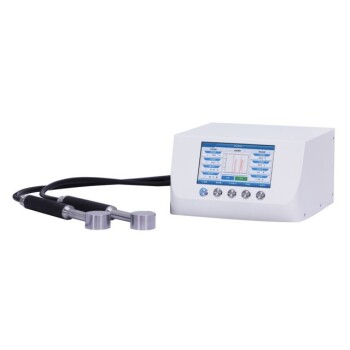
The heated roller is the central bonding mechanism in the ceramic Laminated Object Manufacturing (LOM) process. Its primary function is to simultaneously apply heat and mechanical pressure to the ceramic tapes as they are stacked layer by layer. This specific combination of thermal and physical energy activates the binders within the material to create a cohesive solid.
The heated roller transforms distinct ceramic layers into a unified whole by activating thermoplastic binders, a step essential for preventing structural failure during post-processing.
Establishing the Interlayer Bond
The significance of the heated roller lies in its ability to change the chemical state of the ceramic tape's components. It is not merely a flattening tool; it is a catalyst for adhesion.
Thermal Activation of Binders
Ceramic tapes used in LOM contain specific binders that are sensitive to temperature. The heat from the roller is calibrated to activate these binders, transitioning them into a state where they can adhere to the layer below.
Without this thermal input, the binders would remain inert. The layers would simply sit on top of one another without forming a true physical connection.
Creating a Thermoplastic Bond
The goal of the roller is to generate a thermoplastic bond. This is a specific type of adhesion where the material softens upon heating and hardens upon cooling.
As the roller passes over the tape, it creates an immediate, durable fusion between the current layer and the previous one.
The Critical Role in Defect Prevention
While the roller operates during the initial build phase, its true significance is revealed during the subsequent processing stages. The quality of the bond created here dictates the survival of the part later on.
Preventing Delamination
The most common failure mode in laminated manufacturing is delamination, where layers separate or peel apart.
If the heated roller fails to apply adequate heat or pressure, the bond will be weak. This weakness inevitably leads to cracks or total separation between the ceramic layers.
Surviving Debinding and Sintering
After the LOM process, the "green" (unfinished) part must undergo debinding and sintering. These are high-stress environments where the binder is burned out and the ceramic particles fuse.
If the thermoplastic bond created by the heated roller is insufficient, the part will not withstand the internal stresses of these stages. A reliable bond is the only defense against defects during these final, critical steps.
Ensuring Process Reliability
The heated roller is the variable that connects the raw material to the finished geometry. Adjusting its parameters allows you to control the structural integrity of the final ceramic part.
- If your primary focus is part durability: Prioritize higher pressure and precise temperature control to maximize the strength of the thermoplastic bond.
- If your primary focus is defect reduction: Ensure the roller temperature is sufficient to fully activate the binders to prevent delamination during sintering.
The heated roller acts as the gatekeeper of quality, ensuring that individual tapes fuse into a single, robust component capable of surviving the kiln.
Summary Table:
| Feature | Role of Heated Roller | Impact on Final Ceramic Part |
|---|---|---|
| Thermal Energy | Activates thermoplastic binders in ceramic tapes | Enables chemical bonding between individual layers |
| Mechanical Pressure | Ensures uniform contact and compaction | Minimizes air gaps and increases green body density |
| Interlayer Bonding | Creates a cohesive thermoplastic bond | Prevents structural delamination during handling |
| Post-Processing | Reinforces part structure | Ensures survival during high-stress debinding and sintering |
Elevate Your Advanced Ceramic Research with KINTEK
Precise bonding is the foundation of high-performance ceramic manufacturing. At KINTEK, we specialize in comprehensive laboratory pressing solutions designed to meet the rigorous demands of material science. Whether you are conducting battery research or developing complex laminates, our range of equipment—including manual, automatic, heated, and multifunctional presses, as well as cold and warm isostatic presses (CIP/WIP)—ensures your materials achieve maximum density and structural integrity.
Don't let delamination compromise your results. Partner with KINTEK for glovebox-compatible systems and tailored pressing technology that scales with your innovation.
Contact our technical experts today to find your ideal pressing solution!
References
- Yazid Lakhdar, Ruth Goodridge. Additive manufacturing of advanced ceramic materials. DOI: 10.1016/j.pmatsci.2020.100736
This article is also based on technical information from Kintek Solution Knowledge Base .
Related Products
- Heated Hydraulic Press Machine with Heated Plates for Vacuum Box Laboratory Hot Press
- Heated Hydraulic Press Machine With Heated Plates For Vacuum Box Laboratory Hot Press
- Automatic Heated Hydraulic Press Machine with Heated Plates for Laboratory
- Automatic High Temperature Heated Hydraulic Press Machine with Heated Plates for Lab
- 24T 30T 60T Heated Hydraulic Lab Press Machine with Hot Plates for Laboratory
People Also Ask
- How does a laboratory heated hydraulic press facilitate PBN sample prep for WAXS? Achieve Precise X-Ray Scattering
- What are the requirements for electrode pressing with high-viscosity ionic liquids like EMIM TFSI? Optimize Performance
- What are the industrial applications of heated hydraulic presses? Master Heat & Force for Precision Manufacturing
- Function of a Laboratory Hydraulic Press with Heated Platens in SSE? Enhance Battery Density & Conductivity
- How are heated hydraulic presses utilized in the preparation of thin films? Key Mechanisms and Applications