
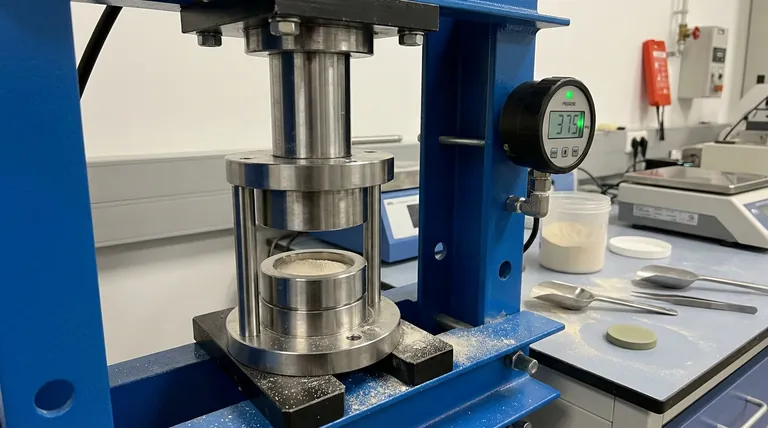
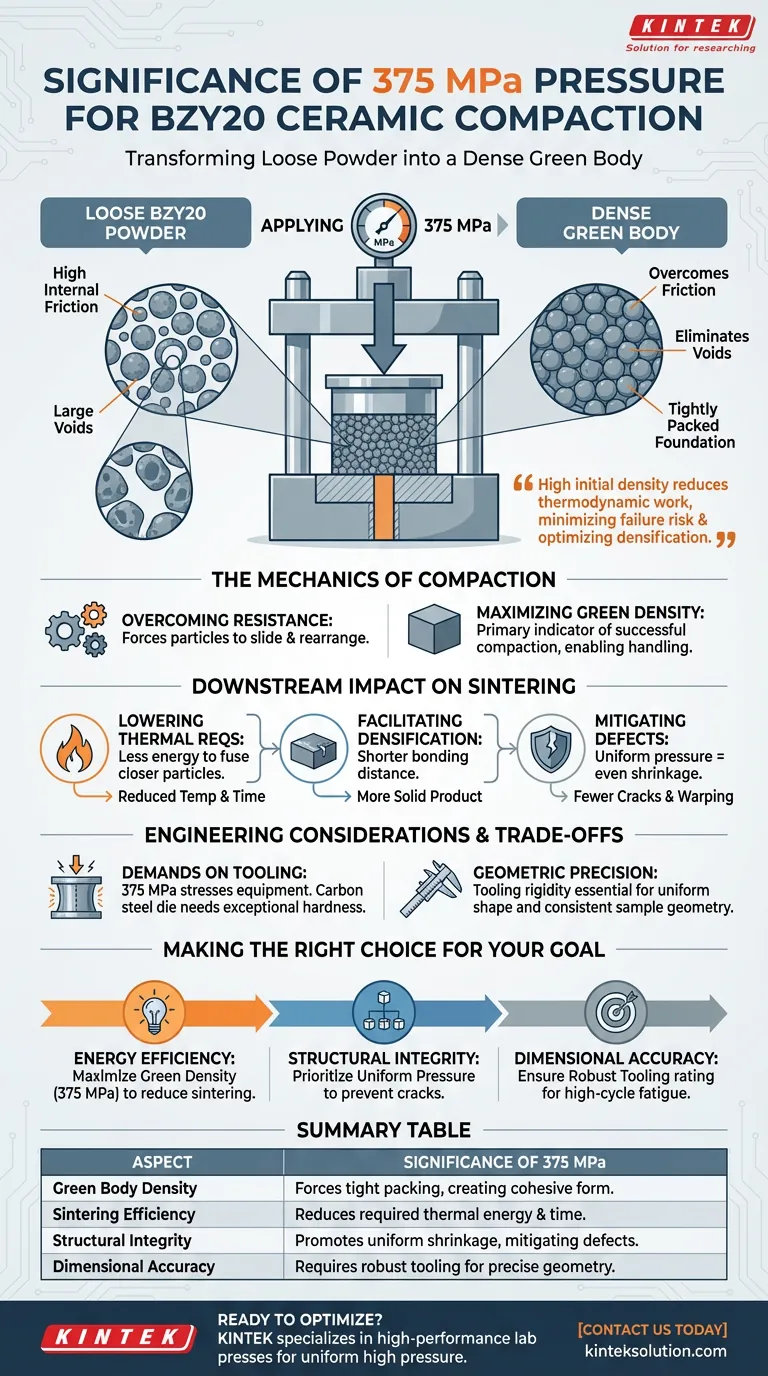
Applying a high pressure of 375 MPa is the critical mechanical step required to transform loose BZY20 powder into a dense, cohesive "green body." This specific pressure level is necessary to overcome internal friction between particles, eliminating voids and forcing a tightly packed arrangement that serves as the foundation for all subsequent processing.
By achieving a high initial density through extreme pressure, you reduce the thermodynamic work required later in the process. This directly minimizes the risk of structural failure during sintering and optimizes the final densification of the ceramic.
The Mechanics of Compaction
Overcoming Particle Resistance
Loose ceramic powder naturally contains voids and resists packing due to friction between individual grains.
Applying 375 MPa provides the force necessary to overcome this inter-particle friction. It forces the particles to slide past one another and rearrange into a significantly tighter configuration.
Maximizing Green Density
The immediate result of this process is an increase in "green density," which is the density of the unfired object.
A high green density is the primary indicator of a successful compaction phase. It ensures the precursor material is solid enough to be handled and chemically consistent enough for firing.
Downstream Impact on Sintering
Lowering Thermal Requirements
High compaction pressure directly influences the efficiency of the sintering (firing) stage.
Because the particles are already mechanically packed close together, less thermal energy is required to fuse them. This can lower both the required sintering temperature and the duration of the heating cycle.
Facilitating Densification
The ultimate goal of ceramic fabrication is to remove porosity to create a solid part.
Starting with a high green density facilitates this densification process. The particles have less distance to travel to bond with neighbors, resulting in a more solid final product.
Mitigating Structural Defects
One of the most common failure modes in ceramics is cracking caused by non-uniform shrinkage.
By applying uniform high pressure, you ensure the green body shrinks evenly during heating. This minimizes the internal stresses that lead to cracks and warping.
Engineering Considerations and Trade-offs
Demands on Tooling
The application of 375 MPa places immense stress on the manufacturing equipment.
The die, typically made of carbon steel, serves as the cavity that defines the cylinder or shape of the ceramic. It must possess exceptional hardness and wear resistance to withstand these forces without deformation.
Geometric Precision
If the tooling cannot support the pressure, the die may deform, leading to inconsistencies in the final part.
To ensure every BZY20 sample has a well-defined geometry, the die must maintain its shape rigidly under load. This is essential for ensuring uniformity in performance tests and final application.
Making the Right Choice for Your Goal
To optimize your BZY20 fabrication process, align your pressing parameters with your specific objectives:
- If your primary focus is energy efficiency: Utilize high pressure (375 MPa) to maximize green density, allowing you to reduce sintering temperatures and dwell times.
- If your primary focus is structural integrity: Prioritize uniform pressure application to prevent differential shrinkage and eliminate cracking during the cooling phase.
- If your primary focus is dimensional accuracy: Ensure your carbon steel die is rated for high-cycle fatigue at 375 MPa to prevent deformation and ensure consistent sample geometry.
High-pressure compaction is not just about shaping powder; it is the prerequisite for a defect-free, high-performance ceramic material.
Summary Table:
| Aspect | Significance of 375 MPa Pressure |
|---|---|
| Green Body Density | Forces tight particle packing, creating a solid, cohesive pre-sintered form. |
| Sintering Efficiency | Reduces required thermal energy and time by minimizing particle travel distance. |
| Structural Integrity | Promotes uniform shrinkage, mitigating internal stresses that cause cracks and warping. |
| Dimensional Accuracy | Requires robust tooling to maintain precise sample geometry under extreme load. |
Ready to optimize your BZY20 ceramic fabrication process with precise compaction?
KINTEK specializes in high-performance lab press machines, including automatic and heated lab presses designed to deliver the uniform high pressure (like 375 MPa) essential for your research and production. Our robust equipment ensures you achieve maximum green density, efficient sintering, and defect-free ceramic components.
Contact us today using the form below to discuss how our presses can enhance your lab's capabilities and help you create superior ceramic materials.
Visual Guide
Related Products
- Lab Round Bidirectional Press Mold
- Lab Polygon Press Mold
- Laboratory Hydraulic Press Lab Pellet Press Machine for Glove Box
- Laboratory Hydraulic Press 2T Lab Pellet Press for KBR FTIR
- Automatic High Temperature Heated Hydraulic Press Machine with Heated Plates for Lab
People Also Ask
- What is the purpose of incorporating cartridge heaters into a lab press mold for MLCC block compression? Optimize Results
- Why is precise cooling management of the lab press mold necessary? Protect Core Integrity in Thermoforming
- What is the function of a pressing tool in thermoplastic panels? Master Precision Shaping & Fusion Bonding
- Why is a high-performance laboratory molding press critical for in-situ electrolyte formation? Unlock Battery Success
- How do the design and geometric precision of pressing molds and mandrels affect the quality of PTFE composite samples?



















