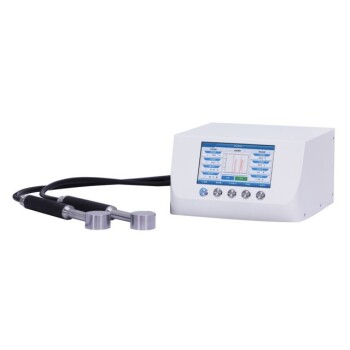
The primary significance of using a laboratory press with precision heating is the ability to standardize the fiber melting and bonding process. By accurately simulating specific combinations of pressure and temperature, this equipment ensures that the experimental nonwoven samples possess a uniform microstructure. This uniformity is the critical variable that prevents density inconsistencies from skewing thermal property data.
By maintaining precise control over temperature and pressure, researchers can eliminate density gradients within the fabric. This structural consistency is essential for obtaining accurate, reproducible measurements regarding thermal conductivity and air permeability.
The Role of Precision in Sample Preparation
Simulating Processing Conditions
To understand how nonwoven fabrics will behave in application, researchers must replicate the exact stresses they endure during manufacturing.
A laboratory press with a precision heating system allows for the accurate simulation of various pressure and temperature combinations. This capability transforms raw fibers into a consolidated sheet under controlled conditions, mirroring real-world processing environments.
Controlling Fiber Bonding
The thermal properties of nonwovens are dictated by how fibers melt and bond together.
Precision heating ensures that the fiber melting process occurs uniformly across the entire sample area. Without this control, inconsistent bonding points can occur, leading to weak spots or overly fused areas that do not represent the material's true potential.
Impact on Material Microstructure
Achieving Structural Uniformity
The primary goal of using a high-end laboratory press is to create a homogeneous sample.
When temperature and pressure are applied evenly, the resulting microstructure of the sample is uniform throughout. This means the arrangement of fibers and voids is consistent, providing a reliable baseline for testing.
Eliminating Density Gradients
A common failure in nonwoven research is the presence of density gradients—areas where the fabric is tighter or looser than the average.
Precision heating effectively eliminates these density gradients. By ensuring the material bonds at the same rate and pressure across its surface, the equipment prevents the formation of dense clusters that would otherwise distort the path of heat or air through the fabric.
Consequences for Data Integrity
Accuracy in Thermal Conductivity
Thermal conductivity tests measure how well a material transfers heat.
If a sample has density gradients due to poor heating control, heat will travel through the material unpredictably. A uniform microstructure ensures that the test results reflect the intrinsic properties of the fiber assembly, rather than artifacts of poor sample preparation.
Reliability of Air Permeability Tests
Air permeability is closely linked to thermal properties in nonwovens, as trapped air is an insulator.
Inconsistent fiber bonding changes how air flows through the material. Eliminating density gradients guarantees that air permeability readings are accurate, allowing researchers to properly correlate airflow with thermal performance.
Understanding the Constraints
Sensitivity to Parameter Settings
While precision systems offer superior control, they also require exact parameter management.
Because the system is capable of such high fidelity, minor deviations in input settings (such as a few degrees in temperature) can significantly alter the microstructure. Researchers must define their experimental protocols rigorously to avoid operator-induced variability.
The Limitation of Idealized Samples
It is important to acknowledge that a precision lab press creates an "ideal" sample.
While this is necessary for fundamental research, these highly uniform samples may outperform materials produced on high-speed, industrial-scale equipment where such precision is harder to maintain. Researchers should factor this difference into their scalability assessments.
Ensuring Validity in Thermal Research
To maximize the value of your thermal property research, align your equipment usage with your specific testing goals:
- If your primary focus is Thermal Conductivity: Prioritize temperature uniformity to prevent density clusters that create artificial heat bridges or insulators.
- If your primary focus is Air Permeability: Focus on precise pressure application to ensure the void fraction (porosity) remains consistent across the sample.
Ultimately, the validity of your thermal data relies entirely on the structural homogeneity of the samples you create.
Summary Table:
| Feature | Research Impact | Benefit to Data Quality |
|---|---|---|
| Precision Heating | Standardizes fiber melting and bonding | Ensures uniform microstructure across samples |
| Pressure Control | Simulates exact manufacturing stresses | Eliminates density gradients and clusters |
| Uniform Bonding | Creates consistent fiber-to-fiber joints | Enhances accuracy of thermal conductivity tests |
| Structural Homogeneity | Maintains constant porosity/void fraction | Improves reliability of air permeability readings |
Elevate Your Battery and Material Research with KINTEK
Precise sample preparation is the foundation of reliable thermal analysis. KINTEK specializes in comprehensive laboratory pressing solutions, offering a versatile range of manual, automatic, heated, multifunctional, and glovebox-compatible models, alongside advanced cold and warm isostatic presses.
Whether you are refining nonwoven fiber bonding or advancing battery research, our equipment provides the extreme temperature and pressure precision required to eliminate density gradients and ensure structural homogeneity.
Ready to achieve superior data integrity? Contact KINTEK Today to Find Your Pressing Solution
References
- Dunja Šajn Gorjanc, Klara Kostajnšek. Permeable Properties of Hygienic Nonwovens Bonded Using Mechanical, Chemical, and Thermal Techniques. DOI: 10.3390/polym16081132
This article is also based on technical information from Kintek Solution Knowledge Base .
Related Products
- Automatic Heated Hydraulic Press Machine with Heated Plates for Laboratory
- Automatic Heated Hydraulic Press Machine with Hot Plates for Laboratory
- Manual Heated Hydraulic Lab Press with Integrated Hot Plates Hydraulic Press Machine
- 24T 30T 60T Heated Hydraulic Lab Press Machine with Hot Plates for Laboratory
- Automatic High Temperature Heated Hydraulic Press Machine with Heated Plates for Lab
People Also Ask
- Function of a Laboratory Hydraulic Press with Heated Platens in SSE? Enhance Battery Density & Conductivity
- Why is a laboratory hydraulic press with heating plates required for PLA/TEC films? Achieve Precise Sample Integrity
- What is the function of a manual heated press for PLA 2D scaffolds? Achieve Precise Material Densification
- How does a laboratory heated hydraulic press facilitate PBN sample prep for WAXS? Achieve Precise X-Ray Scattering
- What are the requirements for electrode pressing with high-viscosity ionic liquids like EMIM TFSI? Optimize Performance