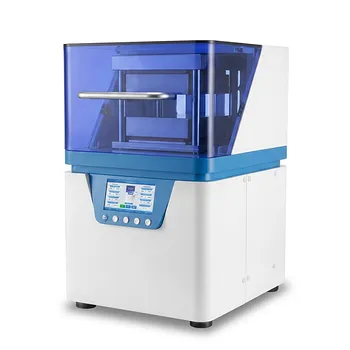
The specific function of a hydraulic press in spectroscopy is to compress loose, powdered materials into solid, homogenous pellets or thin films. By applying uniform high pressure to a mixture of the sample and a matrix material (such as Potassium Bromide), the press creates a dense, stable disc. This physical transformation is a mandatory preparation step for analyzing solids using Fourier Transform Infrared Spectroscopy (FTIR) and X-ray Fluorescence (XRF).
Core Takeaway: The hydraulic press serves as a standardization tool. Its primary value lies not just in flattening the sample, but in creating homogeneity—eliminating voids and inconsistent densities that would otherwise scatter light or distort analytical data.
The Mechanics of Sample Preparation
Creating KBr Pellets for FTIR
For Fourier Transform Infrared Spectroscopy (FTIR), the press plays a critical role in optical transparency. A powdered sample is first diluted with Potassium Bromide (KBr) powder.
Transforming Refractive Material
When the hydraulic press applies force to this mixture inside a die, it fuses the KBr and sample. This turns the refractive powder into a transparent pellet or film. This transparency allows infrared light to pass through the sample within the detection range of the instrument.
Preparing Pellets for XRF
For X-ray Fluorescence (XRF), transparency is not the goal, but physical stability is. The press compresses the sample, often mixed with a binder, into a durable "general sample pellet."
Ensuring Structural Integrity
The pressure fuses the particles together to prevent the sample from dusting or breaking apart inside the vacuum chamber of the XRF instrument.
Why Pressure Matters for Data Integrity
Achieving Homogeneity
The primary enemy of spectroscopic analysis is inconsistency. A hydraulic press applies uniform compression across the entire surface of the sample.
Eliminating Signal Noise
By creating a dense structure with consistent thickness, the press eliminates air gaps and density variations. In FTIR, this directly reduces infrared light scattering losses, which significantly improves the quality of the spectral acquisition.
Guaranteeing Repeatability
Precise pressure control allows for the creation of identical samples over multiple trials. This uniformity ensures that any variance in the data is due to chemical changes in the sample, not physical differences in how the pellet was pressed.
Common Pitfalls to Avoid
Inconsistent Pressure Application
While the press is designed for uniformity, operator error can lead to density gradients. If the pressure is not held for the correct duration, the pellet may "relax" or crack after removal, rendering it useless for analysis.
Moisture Contamination in FTIR
Hydraulic presses used for KBr pellets must be operated in controlled environments. The pressure can generate heat; if the KBr absorbs moisture during the pressing process, the resulting pellet will be cloudy, obscuring the infrared spectrum.
Over-Pressing or Under-Pressing
Applying too much pressure can cause physical deformation of the die or fracture the pellet upon release. Conversely, insufficient pressure results in a porous pellet that crumbles or scatters light excessively.
Making the Right Choice for Your Goal
To maximize the effectiveness of your hydraulic press, align your technique with your specific analytical requirements:
- If your primary focus is FTIR: Prioritize the creation of a transparent matrix by ensuring the KBr is dry and the pressure is sufficient to fuse the powder into a clear film.
- If your primary focus is XRF: Prioritize mechanical stability by using a binder and sufficient dwell time to ensure the pellet does not crumble during handling or analysis.
A hydraulic press transforms a chaotic powder into a disciplined solid, providing the physical baseline required for accurate spectroscopic science.
Summary Table:
| Feature | FTIR Sample Preparation | XRF Sample Preparation |
|---|---|---|
| Primary Goal | Optical transparency for IR light | Physical stability & structural integrity |
| Matrix Material | Potassium Bromide (KBr) | Binder (if necessary) |
| Core Function | Fuses powder into a transparent film | Compresses particles into a durable disc |
| Data Benefit | Reduces signal noise & light scattering | Prevents sample breakage in vacuum chambers |
| Critical Factor | Moisture control & pressure duration | Uniform density & mechanical strength |
Elevate Your Spectroscopic Precision with KINTEK
Don't let poor sample preparation compromise your analytical results. KINTEK specializes in comprehensive laboratory pressing solutions designed to eliminate homogeneity issues and signal noise. Whether you require manual, automatic, heated, or glovebox-compatible models, our presses provide the precise pressure control necessary for perfect FTIR and XRF pellets.
From battery research to material science, our cold and warm isostatic presses ensure your samples meet the highest standards of structural integrity. Contact KINTEK today to find the ideal pressing solution for your lab and guarantee the repeatability of your data.
Related Products
- Automatic Hydraulic Hot Press with Large Plate and Precision Temperature Control for Advanced Material Sample Preparation and Industrial Research
- Automatic Hydraulic Heat Press Machine with Multi Stage Programmable Control and Integrated Water Cooling Plate Size 180x180mm
- Automatic High Temperature Heated Hydraulic Press Machine with Heated Plates for Lab
- Automatic Heated Hydraulic Lab Press with Programmable Touch Screen Controls and Precision Temperature Regulation
- Manual Heated Hydraulic Lab Press with Integrated Hot Plates Hydraulic Press Machine
People Also Ask
- What are the specific features and applications of hydraulic hot press machines? Precision Solutions for Modern Labs
- How does an automatic hydraulic press operate? Achieve Precision and Consistency in Lab Pelleting
- What are the advantages and common applications of an automatic hydraulic press? Elevate Your Lab's Precision
- What is the technical significance of setting a precise dwell time? Achieve Peak Material Density and Stability
- When is an automatic hydraulic press more suitable than a manual press? Scale Your Lab with Precision & Speed