
The specific purpose of applying hot-pressing at 100°C is to thermally soften the polymer matrix, reducing its viscosity so it can flow and fuse completely with lithium salts and inorganic fillers. This specific temperature point ensures the polymer melts sufficiently to permit molecular chain rearrangement, while the simultaneous application of pressure compacts the material into a dense, defect-free thin film with uniform thickness.
By combining thermal fusion with mechanical compression, this process eliminates internal porosity and maximizes interfacial contact. The result is a solid electrolyte capable of high ionic conductivity and robust physical separation of electrodes, which is fundamental to battery safety.
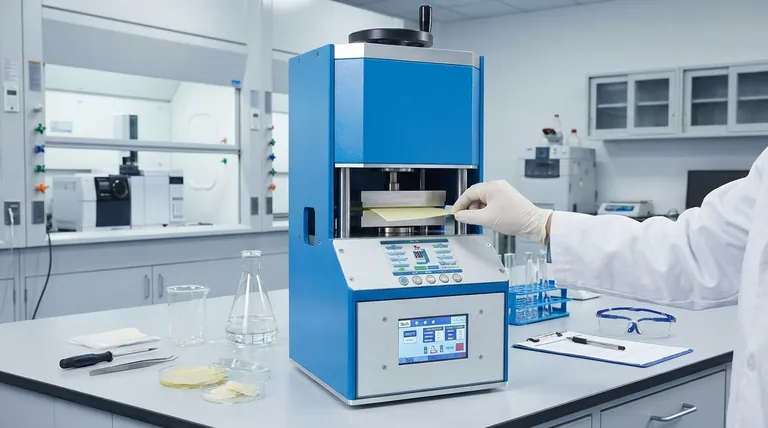
Achieving Structural Integrity
The primary goal of the 100°C hot-pressing step is to transform the physical state of the electrolyte material from a dried powder or porous cast into a functional, monolithic membrane.
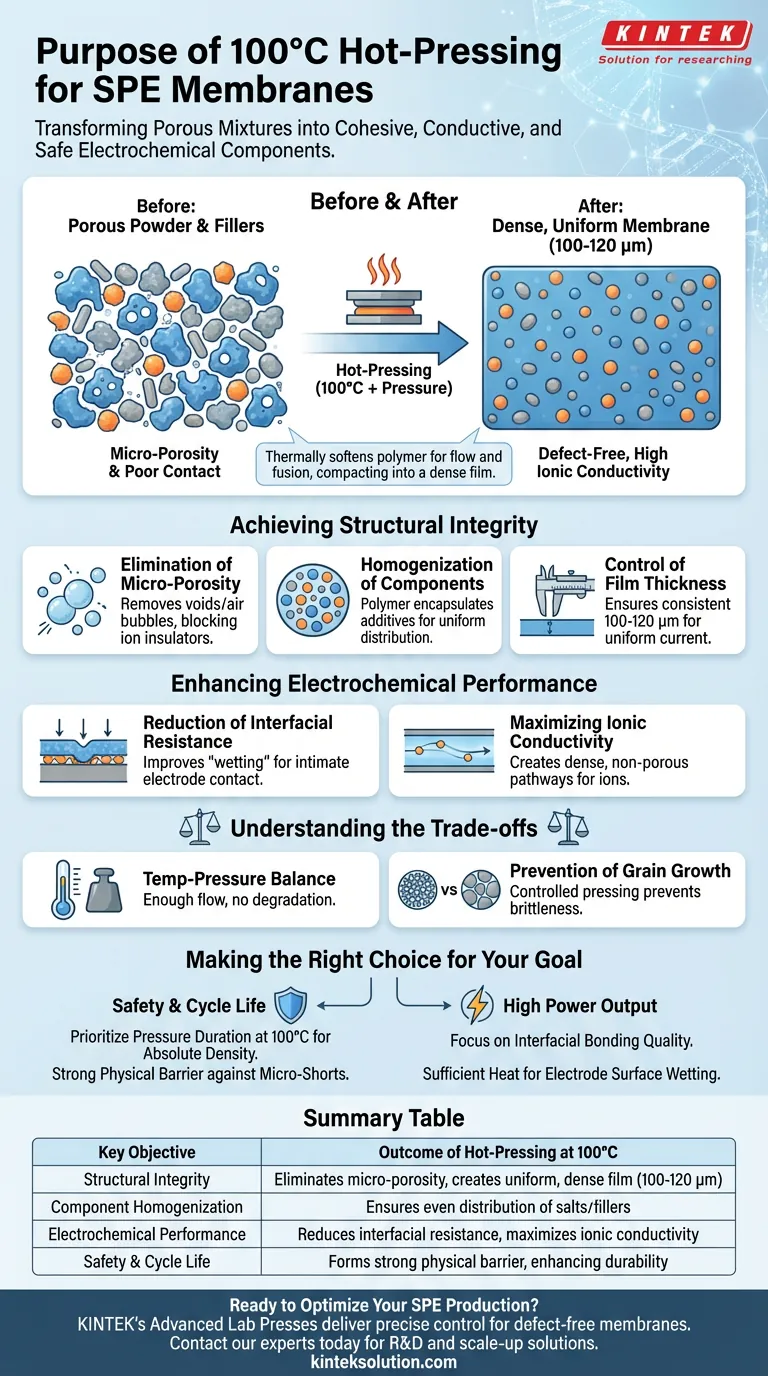
Elimination of Micro-Porosity
The application of heat reduces the polymer's viscosity, allowing it to flow. When combined with pressure, this forces the material to fill microscopic voids and eliminate air bubbles.
This removal of internal pores is critical because voids act as insulators that block ion transport and create weak points in the membrane structure.
Homogenization of Components
At 100°C, the polymer acts as a binder that fully encapsulates additives, such as ceramic fillers (e.g., LLZTO) or lithium salts.
This creates a homogeneous composite where conductive elements are evenly distributed throughout the polymer matrix, rather than clumped in isolated aggregates.
Control of Film Thickness
Hot-pressing creates a uniform membrane thickness, typically targeting the 100-120 micrometer range.
Uniformity is vital for maintaining consistent current density across the cell, preventing "hot spots" that can lead to rapid degradation.
Enhancing Electrochemical Performance
Beyond physical structure, the thermal processing directly influences how the battery performs electrically.
Reduction of Interfacial Resistance
One of the highest barriers in solid-state batteries is the resistance between solid layers. Hot-pressing improves the "wetting" ability of the polymer.
This ensures intimate interfacial contact between the electrolyte and the electrodes (or between the polymer and ceramic fillers), significantly lowering the resistance that ions face when moving across these boundaries.
Maximizing Ionic Conductivity
By creating a dense, non-porous pathway, the process establishes a continuous ion conduction network.
Without the densification achieved at this temperature, the ion transport channels would be interrupted by voids, resulting in poor conductivity and inefficient battery operation.
Understanding the Trade-offs
While hot-pressing is essential, it requires precise calibration.
The Temperature-Pressure Balance
The temperature must be high enough (e.g., 100°C for PEO-based systems) to induce flow, but not so high that it degrades the polymer chains or alters the stoichiometry of the salts.
Prevention of Grain Growth
In systems containing ceramic powders, proper hot-pressing suppresses abnormal grain growth.
If the process is uncontrolled, large grains can form, leading to brittleness. Controlled pressing creates a fine-grained microstructure that offers better mechanical strength and lower grain boundary resistance.
Making the Right Choice for Your Goal
The specific parameters of your hot-pressing stage should be tuned based on your primary performance objectives.
- If your primary focus is Safety and Cycle Life: Prioritize pressure duration at 100°C to ensure absolute density and zero porosity, as this creates the strongest physical barrier against internal micro-shorts.
- If your primary focus is High Power Output: Focus on the quality of the interfacial bonding; the heat must be sufficient to ensure the polymer fully "wets" the electrode surface to minimize resistance.
Ultimately, hot-pressing at 100°C is not just a shaping step; it is the critical activation phase that turns a mixture of chemicals into a cohesive, conductive, and safe electrochemical component.
Summary Table:
| Key Objective | Outcome of Hot-Pressing at 100°C |
|---|---|
| Structural Integrity | Eliminates micro-porosity, creates a uniform, dense thin film (100-120 μm) |
| Component Homogenization | Ensures even distribution of lithium salts and fillers within the polymer matrix |
| Electrochemical Performance | Reduces interfacial resistance, maximizes ionic conductivity for efficient ion transport |
| Safety & Cycle Life | Forms a strong physical barrier against internal shorts, enhancing battery durability |
Ready to optimize your solid polymer electrolyte membrane production? KINTEK's advanced lab press machines, including automatic and heated lab presses, are engineered to deliver the precise temperature and pressure control required for achieving defect-free, high-performance SPE membranes. Whether you're focused on enhancing safety, cycle life, or power output, our presses ensure uniform compaction and thermal fusion for superior battery components. Contact our experts today to discuss how our specialized lab press solutions can accelerate your R&D and scale-up processes.
Visual Guide
References
- Shuaishuai Yan, Kai Liu. Selectively fluorinated aromatic lithium salts regulate the solvation structure and interfacial chemistry for all-solid-state batteries. DOI: 10.1126/sciadv.ads4014
This article is also based on technical information from Kintek Solution Knowledge Base .
Related Products
- Warm Isostatic Press for Solid State Battery Research Warm Isostatic Press
- Manual Laboratory Hydraulic Pellet Press Lab Hydraulic Press
- Lab Heat Press Special Mold
- Automatic Heated Hydraulic Press Machine with Hot Plates for Laboratory
- Automatic High Temperature Heated Hydraulic Press Machine with Heated Plates for Lab
People Also Ask
- Why must composite cathodes be sealed in vacuum lamination bags for WIP? Ensure Battery Stability and Density
- How do sacrificial volume materials (SVM) maintain microchannels in isostatic pressing? Ensure Structural Integrity
- What is the function of elastic molds in warm isostatic pressing? Achieve Uniform Density in Composite Particles
- How does Warm Isostatic Pressing differ from traditional pressing methods? Unlock Uniform Density for Complex Parts
- What are the advantages of using a Warm Isostatic Press (WIP) for batteries? Achieve Superior Interface Contact



















