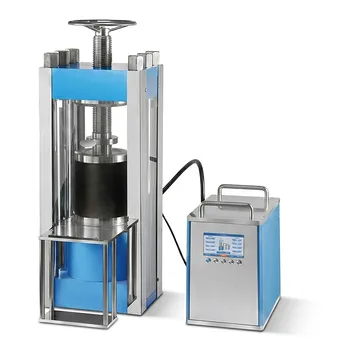
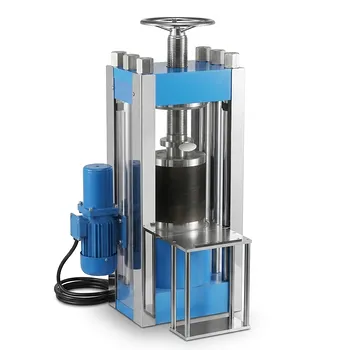
The working principle of a laboratory hot press centers on the simultaneous application of controlled heat and pressure to a material sample to induce physical or chemical changes. This process transforms raw materials—typically placed in a mold or directly between platens—into a consolidated specimen by following a strict sequence of heating, compression, holding, and cooling.
The core function of a hot press is to execute a precise "recipe" of thermal and mechanical energy. Success relies on the accurate synchronization of temperature ramp rates, pressure application, and dwell times to ensure uniform density and structural integrity in the final sample.
The Sequential Process Flow
The operation of a laboratory hot press follows a distinct, linear timeline. Understanding each stage is critical for achieving consistent results.
Sample Preparation and Placement
The process begins with preparing the raw material, which is often a powder, pellet, or laminate.
This material is carefully placed into a mold or positioned directly between the heating platens. Proper alignment is essential to ensure uniform pressure distribution during the cycle.
Parameter Configuration
Before the cycle starts, the operator must input specific process parameters into the control system.
Using a Human-Machine Interface (HMI), you define critical variables such as target temperature, pressure levels, heating rates, and holding (dwell) times.
Heating and Pressing
Once initiated, the machine's heating system energizes the platens to reach the set temperature.
Simultaneously, the pressing system engages, driving the platens together to apply the pre-set hydraulic or mechanical pressure to the sample.
The Dwell Period
This is the most critical phase where the actual material transformation occurs.
The system maintains the target temperature and pressure for a specified duration. This holding time allows the material to flow, cure, sinter, or densify depending on the application.
Pressure Release and Cooling
After the dwell period concludes, the machine releases the pressure.
The sample is then allowed to cool, often assisted by optional cooling systems, to solidify its new shape and properties.
Sample Removal
The final step is the extraction of the processed material.
The sample is removed only after it has cooled to a safe temperature to prevent thermal shock or operator injury.
Critical System Components
To execute the process described above, the hot press relies on the integration of four primary subsystems.
The Control Architecture
Precision is maintained by a sophisticated control system, often utilizing PID (Proportional-Integral-Derivative) logic.
This controller manages the heating rate and pressure stability, ensuring that the actual conditions inside the press match the programmed setpoints.
The Thermal and Mechanical Systems
The heating system ensures efficient heat transfer through the platens, while the pressing system provides the necessary force.
A robust frame is required to withstand these forces without deforming, ensuring the platens remain parallel.
Understanding the Trade-offs
While laboratory hot presses are versatile, optimizing their use requires navigating specific operational trade-offs and maintenance requirements.
Precision vs. Setup Time
High-precision processing using PID controllers allows for exact management of heating rates and dwell times.
However, this requires more complex programming and setup compared to simple manual presses. You must invest time in parameter setting to gain accuracy.
Maintenance vs. Performance
The quality of your sample is directly linked to the condition of the machine.
Neglecting to clean platen surfaces inhibits heat transfer, resulting in uneven heating. Similarly, failing to check hydraulic oil levels can lead to inconsistent pressure application.
Equipment Sensitivity
Sensors drift over time.
Regular calibration of temperature and pressure sensors is non-negotiable; without it, the data on your HMI may not reflect the reality inside the mold, ruining experimental data.
Making the Right Choice for Your Goal
When operating a hot press, your specific research or manufacturing goals should dictate how you prioritize the process parameters.
- If your primary focus is Material Synthesis or Curing: Prioritize the Temperature Controller settings. Ensure your PID parameters are tuned to prevent overshoot, as precise heat management is vital for chemical reactions.
- If your primary focus is Densification or Consolidation: Focus on the Pressing System capabilities. You need to verify that the pressure remains constant throughout the dwell time to eliminate voids.
Mastery of the hot press requires not just operating the machine, but understanding how specific thermal and mechanical variables interact to define your material's final properties.
Summary Table:
| Stage | Key Action | Critical Parameter |
|---|---|---|
| Preparation | Material placement in mold/platens | Alignment & distribution |
| Configuration | Setting HMI/PID control variables | Temp, Pressure, Dwell time |
| Processing | Simultaneous heating and pressing | Ramp rate & pressure stability |
| Dwell Phase | Maintaining setpoints for transformation | Holding time accuracy |
| Cooling | Pressure release and solidification | Cooling rate & safety temp |
Elevate Your Material Research with KINTEK
Maximize the precision of your laboratory processes with KINTEK’s advanced pressing solutions. Whether you are focused on battery research, material densification, or complex curing, our comprehensive range of equipment—including manual, automatic, heated, multifunctional, and glovebox-compatible models, as well as cold and warm isostatic presses—is designed to deliver uniform results every time.
Ready to enhance your lab's efficiency? Contact our experts today to find the perfect press for your application!
Related Products
- 24T 30T 60T Heated Hydraulic Lab Press Machine with Hot Plates for Laboratory
- Laboratory Split Manual Heated Hydraulic Press Machine with Hot Plates
- Heated Hydraulic Press Machine with Heated Plates for Vacuum Box Laboratory Hot Press
- Automatic Heated Hydraulic Press Machine with Hot Plates for Laboratory
- Automatic Large Format Laboratory Heated Hydraulic Press 400x400mm Plate Capacity
People Also Ask
- Function of a Laboratory Hydraulic Press with Heated Platens in SSE? Enhance Battery Density & Conductivity
- Why is a laboratory hydraulic press with heating plates required for PLA/TEC films? Achieve Precise Sample Integrity
- What role does a laboratory heated hydraulic press play in LTCC? Essential for High-Density Ceramic Lamination
- What is the primary function of a laboratory heated hydraulic press? Mastering Thermoplastic Carbon Fiber Composites
- What is the critical role of a laboratory heated hydraulic press? Mastering PVC Sample Prep for Testing