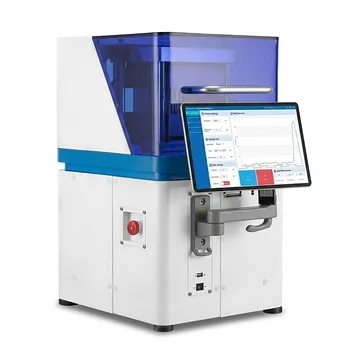
Selecting the optimal laboratory press requires a holistic evaluation of your material's physical properties against the operational capabilities of the equipment. To make an informed choice, you must define the required pressure range and force capacity, the physical dimensions of the sample compartment (platen size and daylight opening), the necessity of automation versus manual control, and critical safety features required for your specific environment.
Core Insight: The ideal press is defined by the intersection of force capacity and control precision. While tonnage ensures you can process the material, the control system—whether manual or automatic—determines the repeatability, safety, and throughput efficiency of your daily operations.
Determining Force and Load Requirements
Matching Pressure to Material Hardness
The most fundamental criterion is the pressure range required for your application. You must assess whether the material to be pressed is soft or hard, as this dictates the force intensity.
calculating Tonnage Needs
Laboratory presses typically offer ranges from 15 to over 100 tons. It is vital to calculate the specific load required to achieve the desired density or lamination for your sample.
Buffer for Versatility
Avoid selecting a press that maxes out exactly at your current requirement. Choosing a press with a broader pressure range allows for future applications involving harder materials or larger sample geometries.
Evaluating Physical Dimensions and Capacity
Platen Size and Sample Area
The platen size (measured in inches or millimeters) must accommodate the maximum dimensions of your samples or molds. Larger platens offer flexibility for various sample sizes but require more physical space.
The Importance of Daylight Opening
Do not confuse platen size with vertical capacity. The "daylight opening" is the vertical space available inside the press. You must ensure this opening is sufficient for your tallest sample assembly, including the mold and any spacers.
Lab Space and Portability
Consider the footprint of the unit itself. Sample volume often dictates whether a compact benchtop unit is sufficient or if a larger floor model is necessary. If the equipment must be moved between workstations, portability becomes a deciding factor.
Operational Control and Workflow
Manual vs. Automatic Operation
Decide between manual pumps and automatic systems based on your volume. Manual presses are cost-effective for low-volume tasks but require physical energy to pump. Automatic presses reduce operator fatigue and increase consistency.
Controlling Process Speed
For sensitive materials, the speed of operation is critical. You may need a press that allows you to control the rate of ramping up to the clamp force or the cooling down speed.
Heating and Environmental Control
If your application involves thermal processing, evaluate the heating and cooling rate requirements. Furthermore, determine if a vacuum or controlled atmosphere is needed to prevent oxidation during the pressing cycle.
Understanding the Trade-offs
Simplicity vs. Data Precision
Manual presses are robust and simple to maintain, making them ideal for basic pelletizing. However, they lack the data logging and precise pressure ramping capabilities of automatic systems, which are often required for research documentation.
Footprint vs. Capacity
Benchtop models save valuable laboratory real estate and are generally lower cost. The trade-off is often a lower maximum tonnage and restricted daylight openings compared to heavy-duty floor models.
Cost vs. Safety Features
Never compromise on safety to save cost. While basic models may lack advanced interlocks, ensure the press includes essential safety features like protective shields, especially when working with high loads or high temperatures.
Making the Right Choice for Your Goal
To select the best press for your laboratory, map your primary objective to the corresponding feature set:
- If your primary focus is routine sample preparation (e.g., KBr pellets): Prioritize a manual benchtop press with a standard 15-25 ton range to balance cost and utility.
- If your primary focus is complex materials research: Choose an automatic press with programmable heating/cooling rates and data logging to ensure experimental reproducibility.
- If your primary focus is processing large or irregular molds: Select a floor model with an adjustable daylight opening and oversized platens to accommodate varying geometries.
Ultimately, the right press is one that provides sufficient power for your hardest material while offering the control necessary for your most delicate application.
Summary Table:
| Key Selection Factor | Manual Press | Automatic Press | Floor Model |
|---|---|---|---|
| Primary Use | Routine sample prep (e.g., KBr pellets) | Complex R&D & high throughput | Large/irregular molds & pilot production |
| Force Range | Generally 15–25 tons | Wide range (up to 100+ tons) | High tonnage capacity |
| Control Type | Manual pump / Physical effort | Programmable / Data logging | Advanced automation options |
| Space Impact | Compact benchtop footprint | Benchtop or standalone | Large footprint |
| Key Benefit | Cost-effective & simple maintenance | Repeatability & reduced fatigue | Maximum daylight & platen size |
Elevate Your Material Research with KINTEK
Precision and power are the cornerstones of successful laboratory pressing. KINTEK specializes in comprehensive laboratory pressing solutions, offering manual, automatic, heated, multifunctional, and glovebox-compatible models, as well as cold and warm isostatic presses widely applied in battery research and advanced materials science.
Whether you need a compact benchtop unit for routine pelletizing or a high-tonnage programmable system for complex lamination, our experts will help you find the perfect match for your tonnage and control requirements. Contact us today to optimize your lab's pressing capabilities!
Related Products
- Laboratory Hydraulic Press Lab Pellet Press Button Battery Press
- Laboratory Hydraulic Press Lab Pellet Press Machine for Glove Box
- Laboratory Split Manual Heated Hydraulic Press Machine with Hot Plates
- Laboratory Hydraulic Pellet Press for XRF KBR FTIR Lab Press
- Laboratory Hydraulic Split Electric Lab Pellet Press
People Also Ask
- How is a laboratory hydraulic press used for HAP composite gels? Master Mineral Substrate Standardization
- What role does a laboratory hydraulic press play in the preparation of piezoelectric ceramic discs for DC-PG? | KINTEK
- What role does a laboratory hydraulic press play in reaction pellets? Optimizing Lunar Soil and Metal Fuel Density
- What role does a laboratory hydraulic press play in the assembly of all-solid-state battery test cells? Expert Guide
- Why is a laboratory hydraulic press required for PBAT and PLA sample preparation? Achieve Flawless Characterization