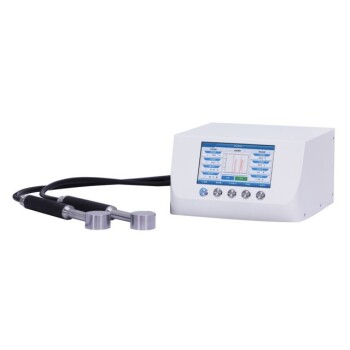
Laboratory heating equipment acts as the critical catalyst during the wet digestion of prostate tissue. By providing continuous and stable thermal energy, the equipment accelerates the chemical reaction between the digestion acid and the biological sample. This high-temperature environment is necessary to break down complex tissue structures, ensuring metals are released for accurate measurement.
The core purpose of heating during digestion is to transform complex biological matter into a simple solution. It powers the chemical destruction of the tissue matrix, converting bound metals into free ions required for Atomic Absorption Spectroscopy.
The Mechanism of Thermal Acceleration
Providing Continuous Energy
The digestion process requires more than just a momentary spike in temperature. The equipment must supply continuous and stable thermal energy throughout the procedure.
This consistency ensures that the reaction does not stall or fluctuate.
Accelerating Chemical Reactions
The interaction between the digestion solution (typically strong acids) and prostate tissue is a chemical reaction.
Heating serves as the primary accelerator for this reaction. Without sufficient thermal energy, the breakdown of the tissue would be prohibitively slow or chemically incomplete.
Breaking Down Biological Structures
Destroying Macromolecular Matrices
Prostate tissue is composed of complex biological macromolecular matrices. These structures physically trap and chemically bind metal elements.
The high-temperature environment created by the heating equipment enables the acid to thoroughly destroy these matrices.
Releasing Bound Metals
The ultimate goal of destroying the matrix is the liberation of the target analytes.
As the tissue structure disintegrates, bound metal elements are released into the solution in a free ionic state.
Preparing for Spectroscopy
The state of the metal is just as important as its extraction.
This process is specifically designed to prepare the sample for Atomic Absorption Spectroscopy. This analytical method requires metals to be free ions to yield accurate quantitative results.
Critical Considerations in Thermal Digestion
The Importance of Stability
While high heat is necessary, the stability of that heat is paramount.
Fluctuating temperatures can lead to uneven digestion rates across different samples. This inconsistency introduces variables that compromise the reproducibility of the analysis.
Risks of Incomplete Destruction
If the heating equipment fails to maintain the necessary high-temperature environment, the matrix destruction will be partial.
Residual biological matter interferes with the spectroscopy reading. This often results in "matrix effects" that obscure the true metal content of the tissue.
Ensuring Analytical Precision
To optimize your digestion process for prostate tissue analysis, consider the following approach:
- If your primary focus is analytical accuracy: Prioritize heating equipment with precise thermal regulation to ensure the complete destruction of the biological matrix without sample loss.
- If your primary focus is process efficiency: Select equipment capable of reaching the target high-temperature environment quickly to accelerate the reaction time.
The integrity of your Atomic Absorption Spectroscopy results depends entirely on the completeness of the initial thermal digestion.
Summary Table:
| Feature | Role in Digestion Process | Impact on Analytical Result |
|---|---|---|
| Continuous Thermal Energy | Maintains reaction kinetics | Ensures consistent sample throughput |
| High-Temperature Environment | Destroys macromolecular matrices | Releases bound metal elements into free ions |
| Thermal Stability | Prevents temperature fluctuations | Guarantees reproducibility and data integrity |
| Chemical Acceleration | Speeds up acid-tissue interaction | Reduces digestion time and prevents stalls |
Elevate Your Research Precision with KINTEK
For battery research and advanced biological analysis, the integrity of your results starts with the sample preparation. KINTEK specializes in comprehensive laboratory pressing and heating solutions, offering a wide range of manual, automatic, heated, and multifunctional models, as well as cold and warm isostatic presses.
Whether you need precise thermal regulation for prostate tissue digestion or robust pressing equipment for battery materials, our solutions are designed to eliminate matrix interference and maximize analytical accuracy. Contact us today to find the perfect equipment for your laboratory!
References
- Okechukwu Paul-Chima Ugwu, Mfon Paulinus Udoudoh. Xylopia aethiopica Attenuates Oxidative Stress and Hepatorenal Damage in Testosterone Propionate-Induced Benign Prostatic Hyperplasia in Rats. DOI: 10.1055/s-0043-1777836
This article is also based on technical information from Kintek Solution Knowledge Base .
Related Products
- Automatic Heated Hydraulic Press Machine with Hot Plates for Laboratory
- Cylindrical Lab Electric Heating Press Mold for Laboratory Use
- Automatic Heated Hydraulic Press Machine with Heated Plates for Laboratory
- 24T 30T 60T Heated Hydraulic Lab Press Machine with Hot Plates for Laboratory
- Laboratory Split Manual Heated Hydraulic Press Machine with Hot Plates
People Also Ask
- Function of a Laboratory Hydraulic Press with Heated Platens in SSE? Enhance Battery Density & Conductivity
- Why is a laboratory hydraulic press with heating plates required for PLA/TEC films? Achieve Precise Sample Integrity
- What are the requirements for electrode pressing with high-viscosity ionic liquids like EMIM TFSI? Optimize Performance
- How does a laboratory heated hydraulic press facilitate PBN sample prep for WAXS? Achieve Precise X-Ray Scattering
- What are the industrial applications of heated hydraulic presses? Master Heat & Force for Precision Manufacturing