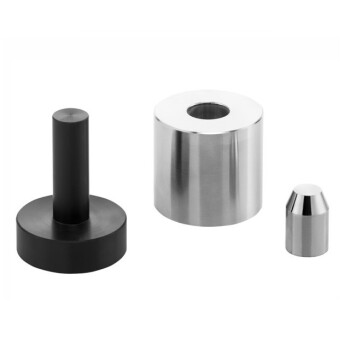
The primary problem a high-pressure laboratory press solves is high interfacial impedance caused by poor physical contact. By applying precisely controlled mechanical force, the press compacts solid electrolyte powders and electrode materials into dense, unified structures. This process eliminates microscopic voids and establishes the continuous solid-to-solid pathways required for efficient ion transport in all-solid-state sodium-ion batteries.
Core Takeaway Unlike liquid batteries that naturally wet internal surfaces, all-solid-state batteries rely entirely on mechanical pressure to move ions between layers. A laboratory press transforms loose powders into a cohesive system, minimizing contact resistance and enabling the electrochemical reactions necessary for battery operation.
Overcoming the Solid-Solid Interface Challenge
Eliminating Contact Resistance
The most significant barrier in solid-state battery assembly is the natural resistance found at the interface of loose materials. A laboratory press applies high pressure to force electrode and electrolyte particles together. This minimizes the contact resistance both within the solid electrolyte layer and at the crucial interface where the electrolyte meets the electrodes.
Densifying the Electrolyte Layer
Loose powder contains pores and voids that act as barriers to ion flow. By applying pressures often ranging from 125 MPa to 545 MPa, the press eliminates these pores, significantly increasing the density of the electrolyte layer. This densification is vital for creating a continuous medium through which sodium ions can travel.
Reducing Grain Boundary Resistance
Beyond just macroscopic contact, the press addresses resistance at the microscopic level. High pressure causes the deformation and tight interlocking of active materials and electrolyte particles. This reduces grain boundary resistance, effectively widening the channels available for ion transport.
Enhancing Stability and Safety
Strengthening Mechanical Structure
A heated laboratory press solves the problem of structural weakness in the electrolyte membrane. By combining heat with pressure, the press facilitates plastic deformation or primary sintering, which enhances the membrane's mechanical strength. A stronger membrane is less susceptible to physical failure during operation.
Suppressing Dendrite Growth
Sodium dendrites (needle-like structures that can cause short circuits) are a major safety concern. A dense, well-compacted structure created by hot-pressing helps physically block dendrite penetration. Furthermore, applying a specific stack pressure (e.g., 10 MPa) stabilizes the interface during volume changes, effectively suppressing dendrite formation during the metal stripping process.
Precision in Manufacturing and Testing
Optimizing Layer-by-Layer Bonding
Different battery layers require different densification parameters to function correctly. A lab press solves this by allowing for a multi-step pressing process. For example, one might apply 250 MPa to the electrolyte first, then 500 MPa to bond the cathode, ensuring each layer achieves optimal density without damaging the others.
Ensuring Data Accuracy
Poor contact between the active material and the current collector can lead to noisy or inaccurate test data. Using precision tools with a press ensures tight mechanical bonding, which prevents signal anomalies. This is particularly important for sensitive diagnostic tests like Operando Electrochemical Mass Spectrometry (OEMS).
Critical Considerations for Pressure Application
The Necessity of "Precise Control"
While high pressure is beneficial, it must be applied with exactitude to avoid damaging materials. The references emphasize controlled pressure rather than just maximum force. Applying the wrong pressure at the wrong stage can fail to establish the necessary "intimate" contact or potentially degrade the material properties.
Thermal Field Management
Pressure alone may not be sufficient for all electrolyte types, particularly polymers or ceramics. The use of a heated press introduces a thermal variable that must be managed alongside mechanical force. This adds complexity but is necessary to achieve the plastic deformation required for high-performance membranes.
Making the Right Choice for Your Goal
To maximize the utility of a high-pressure laboratory press in your assembly process, consider your specific objectives:
- If your primary focus is Electrochemical Performance: Prioritize high-pressure compaction (up to 545 MPa) to minimize pore volume and reduce interfacial impedance for maximum ion transport.
- If your primary focus is Safety and Longevity: Utilize a heated press process and maintain constant stack pressure (around 10 MPa) to densify the membrane against dendrite penetration and stabilize the anode interface.
Ultimately, the laboratory press acts as the critical bridge that turns separate chemical powders into a unified, functional energy storage device.
Summary Table:
| Problem Addressed | Impact of High-Pressure Pressing | Key Benefit |
|---|---|---|
| Interfacial Impedance | Eliminates microscopic voids between solid layers | Enables efficient ion transport |
| Low Electrolyte Density | Compresses powders at 125 MPa - 545 MPa | Increases ion conductivity |
| Sodium Dendrite Growth | Creates dense, well-compacted physical barriers | Prevents short circuits and enhances safety |
| Structural Weakness | Facilitates plastic deformation via hot-pressing | Improves membrane mechanical strength |
| Data Inaccuracy | Ensures tight bonding to current collectors | Eliminates signal noise in testing |
Elevate Your Battery Research with KINTEK Precision
Maximize your all-solid-state battery performance with KINTEK’s industry-leading laboratory pressing solutions. Whether you are addressing grain boundary resistance or optimizing layer-by-layer bonding, our equipment provides the precise pressure and thermal control necessary for breakthrough results.
Our value to your lab:
- Comprehensive Range: Manual, automatic, heated, and multifunctional models.
- Specialized Capability: Glovebox-compatible systems and isostatic presses (CIP/WIP) designed for sensitive battery chemistries.
- Precision Control: Achieve exact densification to suppress dendrites and minimize impedance.
Contact KINTEK Today to Optimize Your Pressing Process
References
- Razu Shahazi, Md. Mahbub Alam. Recent advances in Sodium-ion battery research: Materials, performance, and commercialization prospects. DOI: 10.59400/mtr2951
This article is also based on technical information from Kintek Solution Knowledge Base .
Related Products
- Warm Isostatic Press for Solid State Battery Research Warm Isostatic Press
- Lab Infrared Press Mold for Laboratory Applications
- Laboratory Hydraulic Press Lab Pellet Press Button Battery Press
- Special Shape Lab Press Mold for Laboratory Applications
- 24T 30T 60T Heated Hydraulic Lab Press Machine with Hot Plates for Laboratory
People Also Ask
- Why must composite cathodes be sealed in vacuum lamination bags for WIP? Ensure Battery Stability and Density
- How do sacrificial volume materials (SVM) maintain microchannels in isostatic pressing? Ensure Structural Integrity
- What is the function of elastic molds in warm isostatic pressing? Achieve Uniform Density in Composite Particles
- How does Warm Isostatic Pressing differ from traditional pressing methods? Unlock Uniform Density for Complex Parts
- What is the significance of temperature control in Warm Isostatic Pressing? Unlock Uniform Densification and Process Stability